10 Ways AI Is Changing Digital Marketing in 2026
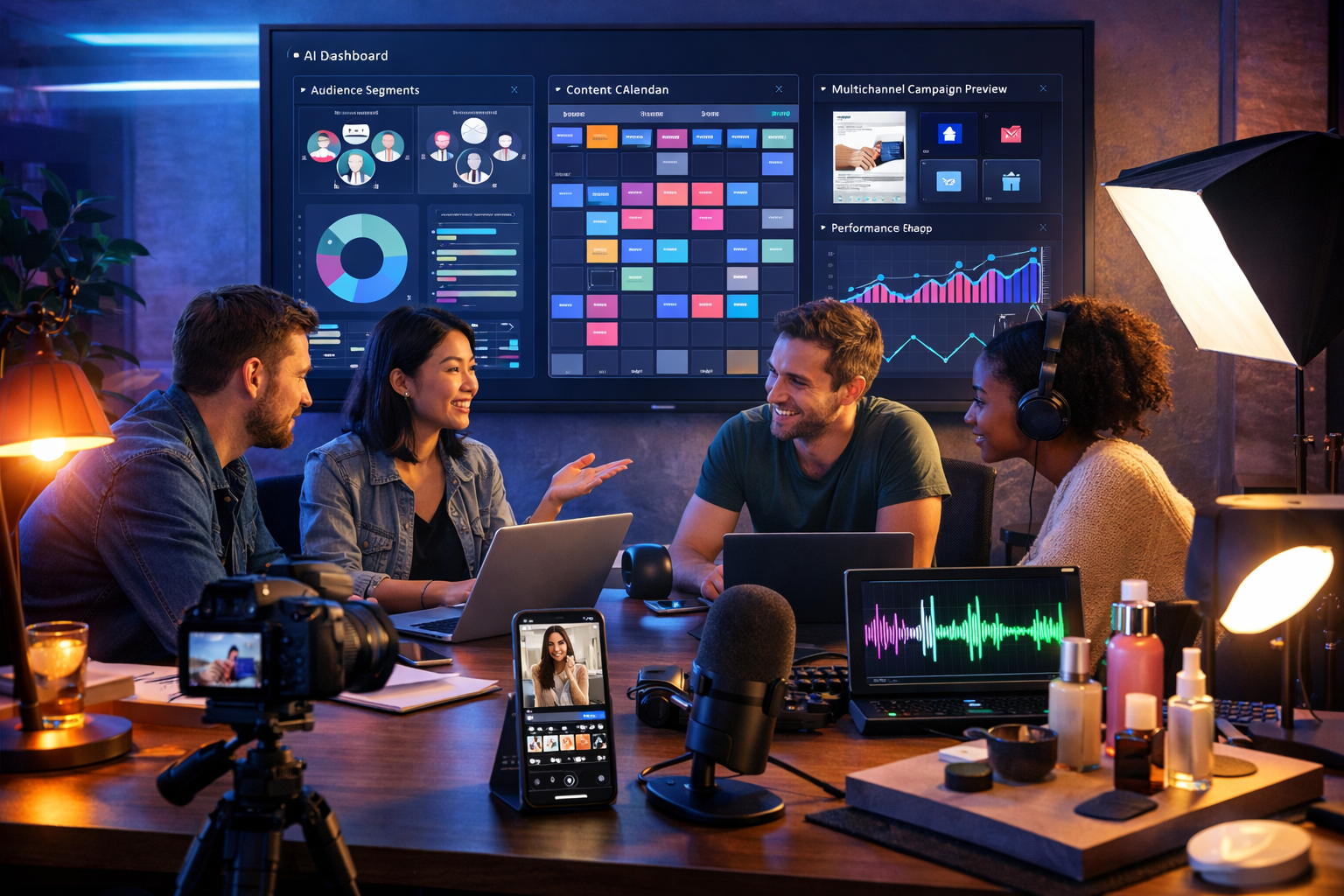
AI is no longer a “nice-to-have” in marketing—it’s the operating system behind how modern teams plan campaigns, produce creative, and optimise performance. In 2026, the biggest change isn’t that AI can write a blog post or generate an image; it’s that AI is connecting insights, creative, testing, and distribution into a faster, more measurable workflow. Below are 10 ways AI is changing digital marketing in 2026, with practical examples and steps you can apply even if you’re a startup or small team.
1) Hyper-personalised content at scale (without losing relevance)
In 2026, personalisation has moved beyond using a first name in an email. AI-driven personalisation now adapts messaging, creative format, and even the offer based on intent signals (pages visited, product interactions, previous purchases, and engagement patterns). The shift is from “segment-based” to “individualised journey-based” marketing.
Practical example: A fitness brand creates three landing page variants automatically: one for beginners (simple routines), one for busy professionals (quick plans), and one for performance athletes (advanced training blocks). Each version uses different imagery, benefits, FAQs, and CTAs.
- Start with 3–5 high-intent segments (not 50). Build clarity first, then scale.
- Create modular copy blocks: headline options, benefits, objections, social proof lines.
- Use AI to draft variants, then add human checks for accuracy and brand tone.
With our AI content tools, you can generate landing page copy, email sequences, and supporting social posts from one brief—then refine per audience while keeping your voice consistent.
2) Search is now “answer-first”: AI Overviews and conversational discovery
Search in 2026 is increasingly driven by AI summaries and conversational interfaces. Users still click results, but many questions are answered before the click—meaning your content must be structured to be quoted, referenced, or used as a trusted source.
What changes in practice: You optimise for “being the best answer”, not just ranking for a keyword. That means clearer definitions, step-by-step guidance, credible examples, and transparent sourcing.
- Include concise summaries and direct answers near the top of pages.
- Use scannable headings that match real questions customers ask.
- Demonstrate expertise: processes, checklists, original frameworks, and real-world considerations.
A helpful workflow is to generate a “question map” (top FAQs and objections) for a topic, then build content sections around those questions. AI can accelerate the drafting, but E-E-A-T comes from your specificity: what you’ve tested, what you recommend, and why.
3) Creative production is multi-format by default (text → image → video → audio)
In 2026, campaigns win by meeting audiences in their preferred format. Instead of writing one blog post and stopping there, teams repurpose into social carousels, short videos, voice-overs, and email series—often within the same day.
Practical example: A B2B SaaS company publishes an “ultimate guide” blog post. Within hours, it also ships: (1) a LinkedIn carousel summarising key steps, (2) a 30-second explainer reel, (3) a narrated audio snippet for the website, and (4) an email campaign with the main takeaways.
- Write one “core asset” (a guide, playbook, or case study) per month.
- Repurpose into at least 10 distribution assets: 3 social posts, 2 emails, 2 short videos, 1 landing page, 1 ad angle set, 1 FAQ section.
- Maintain consistent claims across formats (benefits, pricing, features, limitations).
Gen AI Last is built for this multi-format reality: text, images, audio, and video generation in one place, so your team doesn’t need separate subscriptions just to publish consistently.
4) Predictive analytics is shaping budgets before results appear
AI is increasingly used to forecast performance based on early signals: first 24-hour engagement, creative fatigue, audience overlap, landing page interaction, and historical seasonality. In 2026, marketers are shifting from reactive reporting to proactive budget management.
How to apply it: Use leading indicators (scroll depth, add-to-cart rate, time-on-page, hold rate on video) to make decisions before conversion data matures. This is especially valuable when you have low volume and can’t wait for statistical significance on purchases.
- Define 3 leading indicators per channel (e.g., video hold rate, CTR, landing page engagement).
- Set “stop/scale” thresholds before launching (so decisions are objective).
- Create a weekly cadence: test → learn → produce next creative batch.
5) AI-driven A/B testing is faster—and more creative
Traditional testing often changes one small element (headline A vs B). In 2026, AI enables concept testing: radically different angles, audiences, and offers tested quickly with lower creative cost. The competitive edge is not testing more buttons—it’s testing better ideas.
Practical example: An e-commerce skincare brand tests four concepts: “dermatologist-backed”, “before/after proof”, “ingredient transparency”, and “sensitive skin guarantee”. Each concept has matching visuals, ad copy, landing page hero sections, and email subject lines.
- Test angles first, then refine elements (CTA, headline, layout).
- Generate 10–20 variations, but launch only the best 4–6 after human review.
- Document learnings in a simple “angle library” your team can reuse.
6) Brand voice consistency is being systematised (not improvised)
One of the biggest risks of generative AI is inconsistent tone—especially when multiple team members prompt in different ways. In 2026, strong brands treat voice as a system: guidelines, examples, banned phrases, and a repeatable checklist.
What to do: Create a one-page brand voice sheet that includes: tone (e.g., confident, plain English), vocabulary (words you use), anti-vocabulary (words you avoid), sentence style, and 5–10 sample paragraphs that represent your best work.
- Keep your “voice rules” short enough that anyone can follow them.
- Add a QA step: factual accuracy, tone match, and compliance.
- Refresh examples quarterly based on top-performing content.
This is where an all-in-one platform helps: when your text, image prompts, and video scripts sit in the same workspace, it’s easier to keep creative consistent across channels.
7) Short-form video is becoming the default ad unit—and AI is speeding it up
Short-form video continues to dominate attention in 2026, but producing it manually is slow. AI is changing this by accelerating scripting, storyboard generation, b-roll suggestions, auto-voice-overs, and rapid variant creation for different audiences.
Practical example: A local home services company creates a 20-second “problem → solution → proof → CTA” reel. It then spins variants for: emergency repairs, annual maintenance, and first-time customer discounts—each with different hooks in the first two seconds.
- Use a repeatable structure: Hook → Pain → Solution → Proof → CTA.
- Aim for 3 hooks per offer (curiosity, urgency, contrarian, social proof).
- Create versions optimised for silent viewing (captions-style pacing, clear visuals).
With Gen AI Last’s AI video generation, you can quickly turn scripts into marketing videos and product demos—then pair them with AI audio narration to increase clarity and retention.
8) Product imagery and ad creative are being generated on-demand
In 2026, brands no longer wait for quarterly photoshoots to update visuals. AI image generation enables quick campaign refreshes: seasonal scenes, lifestyle shots, background changes, banner formats, and social graphics tailored to specific promotions.
Practical example: An online coffee retailer generates lifestyle images for different customer contexts: a home office morning routine, a weekend brunch table, and a minimalist studio kitchen—each matched to a specific audience and ad message.
- Define your “visual rules”: colour palette, lighting style, camera angle, props.
- Create image sets for each campaign (not one-off images) to keep consistency.
- Always review for accuracy (e.g., product details, hands, labels, unrealistic claims).
If you’re a small team, AI image generation is a practical way to keep ads fresh without expensive production. Pair it with clear prompts and a checklist, and your creative will improve rapidly.
9) Audio is back: voice search, narration, and “micro-podcasts”
Audio is quietly expanding in 2026: voice search habits, narrated articles, in-app audio explainers, and short podcast-style updates for niche audiences. AI audio generation makes high-quality voice-overs accessible without studio time.
Practical example: A financial educator turns each weekly newsletter into a 4-minute narrated audio briefing. Subscribers can listen during commutes, and the brand earns more touchpoints without writing new content from scratch.
- Choose one audio format: narrated blog highlights, product walkthrough audio, or mini-episodes.
- Keep scripts tight: short sentences, clear signposting, minimal jargon.
- Add a single CTA (too many calls-to-action reduce retention).
Gen AI Last’s AI audio generation supports voice-overs, narration, and background music—useful for both social videos and on-site product explainers.
10) Lean teams are competing with “enterprise output” through AI workflows
Perhaps the most important shift in “10 ways AI is changing digital marketing in 2026” is operational: AI is closing the gap between small teams and large organisations. The winners are building repeatable workflows—briefs, templates, review steps, and distribution checklists—so they can publish more often without lowering quality.
A simple weekly workflow for small teams:
- Monday: Pick one customer problem and one offer. Draft a core message.
- Tuesday: Generate blog + landing page copy drafts. Add real examples and product truth.
- Wednesday: Create image set (ads + social) and a short video script + variants.
- Thursday: Produce video + voice-over. Schedule posts and emails.
- Friday: Review performance, document learnings, decide next week’s angle.
An all-in-one platform matters here: instead of juggling multiple tools for copy, images, audio, and video, you keep production fast and cohesive. If budget is a concern, view pricing from $10/month to get full access across formats—particularly useful for startups that need maximum output per pound spent.
Common pitfalls (and how to avoid them) in AI-driven marketing
AI can speed up production, but speed without judgement creates mediocrity. In 2026, the brands that win with AI avoid a few predictable mistakes:
- Publishing “generic” content: Fix by adding specifics—numbers, steps, screenshots/process, customer language, and clear opinions.
- Ignoring compliance and claims: Fix by running a checklist for regulated industries and avoiding exaggerated outcomes.
- Inconsistent brand voice: Fix with a simple voice sheet and a review step before posting.
- Over-automating customer interactions: Fix by keeping a human path for complex support and sensitive issues.
How to get started today (a 30-minute setup)
If you want results quickly, don’t start with “make more content”. Start with one campaign and build a repeatable system:
- Pick one goal: leads, trials, demos, or purchases.
- Pick one audience: the segment that already converts best.
- Write one clear offer statement: who it’s for, what it does, why it’s different.
- Create one core asset: a guide, landing page, or product demo script.
- Repurpose into 10 assets: 3 social posts, 2 emails, 2 images, 2 short videos, 1 audio narration.
You can do all of this using our AI content tools, then refine the outputs with your product knowledge and customer insights. If you’re ready to test it in your own workflow, start creating for free and build your first multi-format campaign in a single workspace.
Final thoughts: AI is raising the baseline—strategy still wins
AI is changing digital marketing in 2026 by making production and optimisation dramatically faster. But the real advantage comes from the fundamentals: knowing your customer, making a clear promise, proving it with credible evidence, and distributing consistently. Use AI to remove bottlenecks—then invest your human time where it matters most: strategy, truth, and judgement.
Ready to Create with Generative AI?
Join thousands of creators using Gen AI Last to generate text, images, audio, and video — all from one platform. Start your 7-day free trial today.
Start Free — Try 7 DaysQuick Links
Create AI content from $10/month
View Plans