AI Content Features on Instagram TikTok YouTube & Facebook 2026
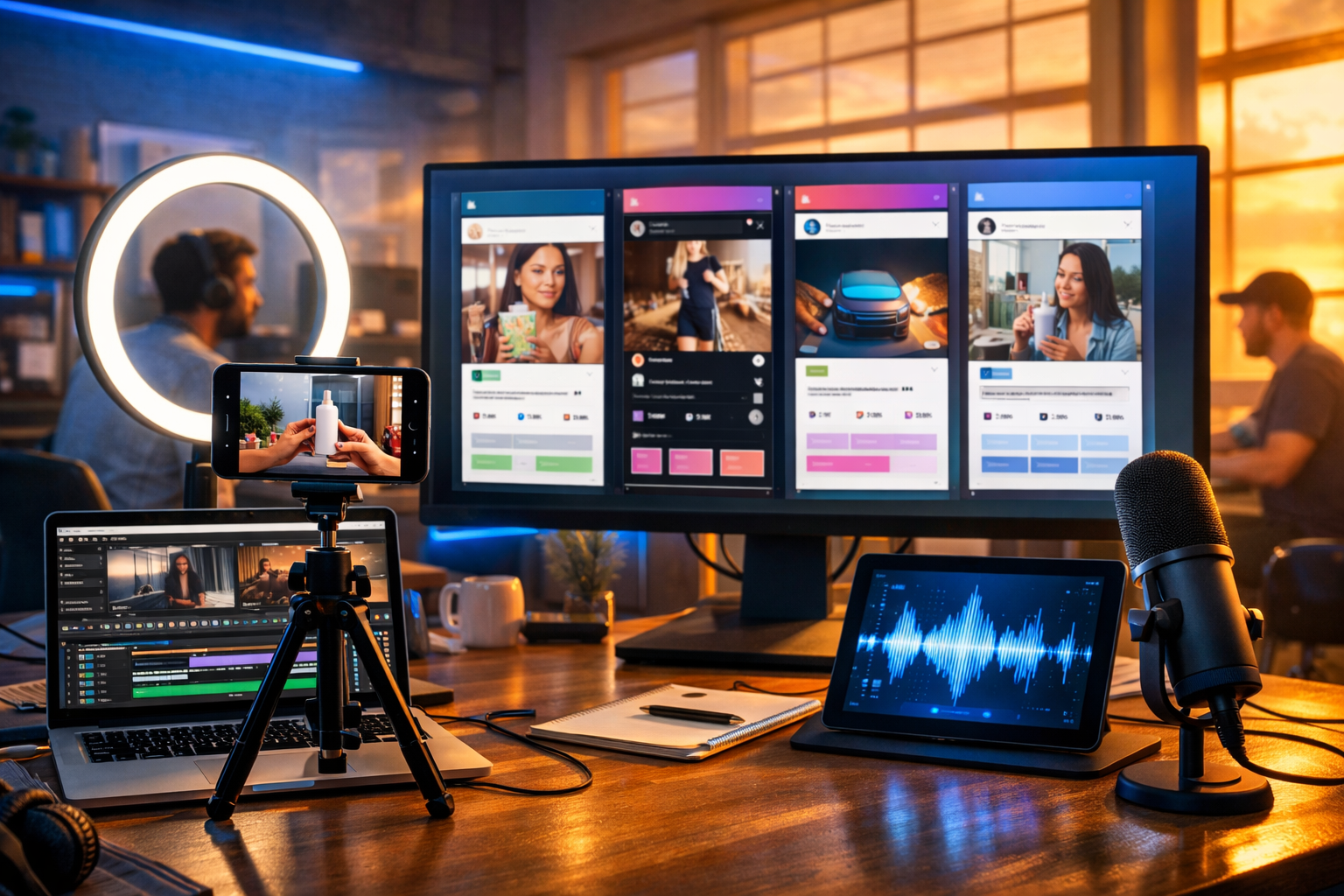
The platforms you rely on in 2026—Instagram, TikTok, YouTube and Facebook—are no longer just “social apps”. They are AI-driven discovery engines with built-in editing, auto-captioning, personalisation and commerce. If you want consistent reach this year, you need to design content that matches each platform’s AI content features while keeping your brand voice, visuals and publishing cadence tight.
This guide breaks down the most important ai content features on instagram tiktok youtube and facebook 2026, what they mean for creators and small teams, and a practical workflow to ship more content without sacrificing quality. We’ll also show how to use our AI content tools (text, image, audio and video generation in one place) to plan, produce and repurpose content faster—starting from $10/month.
What “AI content features” means in 2026 (and why it matters)
In 2026, “AI content features” are the tools and ranking behaviours that platforms use to: (1) help you create content faster, and (2) decide what gets shown to which users. These features typically include:
- Generative editing: automatic cuts, beat-synced pacing, background replacement, and style filters.
- Auto-captions and translation: smarter subtitles, voice isolation, language dubbing and multi-language captions.
- AI-led discovery: recommendations based on watch time, replays, saves, shares, comments, and topic clusters.
- Creative insights: suggestions for hooks, length, posting time, thumbnail/caption improvements.
- Commerce and lead capture: automated product tagging, on-platform checkout prompts, DM automation and lead forms.
The implication is simple: you can’t treat every platform the same. A 25-second meme cut that wins on TikTok may underperform on YouTube Shorts if the first two seconds aren’t crystal clear, while Instagram may reward saves and carousel depth in a way that changes how you structure educational content.
Instagram 2026: AI creation tools + save-driven discovery
Instagram in 2026 is still a visual-first platform, but the algorithm increasingly behaves like a topic recommendation system. AI content features on Instagram reward content that generates saves, shares, and replays, especially for Reels and educational carousels.
Key AI content features on Instagram (2026)
- AI-assisted Reels editing: automatic cut suggestions, beat matching, and template-driven sequences.
- Auto-captions with speaker detection: improved readability and pacing, with higher accuracy for multiple speakers.
- Generative backgrounds and clean-ups: background replacement, object removal and lighting corrections (use with restraint to avoid “uncanny” visuals).
- AI-powered search and topic surfacing: content is matched to user intent via captions, on-screen text, and engagement patterns.
What to post on Instagram in 2026
Aim for formats that create “bookmark value”. Examples:
- Saveable Reels: “3 mistakes to avoid”, “5-step checklist”, “Before/after workflow”.
- Educational carousels: a clear promise on slide 1, then a structured mini-guide.
- Stories for relationship-building: polls, Q&As, behind-the-scenes, launch reminders.
Practical workflow: Instagram content with Gen AI Last
- Write a Reel script hook: Use AI Text Generation to create 10 hook variations for the first 2 seconds (the most expensive real estate in Reels).
- Generate carousel copy: Turn the same topic into a 7-slide outline, with slide-by-slide microcopy and a CTA for saves.
- Create on-brand visuals: Use AI Image Generation for consistent backgrounds, product mockups, or clean social graphics.
- Produce a Reel fast: Use AI Video Generation for B-roll, animated explainers or product demo sequences.
- Add voice-over: Use AI Audio Generation for clear narration (especially helpful if you don’t want to record in a noisy space).
If you’re building a small-team process, keep templates: one “saveable tip Reel” template, one “carousel mini-guide” template, and one “story sequence” template. Consistency is what the algorithm—and your audience—learns to trust.
TikTok 2026: AI discovery, creative acceleration, and retention first
TikTok remains the fastest feedback loop on the internet. In 2026, its AI is exceptionally good at matching niche content to the right viewers, but it is also ruthless: weak retention kills distribution. TikTok’s AI creation tools encourage speed: produce, test, learn, repeat.
Key AI content features on TikTok (2026)
- Smart clip selection: automatic highlights, jump cut recommendations, and “keep/remove” suggestions based on pacing.
- Auto-captions + style presets: better emphasis, timing, and readable subtitle layouts.
- AI voice and audio tools: voice effects, voice clarity enhancement, and trend-aware sound pairing.
- Trend and intent matching: content is clustered by topic as much as by trend, so evergreen explainer content can still win.
What to post on TikTok in 2026
The most reliable TikTok formats are “tight” and “specific”. Try:
- Problem–solution micro tutorials: 15–35 seconds, showing a result quickly.
- POV and founder-led clips: honest, direct camera talk with proof (screenshare, demo, receipts).
- Series formats: Part 1/2/3 content, designed to increase return viewers.
Practical workflow: TikTok scripts, shots, and repurposing
Use this simple prompt structure in Gen AI Last AI Text Generation for TikTok:
- Audience: “UK-based small business owners selling online”.
- Goal: “Increase product page conversions”.
- Format: “25-second TikTok with a 2-second hook, 3 fast tips, and a CTA to comment ‘CHECKLIST’”.
- Proof: “Mention a simple metric and a quick before/after example”.
Then create a second output: a shot list (A-roll, B-roll, on-screen text). Finally, generate a voice-over with AI Audio Generation if you’re filming B-roll only. This keeps production light while maintaining clarity.
YouTube 2026: Shorts for discovery, long-form for trust
YouTube in 2026 is arguably the strongest platform for compounding growth because search and recommendations work together. AI content features help creators package videos better (titles, thumbnails, chapters, dubbing), while the algorithm rewards sustained watch time and session value (keeping viewers on YouTube).
Key AI content features on YouTube (2026)
- AI dubbing and multi-language support: better voice alignment and fewer robotic artefacts, making global reach realistic for small teams.
- Auto chapters and summaries: improved structure for long-form videos, helping retention and search.
- Thumbnail and title insights: performance suggestions based on similar audience behaviour (still requires human judgement).
- Shorts-to-long funneling: stronger linking between Shorts discovery and long-form depth content.
What to post on YouTube in 2026
- Shorts: one idea, one outcome, one clear CTA (e.g., “Full guide in the description”).
- Long-form explainers: 6–12 minutes for most business topics—enough depth to build trust without dragging.
- Product demos and comparisons: show real screens, real results, and common objections.
Practical workflow: One topic → Shorts + long-form package
Pick one weekly topic (for example, “How to write product descriptions that convert”). Use Gen AI Last to produce:
- Long-form outline: intro hook, 3 sections, examples, objections, CTA.
- Two Shorts scripts: each highlights one section as a standalone micro lesson.
- Thumbnail concept prompts: generate 3–5 clean thumbnail-style images (no text baked in) with consistent lighting and brand colours.
- Voice-over options: generate narration for the long-form and a punchier take for Shorts.
Because all media types are available in one platform, you avoid juggling separate tools and subscriptions. If you’re cost-conscious, view pricing from $10/month and build a lean production stack.
Facebook 2026: Reels distribution + community depth
Facebook in 2026 is not “dead”—it’s segmented. Reels can still deliver wide reach, while Groups and Pages can drive deeper community engagement and repeat customers. Facebook’s AI content features increasingly optimise for meaningful interactions: comments that create threads, shares into private conversations, and repeat views.
Key AI content features on Facebook (2026)
- Auto-formatting for Reels: improved cropping, stabilisation, and caption placement for mobile.
- Recommendation across surfaces: Reels, Watch, Feed, and Group suggestions increasingly cross-pollinate.
- AI moderation and comment prompts: better spam filtering plus prompts that encourage discussion.
- Lead and commerce tools: stronger integration of click-to-message, lead forms, and product catalogues.
What to post on Facebook in 2026
- Reels repurposed from TikTok/IG: but adjust the first line of on-screen text to be clearer and less “trend coded”.
- Community posts: “Which would you choose?” questions, case studies, and behind-the-scenes updates.
- Group-first content: mini guides, checklists, and feedback requests that drive long comment threads.
Cross-platform 2026 strategy: create once, customise four times
The biggest mistake in 2026 is “blind reposting”. The second biggest mistake is creating everything from scratch. The sweet spot is a create-once, customise-four-times workflow.
A 2026 content matrix that works
For one core idea per week, produce these deliverables:
- 1 long-form YouTube video (trust + search)
- 2–3 Shorts/Reels (discovery)
- 1 Instagram carousel (saves + authority)
- 3–5 Stories (relationship + conversion)
- 1 Facebook post for discussion (community + leads)
Customisation checklist per platform
- Hook: TikTok needs curiosity + speed; YouTube Shorts needs clarity + payoff; Instagram needs save value; Facebook needs relatability.
- On-screen text: write for silent viewing; keep it high-contrast; avoid clutter near UI elements.
- Length: cut ruthlessly for TikTok; allow slightly more context on Instagram; use chapters and structure for YouTube long-form.
- CTA: Instagram = “save/share”; TikTok = “comment keyword”; YouTube = “watch next”; Facebook = “reply with your situation”.
E-E-A-T in 2026: how to use AI without losing trust
AI can accelerate production, but trust still comes from evidence, experience and clarity. To keep your content credible across Instagram, TikTok, YouTube and Facebook:
- Show proof: real screenshots, real demos, real results (even small wins).
- Be specific: “Increase retention by tightening the first 2 seconds” beats “make better content”.
- Use AI for drafts, not deception: don’t fabricate testimonials, stats, or personal stories.
- Keep a consistent voice: use brand guidelines and reuse your best-performing phrasing.
Gen AI Last helps here because you can generate scripts, visuals and voice-overs from one workflow, then apply your human review once—faster, but still accurate.
Actionable 7-day plan (built for small teams)
If you want to operationalise these ai content features on instagram tiktok youtube and facebook 2026, follow this lean weekly cadence:
- Day 1 (Research): pick one customer problem, collect 5 FAQs from comments/DMs, decide one measurable outcome.
- Day 2 (Scripts): generate a long-form outline + 3 short scripts using AI Text Generation.
- Day 3 (Assets): generate social graphics, simple B-roll, or thumbnail-ready images with AI Image Generation.
- Day 4 (Production): film A-roll (or generate an explainer with AI Video Generation) and produce clean narration with AI Audio Generation.
- Day 5 (Edit + Captions): tighten hooks, add subtitles, and create platform-specific cuts.
- Day 6 (Publish): schedule across platforms, tailor captions and CTAs, pin a top comment with a next step.
- Day 7 (Review): identify one retention drop-off point and one high-performing hook; feed learnings into next week’s prompts.
Common mistakes to avoid in 2026
- Overusing AI effects: “synthetic” visuals can reduce trust. Use enhancement, not gimmicks.
- Ignoring on-screen text: captions and overlays are key signals for accessibility and topic matching.
- One-size-fits-all CTAs: optimise for each platform’s engagement style.
- No repurposing system: if you’re producing from scratch daily, you’ll burn out before the algorithm learns you.
How Gen AI Last helps you keep up (without a big budget)
Most creators and small teams don’t need more tools—they need fewer tools that do more. Gen AI Last combines:
- AI Text Generation: blog posts, product descriptions, email campaigns, social captions, hooks and scripts.
- AI Image Generation: marketing visuals, product photos, social graphics, banners and consistent style assets.
- AI Video Generation: reels, product demos, explainer videos and B-roll alternatives when you can’t film.
- AI Audio Generation: voice-overs, narration, podcast-style audio and background music.
Everything is available on every plan, so you can build a full content pipeline without upgrading just to unlock video or audio. If you want to test the workflow, start creating for free, then scale with predictable pricing when you’re ready.
Conclusion: win 2026 by matching platform AI, not fighting it
The best creators in 2026 aren’t “gaming” Instagram, TikTok, YouTube or Facebook—they’re aligning with the platforms’ AI content features: strong hooks, clear structure, watch-time-friendly edits, saveable value, and community-led conversations. Build one core idea per week, customise it intelligently for each platform, and let your results guide the next round of prompts and production.
When you’re ready to speed up without losing quality, explore our AI content tools and view pricing from $10/month to run a full multi-platform content engine on a small-team budget.
Ready to Create with Generative AI?
Join thousands of creators using Gen AI Last to generate text, images, audio, and video — all from one platform. Start your 7-day free trial today.
Start Free — Try 7 DaysQuick Links
Create AI content from $10/month
View Plans