AI Content Features on Instagram TikTok YouTube and Facebook 2026
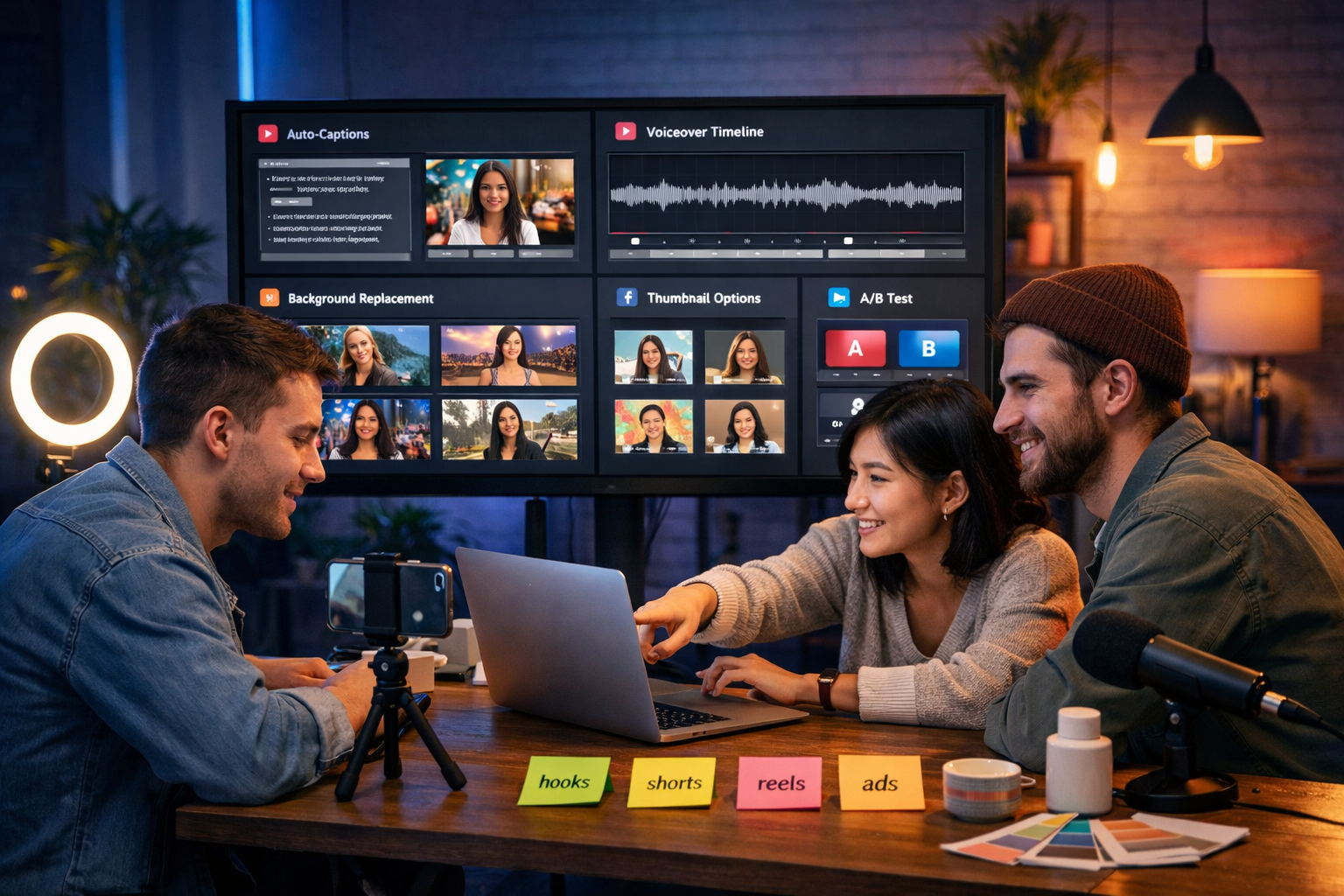
The big shift in 2026 isn’t that social platforms “support AI” — it’s that Instagram, TikTok, YouTube and Facebook are building AI directly into creation, editing, discovery and advertising. If you understand the new AI content features on instagram tiktok youtube and facebook 2026, you can plan content that travels further, adapts faster, and stays compliant as labels and authenticity checks tighten.
This guide breaks down what AI-first features typically look like across each platform in 2026, how they change what wins in the feed, and how to build a lean, repeatable workflow using our AI content tools for text, images, video and audio — all from $10/month.
What “AI content features” really means in 2026
In 2026, “AI features” is no longer just a novelty filter. Across major platforms, AI touches four areas:
- Creation: generative backgrounds, script suggestions, auto-editing, style presets, synthetic voice options.
- Optimisation: automatic hook recommendations, caption variants, thumbnail testing, post time suggestions, audience clustering.
- Distribution: AI-powered recommendation systems tuning for watch time, replays, shares, saves, and “meaningful interactions”.
- Trust & compliance: AI-generated labels, provenance checks, watermark detection, and identity/authenticity signals.
For creators and small teams, the opportunity is speed and consistency. The risk is homogeneity (everyone using the same presets) and reduced trust if content feels synthetic or misleading.
Platform-by-platform: AI content features and what to do with them
Instagram (Reels, Stories, carousels, DMs)
Instagram’s AI features tend to focus on short-form video editing, creative tools for Reels/Stories, and AI-assisted messaging for brands. In 2026, expect Instagram workflows to reward content that looks native, retains attention, and drives saves.
Common AI content features you’ll see (or see expanded):
- Generative edits for backgrounds, objects and scene clean-up (quick “make this look better” enhancements).
- Auto-captions + translation with style controls (highlighting keywords, emojis, pacing).
- Reel templates and auto-beat sync that intelligently cuts to music and emphasises key moments.
- AI sticker/asset generation for Stories (polls, prompts, product callouts).
- DM automation assistance for FAQs, lead capture and follow-ups (especially for creators and shops).
How to win on Instagram in 2026: Prioritise clarity and pace. Instagram tends to reward quick comprehension: a sharp first frame, a single idea per Reel, and captions that match how people watch with sound off.
Actionable workflow with Gen AI Last:
- Write 5 hook options in Gen AI Last (e.g., “Stop doing X if you want Y”). Pick one that matches your Reel concept.
- Generate carousel copy: 8–10 slide headings + short body lines. Keep each slide to one message.
- Create Story assets with AI Image Generation: product-in-hand shots, clean cut-outs, and colour-consistent backgrounds for a cohesive look.
- Add a voiceover using AI Audio Generation if you want consistent narration without re-recording multiple takes.
TikTok (creation tools, search, social commerce)
TikTok pushes AI deeper into creation and discovery. By 2026, TikTok’s AI content features are typically geared towards faster production, easier localisation, and stronger “search-first” publishing — where your video ranks for queries like a mini search engine.
Common AI content features you’ll see (or see expanded):
- AI script and outline helpers that suggest structure, beats, and transitions.
- Smart trimming and highlight extraction (automatically picks the most engaging segment).
- Voice and language tools: auto-dubbing, accent smoothing, multi-language versions.
- Generative effects that create scenes and overlays quickly, plus safer effect moderation.
- Search optimisation prompts: suggested on-screen keywords and caption phrases based on trending queries.
How to win on TikTok in 2026: Think “search + retention”. Build a video around a specific question and answer it fast. Use the first 2 seconds to define the promise (“Here’s the fastest way to…”) and then deliver steps with visual proof.
Actionable workflow with Gen AI Last:
- Generate 10 video ideas from one product or service angle: “10 ways to use…”, “3 mistakes…”, “Before/after…”.
- Write a 20–30 second script with a clear hook, steps, and CTA to comment/DM.
- Create B-roll prompts for AI Video Generation: hands unboxing, screen recordings, lifestyle shots — then cut with your A-roll.
- Produce multi-language voiceovers via AI Audio Generation to test new markets without hiring multiple voice actors.
YouTube (Shorts + long-form + podcasts)
YouTube’s AI content features in 2026 are especially strong in editing assistance, discovery metadata, and multi-format distribution (Shorts feeding long-form; podcasts feeding clips; live streams feeding highlights). YouTube is also rigorous about content quality signals: watch time, satisfaction, and consistency.
Common AI content features you’ll see (or see expanded):
- Automatic chaptering and key moments based on speech and viewer behaviour.
- Title/thumbnail experimentation (native A/B tests and recommendations).
- Audio clean-up and voice tools to improve clarity and reduce noise.
- Auto-dubbing and subtitles for localisation at scale.
- Clip and Shorts generation from long-form content (extractable highlights).
How to win on YouTube in 2026: Package matters, but “satisfaction” matters more. If the title and first 30 seconds match the content promise, viewers stay. Use Shorts to introduce a problem, then point to the long-form solution.
Actionable workflow with Gen AI Last:
- Create a long-form outline (intro, sections, examples, recap). Use Gen AI Last to generate multiple structures, then choose the clearest.
- Write 5 titles and 5 thumbnail concepts that communicate one benefit. Test clarity: could a stranger understand it in 2 seconds?
- Generate a clean voiceover track for explainer segments or intros using AI Audio Generation, especially if you want consistent tone across episodes.
- Produce Shorts cut-down scripts (15–25 seconds) that tease a single insight and link to the full video.
Facebook (Reels, Groups, Pages, ads)
Facebook’s AI content features in 2026 often show up most clearly in ads, creative variation, and community management (Pages and Groups). Facebook is also deeply connected to Meta’s broader AI stack, so expect more automatic creative generation and targeting suggestions.
Common AI content features you’ll see (or see expanded):
- Automatic ad creative variants: multiple headlines, primary text, crops, backgrounds, and calls-to-action.
- Generative product visuals (contextual backgrounds for catalog items).
- Group moderation assistance: spam detection, rule enforcement, suggested responses.
- Reels editing and captioning similar to Instagram, with cross-posting optimisation.
How to win on Facebook in 2026: Blend community and conversion. Organic reach often comes from Groups and shareable Reels, while paid performance improves when you supply strong creative inputs for the AI to iterate on.
Actionable workflow with Gen AI Last:
- Create 10 ad angles (pain point, outcome, proof, objection handling) with AI Text Generation.
- Generate product visuals for each angle (e.g., “skincare on bathroom shelf in soft natural light”, “tool on workbench with cool blue tech vibes”).
- Produce short demo videos in multiple aspect ratios using AI Video Generation, then let platform tools test variations.
The 2026 playbook: how to create AI-native content without looking generic
If everyone has access to similar AI editing features inside the apps, “standing out” comes from inputs: your ideas, your proof, your voice, and your audience knowledge. Use AI for speed, but keep the human edge.
1) Build a “proof-first” content system
AI can generate endless claims. What platforms reward in 2026 is proof: demonstrations, screenshots, case studies, behind-the-scenes and measurable outcomes.
- Replace vague hooks (“This will change your life”) with concrete ones (“I cut editing time from 2 hours to 25 minutes”).
- Show the steps on screen: settings, process, before/after.
- Use consistent formats so viewers recognise you (same intro pattern, same colours, same framing).
2) Create one idea, then adapt it to all platforms
A practical 2026 workflow is “one core idea → four native executions”. Keep the concept consistent, but tailor packaging:
- Instagram: Reel + carousel summary + Story Q&A sticker.
- TikTok: faster pacing, more explicit “search phrase” on screen.
- YouTube: long-form explanation + Shorts teaser.
- Facebook: Reels cross-post + Group discussion prompt + ad variant if it converts.
Gen AI Last makes this efficient because you can generate the script, captions, image assets, voiceover, and multiple cut-down versions in one place. Explore our AI content tools to keep your workflow consistent rather than stitching together five different apps.
3) Treat localisation as a growth lever, not an afterthought
Auto-dubbing and translation features are becoming default across platforms, but quality varies. You’ll get better results by controlling the source script and narration.
- Write in plain language: short sentences, fewer idioms, clear nouns.
- Generate alternative versions of the same script for different regions (e.g., UK vs US terms).
- Use consistent voiceover style with AI Audio Generation so your series sounds like a brand, not a one-off post.
Compliance and trust: labels, authenticity, and safe use of AI in 2026
As AI content features expand, so do the rules. Platforms are increasingly strict about disclosure, impersonation, and misleading edits. Build trust by following three principles:
- Be transparent when AI materially changes reality (e.g., synthetic spokesperson, altered scenes, fabricated “before/after”).
- Don’t use AI to impersonate real people or brands without permission (voice, likeness, signature styles).
- Keep source assets (original footage, product photos, scripts) so you can prove authenticity if challenged.
If you’re running ads, conservative, clear creative usually outperforms clever-but-confusing AI effects. Use AI to polish and scale, not to deceive.
Practical examples: prompts and assets you can create today
Example 1: Instagram Reel + Story (local service)
Goal: generate leads for a local business (e.g., personal trainer, salon, photographer).
- Text prompt (script): “Write a 25-second Reel script for a [service] in [city]. Hook in first 2 seconds, 3 quick benefits, one proof point, CTA to DM ‘BOOK’.”
- Image prompt (Story background): “Create a clean, photorealistic background for an Instagram Story promoting [service], soft natural light, minimal props, space on the right for a poll sticker.”
- Audio: calm, confident 15–25s voiceover for consistent brand delivery.
Example 2: TikTok search-first series (e-commerce)
Goal: rank for “how to use [product]” searches and convert in comments.
- Text prompt (idea list): “Give me 12 TikTok video ideas targeting search phrases about [product], grouped by beginner, advanced, troubleshooting.”
- Video prompt (B-roll): “Generate 6 short clips: unboxing, close-up texture, product in use, before/after comparison, packaging details, lifestyle shot in a bathroom with warm lighting.”
- Audio: energetic voiceover version + a slower, clearer version for non-native audiences.
Example 3: YouTube long-form explainer + Shorts
Goal: build authority and evergreen traffic.
- Text prompt (outline): “Create a 10-minute YouTube outline on [topic] for [audience]. Include 5 sections, examples, common mistakes, and a 30-second conclusion.”
- Text prompt (Shorts cut-down): “Extract 5 Shorts scripts (20 seconds each) from this outline, each with a single actionable tip and a CTA to watch the full video.”
- Audio: clean narration for intros/outros; background music for pacing.
A simple 30-day content plan built for 2026 AI features
Use this plan if you’re a startup or small team and need consistency without burning out.
- Week 1 (foundation): define 4 pillars (problem, solution, proof, personality). Generate 20 hooks and 20 CTAs in Gen AI Last.
- Week 2 (production): batch record A-roll for 8 short videos. Use AI Video Generation for supporting B-roll and transitions.
- Week 3 (repurpose): turn the best 2 topics into one longer YouTube video each, plus 6 Shorts total. Create 2 carousels for Instagram and 2 discussion posts for Facebook Groups.
- Week 4 (optimise): publish variations: test 3 hooks per top topic, swap thumbnails/titles, and update captions for search phrases that start appearing in comments.
Cost and tooling: why an all-in-one platform matters
In 2026, creators often get trapped paying separately for copywriting, design, video, and audio tools — then lose time moving assets between them. Gen AI Last keeps everything in one workflow: AI text for scripts and captions, AI images for social graphics, AI video for reels and explainers, and AI audio for narration and music.
If you’re building on a startup budget, you can view pricing from $10/month and still access all core features across formats.
Key takeaways for “ai content features on instagram tiktok youtube and facebook 2026”
- AI is now embedded in creation, optimisation, distribution, and trust signals across all platforms.
- Proof and clarity beat novelty: audiences and algorithms reward content that delivers on the promise.
- One idea can fuel four platforms when you tailor the packaging (hooks, pacing, aspect ratios, CTAs).
- Localisation is a multiplier when you control the script and voiceover rather than relying on auto tools alone.
- Transparency protects reach: labels and authenticity checks are only getting stricter.
Start building faster, higher-quality social content
If you want to keep up with 2026’s AI-first platforms without adding complexity, streamline your process: generate scripts, visuals, videos and voiceovers in one place, then publish natively where your audience is.
start creating for free and build a week of Instagram, TikTok, YouTube and Facebook content in a single session — then iterate using the platforms’ own AI testing and optimisation features.
Ready to Create with Generative AI?
Join thousands of creators using Gen AI Last to generate text, images, audio, and video — all from one platform. Start your 7-day free trial today.
Start Free — Try 7 DaysQuick Links
Create AI content from $10/month
View Plans