AI Content for Fitness Coaches and Personal Trainers
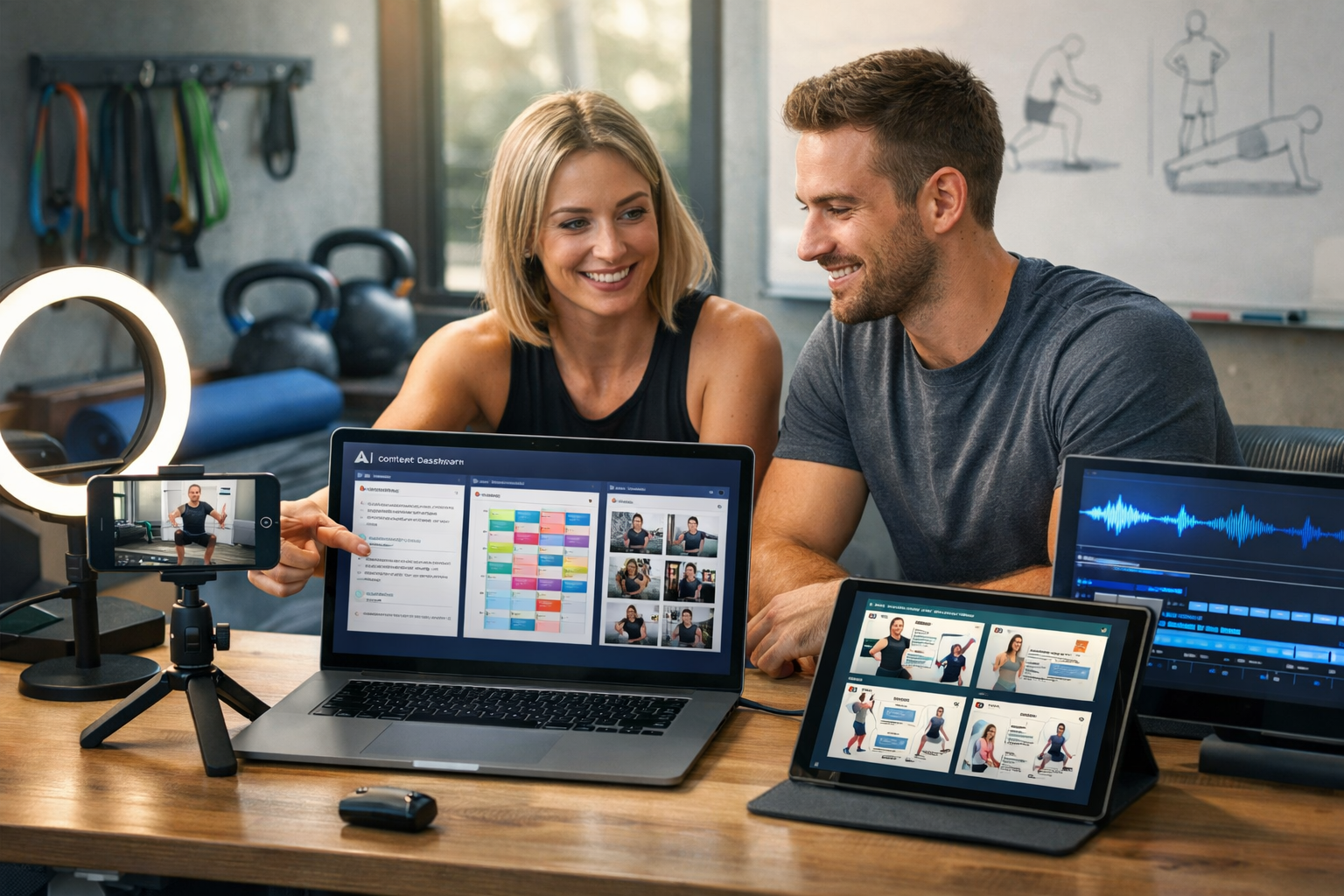
AI content for fitness coaches and personal trainers is no longer a “nice-to-have” for big brands—it’s a practical way to publish consistent, client-focused marketing without living on your laptop every evening. With the right workflow, you can use AI to create educational posts, lead-generating emails, scroll-stopping visuals, short-form videos, and even voice-overs, while still sounding like you and staying evidence-led.
Why AI content matters for fitness coaches and personal trainers
Fitness marketing is a volume game as well as a trust game. Prospects usually need multiple touchpoints—Instagram, a website, emails, short videos—before they book a call or buy a programme. The challenge is that most coaches are already maxed out delivering sessions, programming, and doing admin.
AI helps you do more of what drives revenue (coaching) by speeding up what drains time (first drafts, repurposing, formatting, variation testing). The best results come when you treat AI as your production assistant, not your “expert”. Your expertise—screening, coaching cues, and real client experience—stays central.
- Create consistent content without burning out.
- Maintain a clear niche message (fat loss, strength, postnatal, busy professionals, rehab-adjacent support).
- Turn one idea into many formats: blog → emails → reels → carousel → podcast snippet.
- Test offers and angles quickly (without guessing for weeks).
What “good” AI content looks like in fitness (and what it doesn’t)
Great content for personal trainers is specific, safe, and actionable. It shows that you understand real barriers: shift work, low confidence, plateaus, injuries, time constraints, menopause, or managing nutrition while travelling. AI can help you express these insights clearly—but only if you feed it the right inputs and add your professional judgement.
Good AI-assisted fitness content should be:
- Client-centred: written for one person and one problem, not “everyone who wants to get fit”.
- Evidence-led: cautious with claims; avoids miracle outcomes and includes sensible caveats.
- Consistent with your coaching philosophy: tone, approach, and training style match your brand.
- Actionable: includes cues, checklists, or step-by-step guidance (where appropriate).
Avoid these common AI pitfalls:
- Overpromising: “Lose 10kg in 10 days” style claims harm trust and can breach ad policies.
- Unsafe training advice: generic programming that ignores medical history or contraindications.
- Copycat content: same recycled captions as every other coach.
- No CTA: helpful content with no next step doesn’t convert.
How Gen AI Last supports fitness coaches: text, images, video, and audio in one place
Many coaches waste time bouncing between separate tools for writing, design, video, and voice. Gen AI Last brings those capabilities together so you can build an end-to-end content workflow from a single prompt: AI text for scripts and posts, AI images for social graphics, AI video for reels and promos, and AI audio for voice-overs or podcast-style content.
If you want to explore what’s possible, you can use our AI content tools to generate the first draft assets, then refine with your coaching expertise. And because all features start at one low price, it’s realistic for solo PTs and small studios to implement; view pricing from $10/month.
A simple, repeatable AI content system for coaches
The easiest way to get consistent results is to build a weekly system. Below is a practical framework you can run in 60–120 minutes per week, then schedule content ahead of time.
Step 1: Choose one weekly theme (one audience, one outcome)
Examples:
- “Busy professionals: strength training in 30 minutes”
- “Beginner fat loss: steps, protein, and realistic portions”
- “Women 40+: building muscle and managing recovery”
- “Back pain: training around desk posture (non-medical guidance, referral prompts)”
Step 2: Create one pillar piece (blog or long caption)
Use AI text generation to produce a structured draft: hook, problem, common mistakes, solution, FAQs, and a CTA. Then replace generic sections with your real coaching cues, client stories (anonymised), and your standard progressions/regressions.
Tip: Keep a “brand brief” you paste into every prompt—your niche, tone, training approach, and boundaries (no medical claims, include disclaimers, encourage screening).
Step 3: Repurpose into 5–8 micro-assets
Turn the pillar into:
- 2 short reels scripts (15–30 seconds) with clear opening lines.
- 1 carousel outline (7 slides): myth → truth → steps → CTA.
- 3 short captions for different angles (education, motivation, behind-the-scenes).
- 1 email to your list with a simple call-to-action (book call / download / reply).
Step 4: Produce visuals, video, and audio quickly
Use AI image generation for clean social graphics and thumbnail concepts. Use AI video generation for simple talking-head style promos, explainer videos, or demo-style reels. Add AI audio voice-over if you prefer not to speak on camera every time (or to improve consistency and clarity).
High-performing content ideas for PTs (with prompts you can adapt)
Below are proven content categories that work because they map to how prospects think: “Is this for me?”, “Will it work?”, “Will I stick to it?”, and “Can I trust you?” Use these as templates and tailor them to your niche.
1) The ‘mistakes’ post (without shaming)
Angle: Common pitfalls that stop progress, explained with empathy.
Prompt idea: “Write an Instagram carousel for [audience] about the 5 most common reasons they don’t see progress with [goal]. Keep it supportive, include one actionable fix per slide, and finish with a CTA to book a consultation.”
2) The ‘minimum effective dose’ plan
Angle: Simple routines that fit real schedules (high conversion for busy professionals).
Prompt idea: “Create a 3-day strength template for beginners training at home with dumbbells, 30 minutes per session. Include warm-up, 4 main movements, reps/sets, and progression rules. Add safety notes and encourage individualisation.”
3) The myth-busting reel
Angle: Quick myth → truth → next step.
- “You need to train every day.”
- “Carbs at night make you gain fat.”
- “Light weights tone; heavy weights bulk.”
Prompt idea: “Write a 20-second reel script debunking the myth: [myth]. Add a punchy hook, one simple explanation, and one action step. Keep it friendly and science-aware.”
4) The client journey story (anonymised)
Angle: Show process, not just before/after.
Prompt idea: “Turn this client note into a story post: starting point, obstacles, weekly habits, key turning point, outcomes beyond the scale, and a CTA. Use anonymised language and avoid exact weight-loss claims.”
5) The lead magnet + nurture email sequence
Angle: Convert followers into email subscribers, then into consult calls.
Use AI text generation to draft a short lead magnet (e.g., “Busy Week Meal Builder” or “3-Day Strength Starter”), then create a 5-email sequence:
- Delivery + quick win
- Common mistake + fix
- Story + proof of process
- FAQ + objections
- Offer + booking link
Using AI images for fitness marketing (without looking generic)
AI-generated visuals can elevate your brand when you use them intentionally. The goal is not to replace real training footage; it’s to support it with consistent, on-brand graphics: programme covers, checklists, ingredient visuals, habit trackers, and background scenes for quotes or tips.
Practical image ideas for coaches
- Carousel backgrounds (clean gym textures, dumbbells, minimal studio scenes).
- Lead magnet cover images (e.g., “Home Strength Starter Kit”).
- Email header banners and landing page hero visuals.
- Thumbnail concepts for YouTube or reels highlights.
Tip: Create a consistent “visual system”: the same lighting style, composition, and colour cues each week. This makes your brand recognisable even before people read your handle.
AI video for personal trainers: short-form that actually converts
Video is often the highest-trust format in fitness because people can see how you coach: your energy, clarity, and standards. If filming and editing slows you down, AI video generation can help create quick explainer content, promo clips, and structured reels that you can polish with minimal edits.
3 video formats that work well
- Exercise education: “3 cues to fix your squat depth” (include regressions and safety notes).
- Programme walkthrough: “What’s inside my 6-week strength reset?”
- Objection handling: “If you’ve failed diets before, start here…”
AI audio: voice-overs, mini-podcasts, and workout narration
Audio is an underrated channel for coaches. AI audio generation can help you add voice-overs to reels, create short podcast-style episodes, or produce guided training narration for warm-ups and mobility flows. It’s especially useful if you want consistency across videos, or if you’re recording content late at night and need clean audio without re-takes.
Audio assets you can produce quickly
- Voice-over for a 30-second tip reel (script generated from your pillar content).
- 2–5 minute “coach’s note” episode answering one question per week.
- Background music for promo clips (keep it subtle and consistent).
Compliance, safety, and trust: using AI ethically in fitness
Fitness is a trust-sensitive niche. If your content crosses into medical claims, prescriptive nutrition for health conditions, or unsafe exercise recommendations, you risk harming clients and your reputation. AI can draft faster, but it can’t replace screening or professional judgement.
- Add a clear disclaimer on educational content: it’s general info, not medical advice.
- Encourage appropriate referrals (GP/physio/dietitian) where needed.
- Avoid guaranteed outcomes; focus on process, habits, and measurable behaviours.
- Use your own standards: your exercise regressions, coaching cues, and client communication style.
- Protect privacy: anonymise client stories and remove identifying details.
Example: a 7-day AI content plan for a personal trainer
Here’s a realistic plan you can run weekly, tailored to one theme (e.g., “fat loss for busy professionals”).
- Day 1: Educational carousel — “3 habits that drive fat loss when you’re busy”.
- Day 2: Reel — myth busting (20 seconds) + CTA to download your checklist.
- Day 3: Story/post — behind-the-scenes: your client check-in process and what you track.
- Day 4: Email — “The simplest way to hit protein without tracking”.
- Day 5: Reel — 3-exercise 20-minute session (with options).
- Day 6: Static graphic — FAQ/objections (“Do I need to cut carbs?”).
- Day 7: Offer post — invite to book a consult, limited spots, who it’s for.
Generate the written drafts, captions, scripts, and graphics in one sitting, then schedule. If you want to build this workflow quickly, you can start creating for free and iterate from your first week of content.
How to get better outputs: a coach’s prompt checklist
The difference between generic AI content and content that wins clients is the briefing. Use this checklist before generating anything:
- Audience: Who is this for? (age, schedule, training history, barriers)
- Outcome: What should they do next? (save, DM, book, download, reply)
- Voice: Direct, supportive, no gimmicks; UK spelling; short sentences.
- Boundaries: No medical claims; include safety notes; encourage individualisation.
- Proof: Add your own client insights, coaching cues, and personal experience.
Cost and ROI: why an all-in-one tool matters for solo coaches
Most trainers don’t need a complex marketing stack. You need consistent output across a few channels and a simple way to repurpose what already works. Using one platform for text, images, video, and audio reduces tool overload, cuts monthly costs, and keeps your process straightforward.
Gen AI Last includes AI text, image, video, and audio generation in every plan, starting at a price that makes sense for independent coaches and small studios. If you’re comparing options, view pricing from $10/month and calculate what you’d otherwise spend on separate subscriptions.
Final thoughts: AI content should amplify your coaching, not replace it
The best use of AI content for fitness coaches and personal trainers is simple: publish more consistently, explain your methods more clearly, and guide prospects to the next step—without sacrificing safety or credibility. Start with one theme, create one pillar piece, repurpose it into multiple formats, and refine based on what your audience saves, replies to, and buys.
When you’re ready to build a repeatable workflow for posts, visuals, videos, and voice-overs in one place, explore our AI content tools and start creating for free.
Ready to Create with Generative AI?
Join thousands of creators using Gen AI Last to generate text, images, audio, and video — all from one platform. Start your 7-day free trial today.
Start Free — Try 7 DaysQuick Links
Create AI content from $10/month
View Plans