AI content for travel and hospitality brands: a complete guide
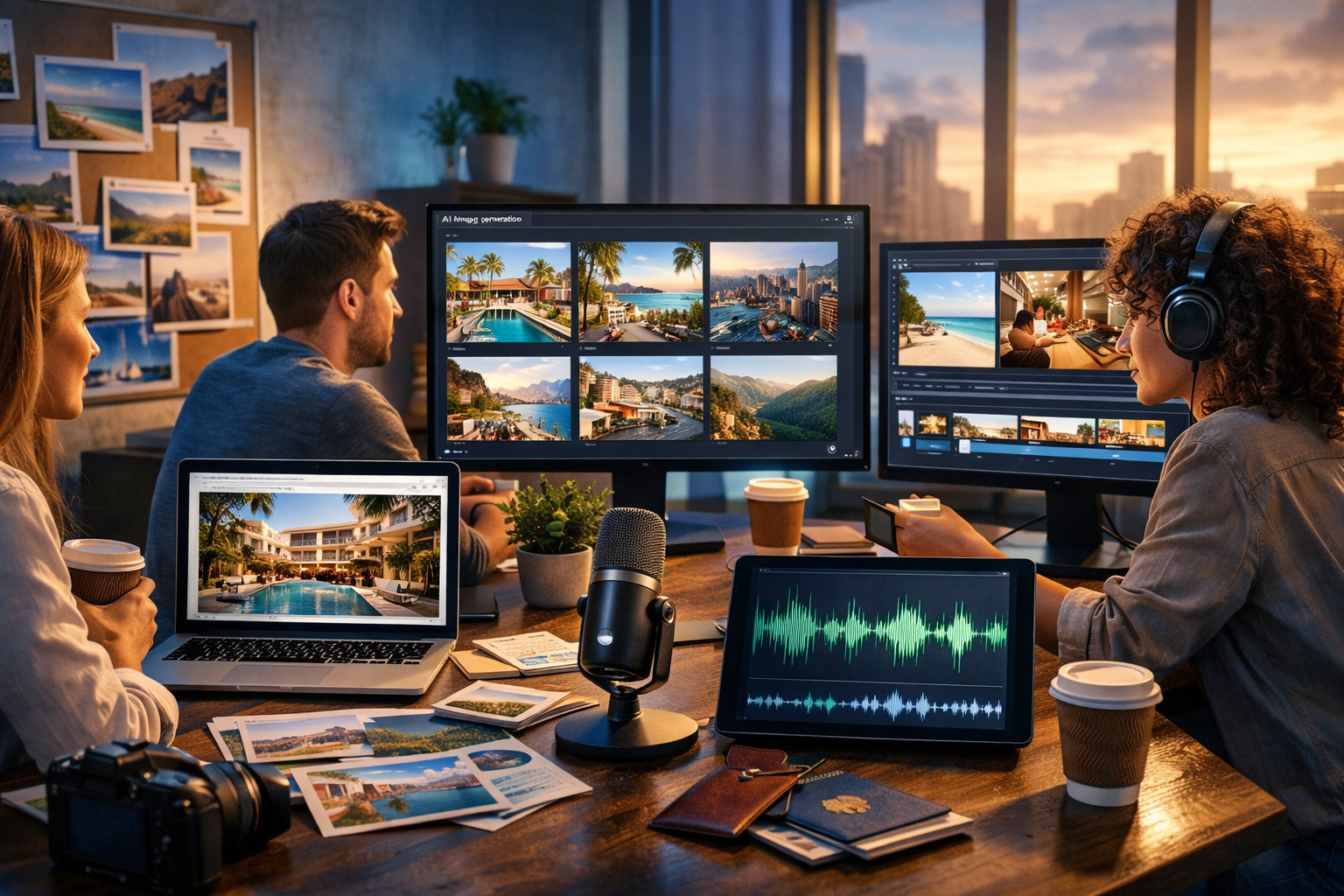
AI content for travel and hospitality brands is no longer a “nice to have” — it’s a practical way to create more high-quality marketing assets (copy, visuals, video and audio) in less time, without sacrificing brand standards. Whether you run a boutique hotel, tour company, airline, OTA partner, restaurant group, or destination marketing organisation, the right AI workflow helps you respond faster to seasons, events and changing demand while keeping messaging consistent across every channel.
Why travel and hospitality teams are adopting AI content
Travel marketing is uniquely content-heavy. Guests want to see rooms, menus, neighbourhoods, itineraries, views, experiences and reviews before they book. At the same time, your offers change constantly: shoulder season packages, school holiday rates, local events, last-minute availability and weather-driven shifts.
AI helps because it can:
- Draft channel-specific copy quickly (website, email, social, ads, OTA listings).
- Generate concept visuals and social creatives when photography is limited.
- Produce short marketing videos and reels at scale for destinations and properties.
- Create voice-overs and narration for tours, promos and explainers.
- Improve consistency across property portfolios, franchises or multi-location brands.
Gen AI Last is built for this multi-format reality: one platform to generate professional text, images, audio and video from simple prompts. You can explore our AI content tools and use them across the entire travel funnel, from inspiration to booking to post-stay retention.
Where AI content fits in the travel customer journey
A good AI strategy maps content to intent. Here’s a practical way to think about it:
- Dreaming: destination guides, inspirational reels, “top 10” lists, seasonal ideas.
- Planning: itineraries, FAQs, comparison pages, packing lists, route maps, accessibility details.
- Booking: landing pages, room/package descriptions, trust messaging, cancellation policies, upsell copy.
- Experiencing: welcome messages, local recommendations, on-property signage copy, audio guides.
- Sharing & returning: review prompts, loyalty emails, “come back” offers, referral campaigns.
AI content becomes most powerful when you build reusable templates for each stage, then personalise by location, traveller segment and season.
AI text generation: practical use cases (with examples)
Text is still the backbone of travel conversion: clear details reduce anxiety, and emotive language increases desire. AI text generation is ideal for producing first drafts quickly — then your team applies brand tone, legal checks and local accuracy.
1) Hotel and accommodation pages that convert
Use AI to draft room types, amenities, inclusions and unique selling points consistently across all properties. A helpful structure:
- Who it’s for (couples, families, business travellers, accessibility needs).
- What’s included (breakfast, parking, late check-out, Wi‑Fi).
- What makes it special (view, local design, spa access, quiet floor).
- Practical details (bed sizes, check-in windows, pet policy).
Example prompt you can adapt: “Write a 180-word room description for a ‘Harbour View King’ at a boutique hotel in Brighton. Tone: warm, premium, modern British. Include: king bed, rainfall shower, balcony, local art, walkable to the pier, ideal for couples. Add a short bullet list of amenities.”
2) Destination content that ranks (and feels human)
Destination guides are perfect for AI-assisted drafting because they follow repeatable patterns, but must be fact-checked. Create outlines for:
- “Best time to visit” by weather and crowd levels.
- Neighbourhood guides by interest (food, culture, beaches, hiking).
- 3-day and 7-day itineraries with realistic travel times.
- Local etiquette and accessibility guidance.
To avoid generic writing, feed the AI details you already have: guest FAQs, concierge notes, tour scripts, menus, and local partnerships.
3) Email campaigns for occupancy, upsells and retention
Travel email performance improves when messaging matches intent: pre-arrival excitement, on-property add-ons, and post-stay loyalty. Use AI to generate variants for A/B tests: subject lines, preview text and body copy.
Example use cases:
- Low-demand date boosts: “48-hour midweek offer” campaigns.
- Pre-arrival upsells: breakfast, parking, spa slots, room upgrades.
- Event-led campaigns: festivals, conferences, school holidays.
- Post-stay: review requests and “book again” incentives.
4) Social captions and ad copy for multiple platforms
One of the biggest time sinks is adapting the same idea to Instagram, TikTok, Facebook, LinkedIn and Google Ads. AI can generate platform-specific versions while keeping the same offer and CTA.
Tip: Build a “brand voice card” prompt once (tone, banned phrases, preferred spellings, target audience, and proof points), then reuse it for every campaign.
AI image generation: fill content gaps without expensive shoots
You should still use real photography for rooms and key facilities where accuracy matters. But AI image generation is extremely useful for:
- Campaign concepts: hero banners for seasonal offers (e.g., “winter city break”).
- Social graphics: stylised destination mood shots, quote cards, itinerary tiles.
- Blog imagery: supporting visuals for guides and long-form content.
- Restaurant and spa promos: conceptual visuals when menu photography is pending.
Best practice for hospitality visuals: avoid generating “fake rooms” that could mislead guests. Use AI images for ambience, lifestyle and campaign art direction, and keep property-specific images authentic.
With Gen AI Last, you can create marketing-ready visuals quickly and keep style consistent across a portfolio — particularly useful for multi-location hospitality brands that need cohesive social grids and paid creative.
AI video generation: scale reels, ads and destination promos
Short-form video is often the difference between being seen and being ignored. The challenge is producing enough variations for different audiences, offers and placements. AI video generation helps you turn a single concept into multiple versions.
High-performing video formats in travel:
- “3 reasons to visit” destination reels.
- Room walk-through style edits (using your real clips) plus AI-generated transitions and captions.
- Itinerary explainers: day-by-day highlights with map-style visuals.
- Event promos: “Stay with us for [festival] weekend”.
Actionable workflow: write a 20–30 second script (AI text), generate or select visuals (AI images or real footage), produce a short video cut (AI video), then add voice-over (AI audio). One idea becomes a full asset pack.
AI audio generation: voice-overs, tours and brand sound
Audio is underused in travel marketing, yet it can improve accessibility and engagement. AI audio generation supports:
- Voice-overs for reels, ads and property explainers.
- Podcast-style destination episodes for SEO and loyalty audiences.
- Audio guides for walking tours, museum partners, or local trails.
- Background music for social videos and promo clips.
A practical tip: create two voice styles — one “warm concierge” voice for guest-facing content, and one “confident narrator” voice for explainers and brand campaigns.
A repeatable AI content workflow for travel and hospitality teams
The biggest gains come from process, not one-off generations. Here’s a simple workflow you can run weekly.
- Pick one campaign theme: e.g., “Spring weekends”, “Family half-term”, “Gastro getaway”.
- Define segments: couples, families, solo travellers, business, locals (staycations).
- Create a message matrix: offer + proof + urgency + CTA for each segment.
- Generate assets: blog outline, landing page copy, 5–10 social captions, 3 email variants, 3 ad variants.
- Produce creatives: 3–5 image concepts and 2 short videos per segment.
- Quality control: fact-check, legal/policy review, brand tone, accessibility checks.
- Publish and measure: track bookings, click-through, saves/shares, and email conversions.
Because Gen AI Last includes text, image, video and audio in every plan, small teams can build an end-to-end content pipeline without stitching together multiple subscriptions. You can view pricing from $10/month and scale output without scaling headcount.
Prompt templates you can copy for travel and hospitality brands
These templates are designed to produce usable first drafts with fewer generic phrases. Replace brackets with your details.
Template 1: SEO blog post (destination or experience)
Prompt: “Write a 1,600-word SEO blog post targeting the keyword ‘[keyword]’. Audience: [families/couples/business travellers]. Location: [city/region]. Include: best time to visit, 3-day itinerary, where to stay (without naming competitors), transport tips, accessibility notes, and 10 FAQs. Tone: helpful, locally informed, British English. Avoid clichés and do not invent attractions; use only the facts I provide: [paste bullet facts]. End with a soft CTA to book.”
Template 2: Hotel package landing page
Prompt: “Create a landing page draft for ‘[Package name]’ at [Hotel name] in [Location]. Include: headline options (5), hero paragraph, inclusions, who it’s for, sample itinerary, terms highlights (cancellation, dates), and 6 CTA variations. Tone: premium but clear, no exaggeration. Must mention: [key inclusions], [price range], [booking window].”
Template 3: Social reel script + shot list
Prompt: “Write a 25-second Instagram/TikTok reel script promoting [experience/property]. Provide: hook (0–2s), scene-by-scene shot list (6–8 shots), on-screen caption text, and a voice-over script. Tone: upbeat, modern, informative. Include: [unique feature], [location cue], and clear CTA.”
Template 4: Pre-arrival upsell email
Prompt: “Write a pre-arrival email for guests arriving in [X days] at [Hotel]. Goal: upsell [breakfast/spa/parking/late checkout]. Provide 3 subject lines and 2 body variants: one concise, one story-led. Include reassurance on flexibility and a clear call to action. Tone: concierge-style, friendly British English.”
Brand safety, accuracy and trust: what to control
In travel, trust is everything. AI can accelerate creation, but your team must control accuracy and compliance. Build a checklist and make it non-negotiable.
- Fact-checking: opening times, distances, seasonal closures, local transport rules, accessibility claims.
- Avoid misleading imagery: don’t generate property-specific photos that could be mistaken for real facilities.
- Policies and pricing: ensure cancellation and inclusions match your booking engine and T&Cs.
- Local sensitivity: respect cultural norms; avoid stereotypes in destination writing.
- Data privacy: don’t paste personal guest data into prompts; use anonymised segments.
A simple rule: use AI to draft, not to decide. Your experts (revenue, guest services, local partners) validate the details, and marketing shapes the story.
How to measure results (beyond “we posted more”)
More content only matters if it improves revenue outcomes. Track a few metrics per channel:
- SEO: rankings for destination keywords, organic sessions, and assisted conversions.
- Email: revenue per send, conversion rate to booking/upsell, unsubscribes.
- Paid social: CTR, cost per landing page view, and cost per booking (where tracked).
- On-site: landing page conversion, scroll depth, click-to-book.
- Creative testing: performance by segment, offer, and visual style.
Because AI reduces production friction, you can run more structured tests: same offer, different angle; same angle, different creative; same creative, different CTA.
Getting started quickly with Gen AI Last
If you want to implement AI content for travel and hospitality brands without overhauling your entire marketing stack, start with one campaign and one channel — then expand.
- Choose a revenue-linked goal: fill low-demand dates, increase direct bookings, or sell add-ons.
- Generate a complete asset pack: landing page copy, email, 10 social posts, 3 ad variants, 5 images, 2 short videos, and a voice-over.
- Reuse what works: turn the best-performing angle into a repeatable template for future seasons.
Gen AI Last makes this practical for startups and small teams because every plan includes text, image, audio and video generation from just $10/month. If you want to test it with your next campaign, start creating for free and build your first travel content workflow in an afternoon.
Final thoughts: AI that supports your hospitality expertise
The brands that win with AI won’t be the ones publishing the most generic output — they’ll be the ones combining AI speed with real hospitality expertise: accurate details, genuine local recommendations, and a consistent guest-first tone. Use AI to remove bottlenecks, then invest your human time where it matters: experience design, storytelling, partnerships and service.
With an all-in-one platform like Gen AI Last, you can keep your content production simple: one place to create the words, visuals, videos and audio that help travellers choose you — and book with confidence.
Ready to Create with Generative AI?
Join thousands of creators using Gen AI Last to generate text, images, audio, and video — all from one platform. Start your 7-day free trial today.
Start Free — Try 7 DaysQuick Links
Create AI content from $10/month
View Plans