AI Content for Travel and Hospitality Brands: A Practical Guide
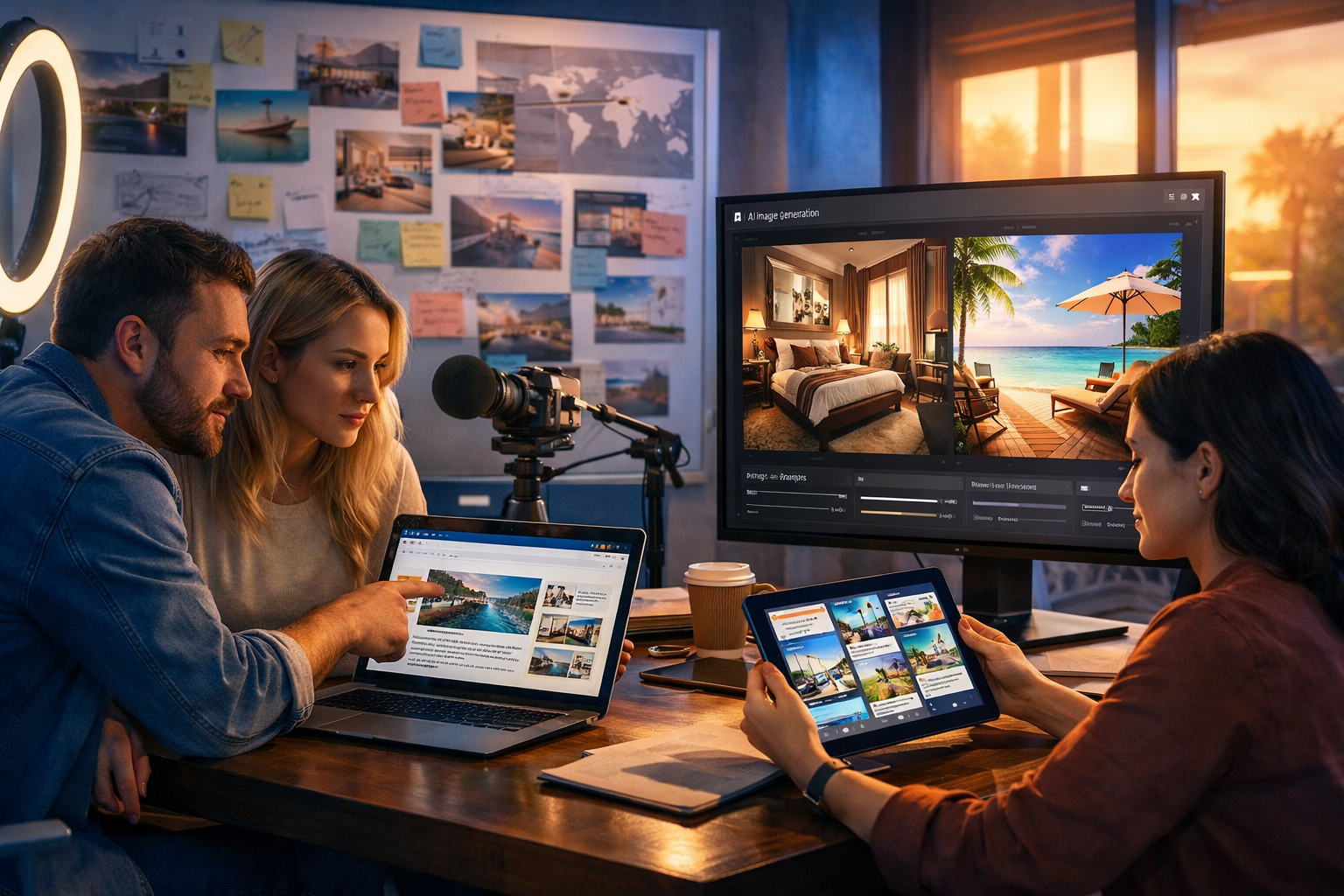
Travel and hospitality brands live or die by how vividly they can sell an experience—yet they also juggle constant change: seasonal rates, availability, local events, route updates and last-minute disruptions. AI content can help you move faster, produce more campaign assets, and personalise messaging across markets. The winning approach is not “generate and post”; it’s building a reliable workflow that protects accuracy, brand voice and guest trust.
What “AI content” means for travel and hospitality brands
In this sector, content is more than blog posts. It includes room and package descriptions, OTA-ready snippets, email sequences, paid ads, social reels, destination guides, voice-overs for videos, and image assets that match your brand style. “AI content for travel and hospitality brands” means using generative AI to draft, iterate and repurpose these assets—while your team remains responsible for facts, compliance, and the final sign-off.
With our AI content tools, you can generate professional text, images, video and audio from a simple prompt—useful when you need a complete campaign pack (copy + visuals + short video + narration) without the cost and coordination overhead of multiple tools.
Why AI is especially valuable in travel and hospitality
- High volume, high variation: multiple properties, room types, tours, routes, seasons, languages and traveller segments.
- Always-on marketing: guests research year-round, but your offers peak around events, school holidays and weather windows.
- Experience-led storytelling: you need consistent tone and imagery that makes people feel the destination.
- Operational change: amenities, opening hours, policies and inclusions shift—content must keep up.
- Distribution complexity: your message needs to work on website, email, social, paid ads, OTAs and in-property screens.
AI helps you scale production and testing. Your edge comes from the human layer: local knowledge, service design, hospitality tone, and rigorous fact-checking.
The content pillars that drive bookings
Before generating anything, map content to the booking journey. These pillars tend to perform across hotels, airlines, attractions and tour operators:
- Inspiration: destination highlights, itineraries, seasonal guides, “48 hours in…”
- Consideration: comparisons (neighbourhoods, room types), FAQs, transport guidance, accessibility.
- Conversion: offer pages, package descriptions, urgency messaging, clear inclusions/exclusions.
- Pre-stay / pre-trip: check-in instructions, packing lists, “what to expect”, dining and spa booking prompts.
- On-property / in-destination: in-room guides, activity suggestions, upsell flows.
- Post-stay: review requests, loyalty, referral prompts, reactivation.
AI is most effective when you treat these as systems: one core story becomes many assets, each adapted to platform and traveller intent.
How to use AI text generation without sounding generic
The biggest risk with AI-written travel copy is sameness. Avoid “wanderlust” clichés by grounding prompts in concrete details, then enforcing brand voice rules. AI should draft; your team should verify and refine.
1) Build a “voice sheet” for every brand or property
Create a short guideline you can paste into prompts:
- Tone (e.g., calm luxury, friendly boutique, adventurous, family-first).
- Words to use/avoid (e.g., avoid “hidden gem”, avoid excessive exclamation marks).
- Reading level and sentence length (especially for mobile).
- Proof points (e.g., Michelin-listed restaurant, 3-minute walk to station—only if true).
2) Prompt with facts, constraints and purpose
A strong prompt includes: audience + context + unique details + required sections + SEO intent. Example you can adapt:
Example prompt (website copy):
“Write a 180–220 word room description for our ‘Harbour View King’ at a 4-star waterfront hotel in Portsmouth. Audience: couples, weekend breaks. Tone: warm, modern British, understated. Include: king bed, rainfall shower, workspace, blackout curtains, view of the marina, complimentary Wi‑Fi. Do not claim ‘best’ or ‘luxury’. End with a 1-sentence CTA. Avoid clichés.”
With Gen AI Last, you can generate multiple variants quickly for A/B testing—then keep the winners as reusable templates for other room types and properties.
3) Repurpose one core idea across formats
Turn a destination guide into:
- a blog post for organic SEO
- a 5-email pre-trip series
- three paid social ad angles (food, culture, family)
- a 30-second reel script
- a concise FAQ for your booking page
This is where an all-in-one platform matters: you can generate the copy, matching visuals, a short video and a voice-over without switching tools or subscriptions.
AI images for travel brands: realistic, consistent, and compliant
Imagery is powerful—but also sensitive. For hospitality, never misrepresent room layouts, views or facilities. Use AI images primarily for campaign visuals, conceptual banners, social graphics backgrounds, and seasonal creative that complements your real photography.
Where AI image generation works best
- Promotional creatives: “Spring city breaks” banner visuals with on-brand colour grading.
- Illustrative destination moods: abstracted scenic compositions for blog headers.
- Social backgrounds: story templates and carousel frames.
- Concept mock-ups: pitch decks for partnerships (airline + hotel + attraction).
Prompting tips for credible travel visuals
Include lens cues, lighting, and brand styling. Also add “no text, no watermark, no logo” and specify diverse, respectful representation.
Example prompt (social campaign visual):
“Photorealistic lifestyle scene: couple checking in at a contemporary boutique hotel reception, warm ambient lighting, clean minimal décor, British coastal town vibe, 35mm lens, shallow depth of field, natural skin tones, candid moment, no text, no logos.”
AI video: turning destinations into scroll-stopping assets
Short-form video drives discovery, but production can bottleneck small teams. AI video generation helps you prototype concepts, create simple explainer videos, and build social reels faster—especially when combined with your existing footage or photography.
High-performing video use cases
- Offer highlights: “Stay 3 nights, pay 2” with animated scene transitions and clear inclusions.
- Property walkthrough teasers: lobby → room → breakfast → pool/spa (keep claims accurate).
- Itinerary reels: day-by-day narrative for city breaks and tours.
- Explainers: “How airport transfers work”, “How to use mobile check-in”.
A practical workflow is: generate a script, generate (or select) visuals, then add a voice-over and captions. Gen AI Last supports text, video and audio creation in one place, making this end-to-end process far simpler for lean marketing teams.
AI audio: voice-overs, narration and multilingual reach
Audio is a quiet conversion lever in travel: voice-over for reels, welcome videos, accessibility-friendly narration, and even short podcast-style destination guides. AI audio generation can help you produce consistent narration without booking studio time for every small update.
Where AI audio fits in hospitality
- Social ads: voice-over that matches on-screen offers and timings.
- In-room or pre-arrival video: “How to get here”, “Breakfast hours”, “Spa booking”.
- Multilingual messaging: draft copy in English, translate with care, then generate language-appropriate narration.
- Background music beds: calm lounge, upbeat adventure, family-friendly—aligned to brand mood.
A simple, repeatable AI content workflow (that protects trust)
For travel and hospitality, accuracy is non-negotiable. Use this workflow to scale safely:
- Collect verified inputs: amenities, distances, policies, inclusions, terms, price ranges, dates, accessibility notes. Keep a single source of truth.
- Define the intent: SEO article, booking page, email, ad, or pre-trip guide—each needs different structure.
- Generate draft variants: produce 3–5 options for headlines, hooks and CTAs. Choose the strongest.
- Human edit for brand voice: add local detail, remove fluff, ensure hospitality tone (helpful, calm, confident).
- Fact-check and compliance review: confirm claims, licensing (where relevant), and avoid prohibited superlatives or misleading images.
- Publish and measure: track CTR, conversion rate, time on page, email clicks, and video completion rates.
- Iterate: refresh copy when policies or offers change; update seasonal assets rather than starting from scratch.
SEO tactics for AI content in travel (what actually works)
AI can help you cover more keywords, but rankings come from usefulness, structure and originality. Focus on the searcher’s job-to-be-done: planning, comparing, budgeting, and reducing uncertainty.
Target intent, not just volume
- Informational: “best time to visit”, “how to get from airport to city centre”.
- Commercial: “family-friendly hotels in…”, “boutique hotel near…”.
- Transactional: “book airport transfer”, “hotel with parking”.
Make content demonstrably local and specific
Add details AI cannot guess reliably: neighbourhood nuances, realistic timings, seasonal trade-offs, accessibility notes, etiquette tips, and in-house recommendations. Use structured sections (e.g., “Getting around”, “Weather”, “Costs”, “Where to stay”) so Google and readers can skim.
Build topic clusters around properties and destinations
Instead of isolated blog posts, publish clusters:
- Core page: “Hotel in Bath near the Roman Baths”
- Support: “Weekend itinerary: Bath in 48 hours”
- Support: “Best cafes and bookstores near Pulteney Bridge”
- Support: “Parking in Bath: what travellers should know”
Practical examples: prompts you can copy and use today
Use these as starting points in Gen AI Last, then replace bracketed details with your verified information.
Example 1: Destination blog post outline (SEO)
Prompt:
“Create an SEO-optimised blog post outline for ‘[Destination] in [Season/Month]’. Audience: [couples/families/solo travellers]. Include H2 sections for: weather, what to pack, top 7 experiences, a 2-day itinerary, getting around, budget ranges, accessibility notes, and FAQs. Tone: practical, not salesy. Add suggested title tags and meta description options.”
Example 2: Email campaign for abandoned booking
Prompt:
“Write a 3-email abandoned booking sequence for [Hotel/Brand]. Audience: [business travellers]. Offer: [free breakfast / late check-out]. Include subject lines (max 45 characters), preview text, and a clear CTA. Tone: reassuring, helpful. Mention flexible cancellation only if policy allows: [paste policy].”
Example 3: Social carousel copy for a package
Prompt:
“Write Instagram carousel copy (8 slides) for a ‘[3-night spa escape]’ package. Provide slide headlines (max 6 words) and 1–2 short lines per slide. Highlight inclusions: [list]. Avoid price claims unless included: [price]. End with booking CTA and booking window: [dates].”
Example 4: 30-second reel script + voice-over
Prompt:
“Write a 30-second vertical reel script for [Tour/Hotel]. Structure: 0–3s hook, 3–20s highlights (3 beats), 20–27s reassurance (what’s included / how it works), 27–30s CTA. Provide on-screen text suggestions and a voice-over script. Tone: energetic but premium. Do not exaggerate.”
Common pitfalls (and how to avoid them)
- Hallucinated details: AI may invent distances, awards, facilities or policies. Always provide verified facts and re-check before publishing.
- Misleading imagery: don’t use AI images to depict your exact rooms/views unless clearly accurate and approved. Use AI for conceptual marketing visuals instead.
- Over-automation: guests notice “template speak”. Add local texture: specific streets, markets, viewpoints, and practical tips.
- Ignoring accessibility and inclusivity: include mobility notes, dietary options (when true), and respectful representation in visuals.
- Single-channel thinking: one blog post won’t carry a campaign. Build a content pack: article + email + social + reel + landing page.
How Gen AI Last supports small travel teams
Startups, independent hotels, tour operators and small agencies often have the same expectations as big brands—without the headcount. Gen AI Last is designed for that reality: one platform for text, images, video and audio generation, so you can produce complete campaigns quickly and keep creative consistent.
If you want to experiment without a large commitment, you can view pricing from $10/month and scale only when you see results. When you’re ready to build your first campaign pack, start creating for free and use the example prompts above as your baseline.
Quick checklist: publish-ready AI content for travel
- All claims verified (amenities, distances, times, policies, inclusions).
- Tone matches brand voice sheet; clichés removed.
- Content mapped to intent (inspire/compare/book/pre-trip).
- Images are compliant and not misleading; real photography used where required.
- Video includes clear hook, benefits, reassurance, CTA.
- Audio narration matches pacing and avoids overpromising.
- Performance tracked and content refreshed seasonally.
AI content for travel and hospitality brands works best when it’s treated as a production advantage—not a substitute for expertise. Combine verified operational inputs with strong prompting, human editing and an end-to-end toolset, and you can ship more campaigns, faster, without sacrificing the trust that turns browsers into guests.
Ready to Create with Generative AI?
Join thousands of creators using Gen AI Last to generate text, images, audio, and video — all from one platform. Start your 7-day free trial today.
Start Free — Try 7 DaysQuick Links
Create AI content from $10/month
View Plans