AI Content for Travel and Hospitality Brands (2026 Guide)
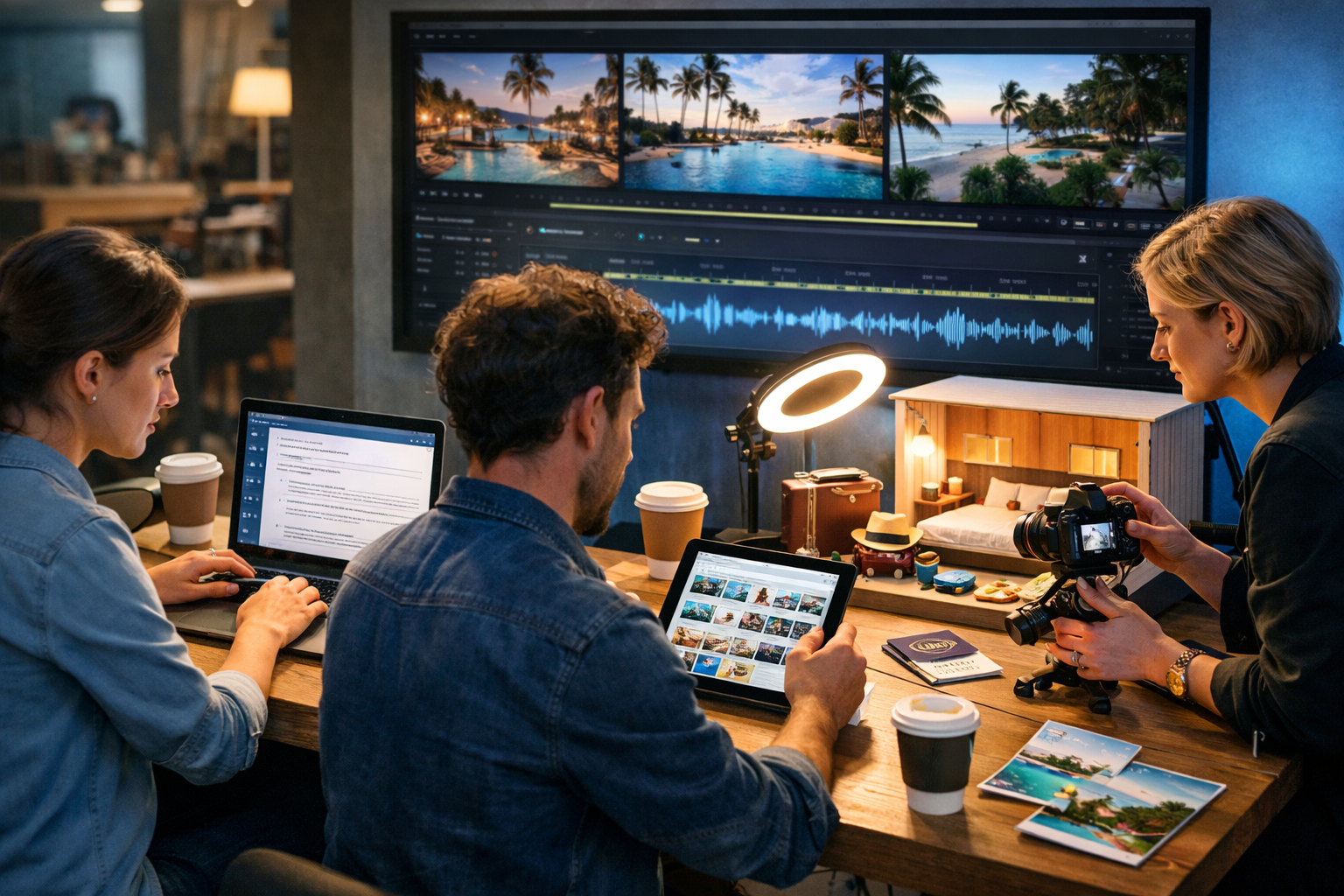
AI content for travel and hospitality brands is no longer just about writing quicker captions—it’s about producing consistent, on-brand storytelling across every touchpoint that influences bookings: search, social, email, OTAs, and on-property messaging. This guide shows how to use AI to create better content at scale (without losing authenticity), with practical workflows, ready-to-use prompts, and examples you can adapt for hotels, airlines, tour operators, restaurants, and destination marketers.
Why AI content matters in travel and hospitality
Travel customers research heavily, compare rapidly, and expect immediate answers. At the same time, brands must keep content fresh across seasons, events, and changing demand. AI helps teams move faster, but the real advantage is consistency: one brand voice, many formats, and quicker localisation.
- Higher publishing cadence for destination guides, itineraries, and hotel pages.
- More personalised messaging for segments (families, couples, business travellers, solo explorers).
- Better conversion assets: landing pages, email sequences, paid social variants, and retargeting copy.
- Multi-format production (text, images, video, audio) without needing a large in-house studio.
With our AI content tools, you can generate professional text, images, video, and audio from simple prompts—useful for small travel teams who need results quickly and can’t justify multiple subscriptions.
Where AI content works best across the travel funnel
The highest-performing travel marketing programmes typically map content to intent. Use AI to cover each stage with the right format and message.
1) Dreaming (inspiration)
- Short-form social: reels scripts, carousel captions, hooks and CTAs.
- Hero visuals: seasonal campaign imagery, mood boards, lifestyle shots.
- Brand stories: “why stay with us”, sustainability initiatives, local partnerships.
2) Planning (research)
- SEO destination articles, FAQs, packing lists, comparison guides.
- Itineraries by length and persona (48 hours, 5 days, foodie weekend).
- Video explainers: how to get here, what’s included, check-in process.
3) Booking (conversion)
- Landing pages with clear value propositions and objections handling.
- Email sequences: browse abandonment, price-drop alerts, limited-time offers.
- Paid ad variants: multiple headlines and primary texts for A/B tests.
4) Experience (on-property and in-trip)
- Pre-arrival emails: “what to pack”, “how to check in”, upsell spa/dining.
- In-stay messaging: room guides, property maps, activity highlights.
- Audio: welcome narration, museum-style mini guides, tour voice-overs.
5) Loyalty (reviews and repeat stays)
- Review response templates tailored by topic (noise, cleanliness, service).
- Post-stay storytelling: recap reels, photo prompts, referral incentives.
- Newsletter content that highlights local events and seasonal reasons to return.
A practical AI content workflow (that keeps your brand authentic)
The biggest fear with AI in travel marketing is sounding generic. The fix is process: feed AI the right inputs, set quality gates, and treat the model as a production partner—not an autopilot.
Step 1: Create a “Brand Voice + Proof” brief
Before generating anything, define the constraints that make your content feel like you:
- Voice: warm boutique, premium minimalist, family-friendly, adventure-led, etc.
- Audience: key segments and their motivations.
- Proof points: verified amenities, distances, policies, unique experiences, awards.
- Do-not-say list: banned claims (e.g., “5 minutes from airport” unless verified).
- Compliance: accessibility notes, pricing disclaimers, seasonal availability.
You can paste this brief at the top of your prompt in Gen AI Last so each output stays aligned.
Step 2: Generate a content “cluster” instead of a single asset
Travel SEO and social both reward topical depth. Rather than “one blog post”, generate a cluster: the main destination guide plus supporting pages (transport, best time to visit, family itinerary, restaurant guide, FAQs). This improves internal linking and makes planning easier for readers.
Step 3: Repurpose across formats
A single itinerary can become:
- A long-form blog post (SEO).
- A 30-second reel script (social).
- A narrated audio guide (on-trip).
- A carousel with “Day 1 / Day 2 / Day 3” panels (social).
- An email “weekend plan” to convert subscribers (CRM).
Gen AI Last supports text, image, video, and audio generation in one place, which helps keep creative consistent across channels.
Step 4: Human QA for accuracy, safety, and brand fit
AI can hallucinate. For travel and hospitality, this is risky: wrong opening times, incorrect distances, outdated policies, or overstated claims. Build a quick checklist:
- Verify facts (hours, prices, distances, inclusions, terms).
- Check accessibility and inclusivity language.
- Remove clichés and generic phrases; add local specificity.
- Ensure images/video match reality (room types, amenities, locations).
High-impact use cases (with examples you can copy)
Use case 1: SEO destination guides that actually convert
Many travel blogs attract traffic but don’t drive bookings because they miss intent. A conversion-friendly guide includes: clear “who it’s for”, seasonal advice, transport, map-style structure, and a relevant CTA (packages, rooms, tours).
Example brief: A boutique hotel in Edinburgh wants to rank for weekend breaks and push direct bookings.
- Primary article: “48 Hours in Edinburgh: A Boutique Weekend Itinerary”.
- Support articles: “Best time to visit Edinburgh”, “Edinburgh in winter: what to do”, “Family-friendly Edinburgh itinerary”.
- On-page CTA: “Check availability” + “Explore weekend packages”.
Tip: ask AI to include “decision points” (what to book in advance, how to avoid queues, budget vs premium options). That’s what turns inspiration into action.
Use case 2: Hotel and resort email campaigns that feel personal
AI shines when you need multiple versions: different subject lines, segments, and tone variations. Use it to build a sequence rather than one-off blasts.
- Pre-arrival: top 5 tips, add-ons, check-in info.
- Mid-stay: “Tonight’s dining availability”, “Tomorrow’s weather + ideas”.
- Post-stay: review request + return offer.
Practical approach: generate 10 subject lines, pick 2, A/B test, then let the winner inform future prompts.
Use case 3: Scroll-stopping social visuals and banners
Travel is visual, but photoshoots are expensive. AI images can fill gaps: seasonal campaign art, abstract lifestyle imagery, “concept” visuals for blog headers, and story backgrounds. The key is using brand constraints (palette, mood, composition) and avoiding misleading depictions of real rooms or landmarks when accuracy matters.
- Create consistent templates: hero banner style, lighting, lens, colour grade.
- Generate variants for different markets (e.g., “winter city break” vs “summer rooftop”).
- Use AI imagery for editorial/inspiration; use real photography for exact room types and facilities.
Use case 4: Short-form video for destinations, tours, and hotels
If you’re not publishing video consistently, you’re leaving attention on the table. AI helps you produce video scripts, storyboards, captions, and even full promotional clips depending on your needs.
- Reels/TikTok structure: hook (0–2s), payoff (3–12s), proof (13–20s), CTA (final seconds).
- UGC-style: “3 things I’d do again at this hotel”.
- Explainers: “How airport transfers work”, “What’s included in half-board”.
Workflow idea: generate 5 hooks + 3 CTAs per campaign and rotate them across variants to fight creative fatigue.
Use case 5: Audio for tours, on-property experiences, and accessibility
Audio is underused in hospitality. With AI audio, you can create short narrations for self-guided tours, spa introductions, in-room welcome messages, or podcast-style destination stories.
- Add multilingual narration for key guest information.
- Create consistent voice for brand storytelling.
- Support accessibility with clear spoken guidance.
Ready-to-use prompts for travel and hospitality
Copy, paste, and edit these prompts inside Gen AI Last. Replace bracketed text with your details and include your “Brand Voice + Proof” brief above them for best results.
Prompt: SEO blog post that matches search intent
Prompt: “Write a 1,800-word SEO blog post targeting ‘[keyword]’ for a [hotel/tour/operator] in [location]. Include: intro, who this is for, best time to go, 3-day itinerary, transport tips, budget vs premium options, FAQs, and a concluding CTA to book direct. Use British English. Avoid clichés. Include practical details and suggest internal links.”
Prompt: Email sequence for direct bookings
Prompt: “Create a 4-email sequence for [segment] planning a trip to [destination]. Goal: drive direct bookings for [property/brand]. Provide subject lines (10 options each), preview text, and body copy. Include one urgency email and one social proof email. Keep it friendly, premium, and clear.”
Prompt: Social reel scripts (batch creation)
Prompt: “Generate 8 short-form video scripts (20–30 seconds) promoting [experience/property]. Each script must include: hook in first 2 seconds, 5–7 shot list, on-screen captions, voice-over, and CTA. Create 4 scripts for couples and 4 for families. Keep tone [tone].”
Prompt: Image generation for seasonal campaigns
Prompt: “Create a photorealistic 16:9 hero image for a travel campaign: [season] in [destination]. Mood: [mood], colour palette: [palette]. Include [objects/scenes] and leave negative space on the right for a headline (do not add text). Avoid logos and identifiable trademarks.”
Prompt: Audio narration for an on-property guide
Prompt: “Write a 60–90 second welcoming narration for guests arriving at [property]. Include: warm greeting, 3 key amenities, quiet-hours reminder, and how to contact reception. Tone: calm and reassuring. Then provide an alternative version for families with children.”
Brand safety and trust: what travel teams must get right
Travel is a trust business. AI-generated content should never undermine that trust. Prioritise these safeguards:
- Accuracy first: verify policies (cancellation, deposits), inclusions, fees, and accessibility information.
- Avoid misleading imagery: don’t portray facilities you don’t have; label concept visuals internally.
- Respect privacy: no scraping or reusing guest data without consent; anonymise examples.
- Local sensitivity: ensure cultural references are correct and respectful.
- Review gating: use a simple approval step before publishing (especially for offers and legal terms).
A 30-day AI content plan for a small travel team
If you’re starting from scratch, this month-long plan builds momentum without overwhelming your team.
- Week 1: Define voice, proof points, and content pillars. Generate one flagship destination guide and a landing page.
- Week 2: Repurpose into 6 social posts + 3 reel scripts + 1 email campaign. Generate campaign images for each post.
- Week 3: Build FAQs and snippets for your top conversion pages. Create a short explainer video and captions.
- Week 4: Create post-stay review responses, a newsletter edition, and an audio welcome narration. Review performance and iterate prompts.
Why Gen AI Last fits travel and hospitality brands
Travel marketing needs variety: long-form SEO content, social creative, video scripts, and sometimes audio narration—often with limited budget and time. Gen AI Last brings these capabilities together in one platform, so you can keep campaigns consistent and move from idea to publishable assets quickly.
- Generate blogs, landing pages, email campaigns, and social copy with AI text generation.
- Create marketing visuals, banners, and social graphics with AI image generation.
- Produce promotional clips and reels with AI video generation.
- Add voice-overs, narration, and background audio with AI audio generation.
All plans include full access to text, image, audio, and video generation—so you don’t have to choose between tools. You can view pricing from $10/month or start creating for free to test workflows with your own brand assets.
Key takeaways
- The best AI content for travel and hospitality brands is specific, verified, and mapped to the booking journey.
- Generate content clusters, then repurpose into social, email, video, and audio for maximum reach.
- Protect trust with a simple QA checklist: facts, policies, imagery realism, and brand tone.
- Use an all-in-one tool to keep creative consistent and costs predictable.
If you want to move faster without sounding generic, build your “Brand Voice + Proof” brief, then batch-create a full campaign (blog + visuals + video + email) using our AI content tools.
Ready to Create with Generative AI?
Join thousands of creators using Gen AI Last to generate text, images, audio, and video — all from one platform. Start your 7-day free trial today.
Start Free — Try 7 DaysQuick Links
Create AI content from $10/month
View Plans