AI copywriting: how to write persuasive sales copy
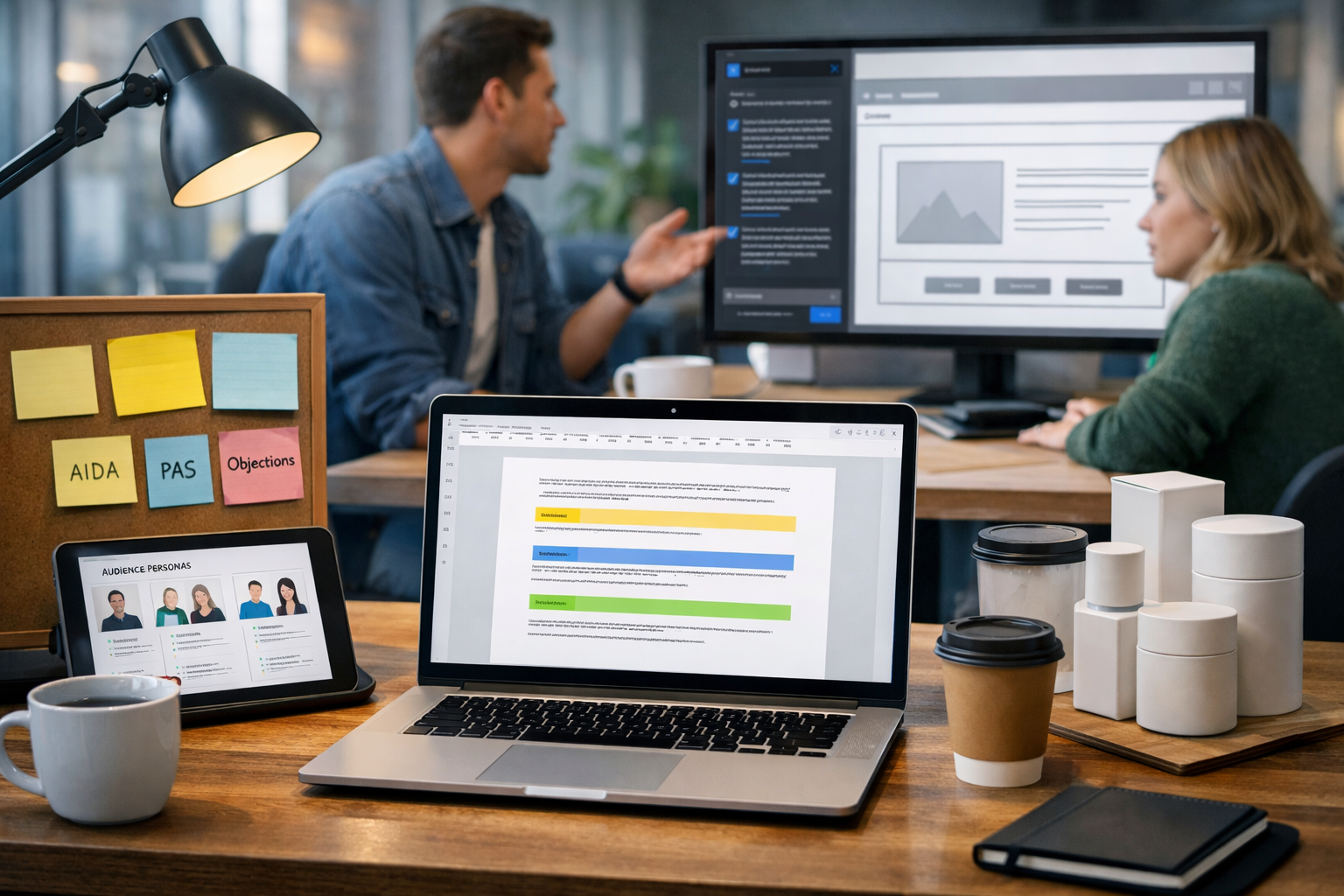
Persuasive sales copy isn’t about hype—it’s about clarity, credibility, and making the next step feel obvious. AI copywriting can help you get there faster, but only if you give the model the right inputs, structure the message with proven frameworks, and validate the result against real customer intent. This guide shows you exactly how to write persuasive sales copy with AI—headlines, landing pages, product descriptions, emails, and ads—using practical templates and examples you can adapt in minutes.
What “persuasive” sales copy really means (and why AI helps)
Persuasive copy moves a reader from “interesting” to “I want this” to “I’ll act now”—without feeling pushed. It works when it matches how buyers make decisions: they seek relevance, evidence, low risk, and a clear path to value.
AI helps because it can:
- Generate multiple angles quickly (benefit-led, problem-led, proof-led).
- Rewrite for different tones and audiences (B2B, DTC, technical, premium).
- Produce on-brand assets across channels (landing page + emails + ads) consistently.
Gen AI Last brings this together in one place: text for sales pages and campaigns, plus images for hero sections, audio voice-overs for explainers, and short-form videos for ads and product demos. Explore our AI content tools to build a complete conversion funnel from a single brief.
Start with the persuasion inputs: a simple 10-minute brief
Most “bad AI copy” is actually “bad briefing”. Before you generate anything, capture these essentials (you can paste this straight into Gen AI Last as context):
- Offer: What are you selling? What’s included? What’s the price/range?
- Audience: Who is it for? Role, industry, situation, sophistication level.
- Primary pain: What problem do they urgently want solved?
- Desired outcome: What does success look like in their words?
- Unique mechanism: What makes your approach different (process, tech, guarantee, ingredient, method)?
- Proof: Numbers, testimonials, case studies, logos, before/after, demos.
- Objections: Price, time, risk, complexity, trust, “will it work for me?”
- CTA: Buy now, book a call, start free trial, download, sign up.
If you only do one thing: write down the top 5 objections and the evidence you’ll use to neutralise each. That’s where most conversions are won.
Three proven frameworks for persuasive sales copy (with AI prompts)
Frameworks keep your message logical and buyer-focused. Use one as your “spine”, then let AI generate variations for different channels.
1) PAS: Problem → Agitate → Solution
Best for: cold traffic, awareness-stage audiences, pain-driven products.
- Problem: Name the pain clearly.
- Agitate: Show cost of inaction (time, money, stress, missed opportunities).
- Solution: Present your offer as the obvious next step.
AI prompt (paste into Gen AI Last):
Write PAS sales copy for a [landing page section/email/ad]. Audience: [who]. Problem: [pain]. Agitate with realistic consequences (no fearmongering). Solution: [offer] using [unique mechanism]. Include 3 benefit bullets, 1 proof point, and a clear CTA. Tone: [tone]. British English.
2) AIDA: Attention → Interest → Desire → Action
Best for: landing pages, product pages, email sequences.
- Attention: A specific promise or bold insight.
- Interest: Why it matters now; how it works at a high level.
- Desire: Outcomes, proof, differentiation, reduced risk.
- Action: One clear next step and what happens after.
AI prompt:
Create AIDA copy for a sales page for [product]. Include: 10 headline options, a hero subheading, 5 benefit bullets (outcome-led), a short “how it works” section, a proof section (use placeholders if needed), an objections/FAQ section, and 3 CTAs. Keep sentences crisp, avoid buzzwords, British English.
3) Jobs-to-be-Done (JTBD): Situation → Motivation → Expected outcome
Best for: crowded markets where differentiation matters. JTBD copy mirrors what buyers are “hiring” your product to do.
AI prompt:
Write sales copy using a JTBD angle. Audience: [who]. Situation: when they [context]. Motivation: they want to [motivation]. Expected outcome: so they can [desired result]. Produce: 1 positioning statement, 6 feature-to-outcome mappings, 5 customer-voice lines (quotes), and a CTA section. British English, confident and specific.
How to structure a high-converting sales page (section by section)
A persuasive page answers questions in the order buyers ask them. Here’s a battle-tested structure you can generate in Gen AI Last and then refine with your real proof.
1) Hero section: promise + audience + outcome
Your hero should do three things: say who it’s for, what it does, and why it’s better. Avoid vague claims like “revolutionary” or “next-gen”.
- Headline formula: Get [outcome] without [common pain]—even if [constraint].
- Subheading: What it is + who it’s for + how it works (one sentence).
- CTA: One primary action; one secondary action (optional).
Example (SaaS): “Write sales emails your team can send today—without starting from a blank page.”
2) Problem and stakes: show you understand their world
Make it specific. Name the moments that trigger frustration (missed deadlines, low response rates, ad spend wasted). Then quantify stakes if you can: hours lost, pipeline impact, opportunity cost.
3) The mechanism: what makes you different
Persuasion increases when your solution feels distinctive. “AI-powered” is not a mechanism by itself. A mechanism is your method: templates, workflow, review system, ingredients, or process.
For Gen AI Last users, a strong mechanism might be: “One brief generates your landing copy, ad creatives, voice-over, and explainer video—consistent across every channel.”
4) Benefits (outcomes) anchored to proof
Benefits should be measurable and customer-centric. A simple pattern: Outcome + timeframe + how.
- Ship a complete campaign in an afternoon by generating page copy, emails, and ads from one prompt.
- Improve message consistency with on-brand variations and tighter editing.
- Reduce production bottlenecks by creating images, video, and audio in the same workspace.
5) Social proof and credibility
If you have proof, put it near the claim it supports. If you don’t yet, use credible substitutes: process screenshots, sample outputs, before/after rewrites, founder story, or transparent benchmarks.
6) Objections and risk reversal (FAQ, guarantees, clarity)
Don’t hide the hard questions. Address them head-on with specifics: what’s included, what isn’t, how long it takes, and who it’s not for.
- Price objection: Compare cost to alternatives (agency, freelancer, tool stack).
- Quality objection: Explain your review/edit workflow and provide examples.
- Time objection: Show a “10-minute setup → 30-minute output” workflow.
If your offer is price-sensitive, clarity sells. For Gen AI Last, you can explicitly anchor value with view pricing from $10/month—full access to text, image, audio, and video generation.
AI copywriting workflow: generate, select, then edit like a pro
Use AI to produce options, but use human judgement to choose and refine. Here’s a repeatable workflow that keeps quality high.
Step 1: Generate 10 variants, not 1
Ask for diversity (angles, tones, lengths). You’re hunting for the best “idea”, not perfect wording on the first attempt.
Prompt add-on: “Create 10 distinct angles: speed, reliability, ease of use, cost, social proof, differentiation, premium quality, beginner-friendly, expert-grade, risk-free.”
Step 2: Score variants against a persuasion checklist
- Relevance: Does it clearly speak to the target audience?
- Specificity: Any numbers, timeframes, concrete deliverables?
- Credibility: Are claims supportable with proof?
- Clarity: Could a tired reader grasp it in 5 seconds?
- Momentum: Does each line lead naturally to the next?
Step 3: Edit for customer voice (not brand ego)
Swap internal jargon for the words customers use. If you have reviews, sales calls, or support tickets, feed a few anonymised lines into Gen AI Last and ask it to mirror that language while staying accurate.
Prompt: “Rewrite this copy using the customer’s words from these quotes: [paste]. Keep meaning identical, remove hype, British English.”
Step 4: Add proof, friction removers, and a stronger CTA
AI can draft, but you must supply proof. Add at least one of: a testimonial, a screenshot, a metric, a demo video, or a specific guarantee/commitment.
Persuasive copy examples you can adapt (headlines, bullets, CTAs)
Use these as patterns. Replace the brackets with your specifics.
Headline patterns
- “Create [result] in [timeframe]—without [objection].”
- “The simplest way for [audience] to [desired outcome].”
- “Turn [painful input] into [valuable output] with a repeatable workflow.”
Benefit bullets (feature → outcome)
- Templates and frameworks: Ship copy that follows proven structures instead of guessing.
- Multi-format generation: Keep your landing page, emails, and ads aligned across the funnel.
- Fast iteration: Test new angles quickly when performance drops.
CTA patterns that reduce friction
- “Generate your first draft now” (clear and low commitment)
- “See examples for your industry” (curiosity + relevance)
- “Start free, then upgrade when it works” (risk reversal)
If you want to trial the workflow immediately, start creating for free and generate a landing page draft plus email follow-up in the same session.
Use AI beyond text: add images, video, and audio to increase conversions
Persuasion improves when the message is reinforced visually and verbally. Gen AI Last lets small teams create the supporting assets without a bloated tool stack.
AI images: visual proof and faster comprehension
Use AI images to create:
- Hero visuals that show the outcome (not abstract tech art).
- Feature callouts (e.g., dashboard-style mock-ups, device scenes).
- Social ad creatives aligned to your copy angle.
AI video: explain the mechanism and remove doubt
Short explainers and product demos often outperform long text for sceptical audiences. Turn your “how it works” section into a 20–45 second reel: hook → problem → mechanism → proof → CTA.
AI audio: voice-overs that build trust
A calm voice-over can make a demo feel more credible and polished. Use it for walkthroughs, ads, or onboarding sequences, especially if your audience prefers listening.
Common AI copywriting mistakes (and how to avoid them)
- Vague promises: Replace “boost productivity” with a specific outcome and scenario.
- Feature dumping: Translate features into outcomes and user moments.
- Generic tone: Provide customer quotes and competitor positioning; ask for distinct voice.
- Over-claiming: Keep claims provable; add “typical results” language when needed.
- No CTA clarity: One primary action per page section; remove competing buttons.
A ready-to-use “persuasive sales copy” master prompt
Copy and customise this in Gen AI Last for consistently strong outputs:
Master prompt: You are a conversion copywriter. Write persuasive sales copy for [offer] aimed at [audience]. Context: [market], [price], [competitors]. Customer pains: [list]. Desired outcomes: [list]. Unique mechanism: [explain]. Proof available: [testimonials/metrics/case studies]. Objections: [list]. Voice: [tone], British English, short sentences, no clichés. Deliver: (1) 12 headline options, (2) hero section copy with CTA, (3) benefits section with 6 bullets (outcome-led), (4) “how it works” in 3 steps, (5) proof section placeholders, (6) objections/FAQ with concise answers, (7) 5 CTA variants, (8) a 5-email follow-up sequence (subject lines + body). Provide two versions: one for cautious buyers, one for fast movers.
Putting it all together: a simple weekly optimisation routine
Persuasive copy is built through iteration. Each week:
- Pick one page or email to improve (not everything at once).
- Choose one lever: headline, offer clarity, proof placement, objection handling, or CTA.
- Generate 5–10 variants in Gen AI Last and select the top 2.
- Run an A/B test (or rotate variations weekly if traffic is low).
- Keep the winner and repeat.
When you combine disciplined frameworks with fast AI iteration, you don’t just write more copy—you learn what your customers actually respond to.
Create persuasive sales copy faster with Gen AI Last
Gen AI Last is built for startups and small teams that need high-quality sales assets without the agency overhead. Generate your landing pages, product descriptions, email campaigns, and social ads—then produce matching visuals, voice-overs, and videos from the same brief using our AI content tools. If you’re ready to ship more campaigns with less friction, view pricing from $10/month or start creating for free.
Ready to Create with Generative AI?
Join thousands of creators using Gen AI Last to generate text, images, audio, and video — all from one platform. Start your 7-day free trial today.
Start Free — Try 7 DaysQuick Links
Create AI content from $10/month
View Plans