AI Voice Cloning for Brand Consistency: A Practical Guide
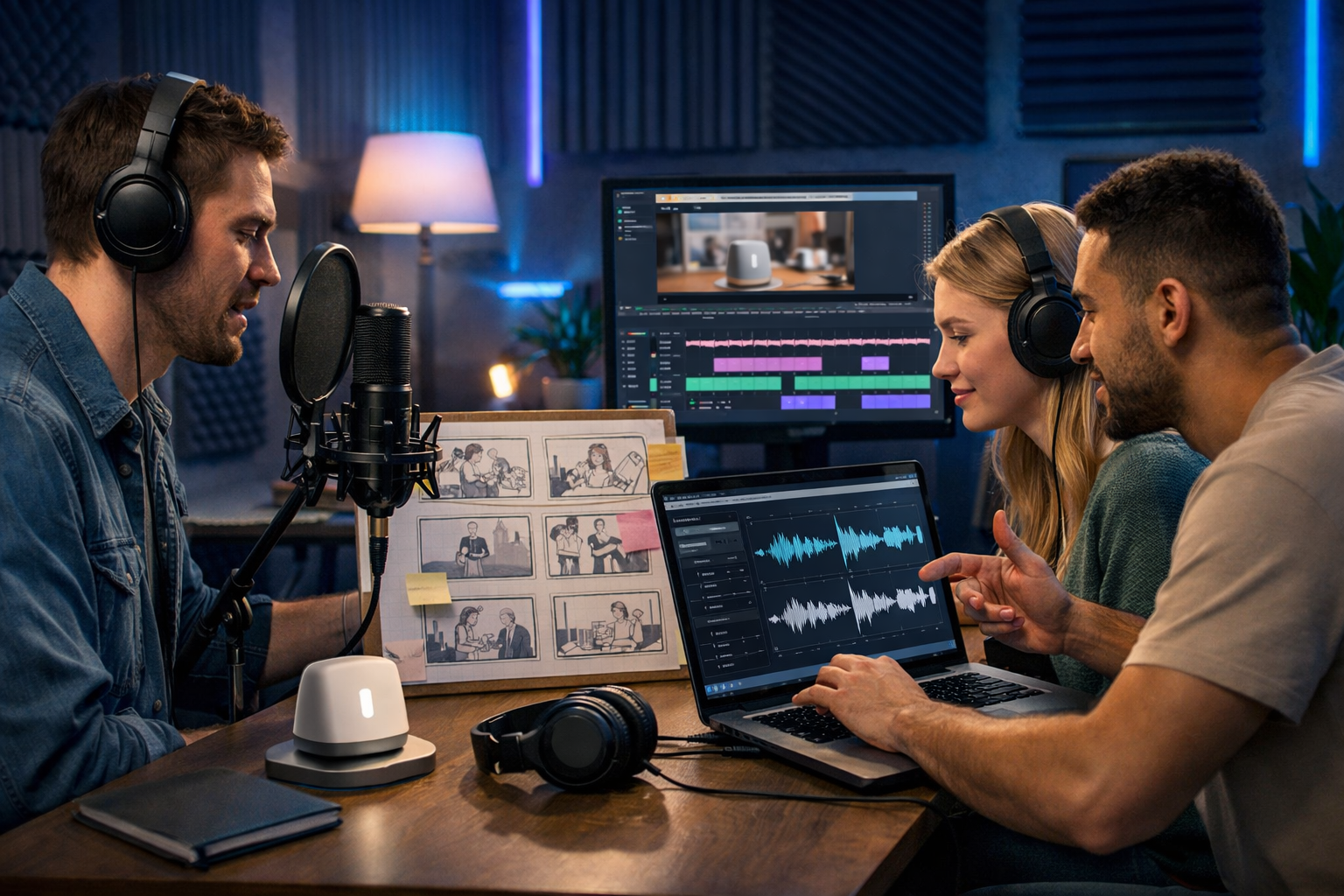
Brand consistency isn’t just visual. It’s the sound of your company every time a customer hears an ad, a product demo, an onboarding video or a support walkthrough. AI voice cloning for brand consistency gives you a repeatable, scalable way to deliver the same recognisable voice across channels—without booking studio time for every single update.
What is AI voice cloning (and why it matters for brand consistency)?
AI voice cloning is the process of creating a synthetic voice that closely matches a real speaker. In practical marketing terms, it means you can generate voice-overs on demand that sound like the same presenter every time, even when you’re producing dozens of assets a week.
Brand consistency relies on repetition and recognisability. If your visuals use the same palette and typography, your audio should follow similar rules: tone, pace, pronunciation, energy, and emotional intent. The more your brand appears across platforms (TikTok, YouTube, podcasts, webinars, in-app tutorials), the more valuable a consistent voice becomes.
Voice consistency is not the same as “a nice voice”
A pleasant voice helps, but consistency is about control and repeatability. Two human recordings done weeks apart can vary due to fatigue, mic differences, background noise, or a slightly different performance. AI voice cloning can reduce those variations—provided you set brand guidelines and quality checks.
Where AI voice cloning fits in a modern content pipeline
Most teams already have a written brand voice guide for copy. Audio usually gets far less structure. Voice cloning works best when it becomes part of a single production system rather than a one-off tool.
With Gen AI Last, small teams can keep everything in one place: scripts with AI text generation, visuals with image generation, voice-overs with AI audio, and finished assets via AI video generation. That matters because brand consistency is easier when your workflow is connected.
Explore our AI content tools to build an end-to-end pipeline for text, visuals, audio and video.
Typical “consistent voice” workflow
- Define your audio brand guidelines (tone, pace, pronunciation, energy, do/don’t).
- Write scripts using a repeatable template (hook, promise, proof, CTA).
- Generate voice-overs with the same voice model, settings and QA checklist.
- Pair with consistent visuals (colours, layouts, motion style) and export video variants.
- Run periodic audits to keep the voice “on brand” as campaigns evolve.
Key benefits of AI voice cloning for brand consistency
Used responsibly, voice cloning can deliver tangible operational advantages, not just “cool AI”.
- Faster production: update product pricing, features or legal copy in minutes, not days.
- Cross-channel consistency: the same voice across ads, reels, explainers, podcasts and help content.
- Lower costs: fewer studio bookings and less editing time for minor revisions.
- Localisation at scale: adapt scripts for regions while keeping the same “speaker identity” (where your tool supports it).
- Continuity: maintain the same voice when your presenter is unavailable, travelling, or between contracts.
Risks and ethical guardrails you must address
Because voice is personal and identity-linked, AI voice cloning comes with higher trust and compliance expectations than many other marketing tools. Brand consistency should never come at the expense of customer trust.
1) Consent and rights management
Only clone voices with explicit permission from the speaker, ideally in writing. Your agreement should cover: allowed use cases (ads, internal training, product content), duration, territories, whether the voice can be modified, and what happens if the speaker leaves.
2) Disclosure and transparency
Depending on region and platform policies, you may need to disclose AI-generated audio. Even when not required, disclosure can protect your brand reputation. A simple approach is to include an “AI-assisted” note in video descriptions or internal documentation.
3) Security and misuse prevention
Treat voice assets as sensitive. Limit access to voice models, store source audio securely, and keep a log of who generated what. If your company has approvals for paid ads, apply the same discipline to audio generation.
4) Quality drift (the consistency killer)
Even with a cloned voice, performance can drift if scripts change in style, or if teams use different pacing, emphasis or mixing settings. Brand consistency requires a standard operating procedure, not just a voice model.
How to create an audio brand guide (simple but effective)
A written “audio brand guide” gives everyone the same target—especially when multiple people generate voice-overs.
- Voice persona: e.g., “calm, knowledgeable, friendly expert—never salesy”.
- Pace: words per minute range, plus when to slow down (pricing, safety notes, key claims).
- Energy level: define baseline and where it can lift (hooks, CTAs) without becoming hype.
- Pronunciation list: product names, founders’ names, acronyms, industry terms.
- Formatting rules: how scripts mark pauses, emphasis, and numbers (e.g., “ten pounds” vs “£10”).
- Mixing standards: loudness target, noise floor expectations, background music policy.
Keep it to one page. If it’s too long, people won’t use it.
Practical use cases: where cloned voice drives consistency
Paid social ads and short-form video
Short-form is iterative: dozens of hooks, variants and retakes. Voice cloning lets you test new scripts while keeping the same recognisable narrator. You can create consistent intros such as “In 30 seconds, here’s how…” while changing only the body copy.
Tip: generate multiple takes with slightly different pacing and emphasis, then keep the winning “delivery style” as your standard for future ads.
Product demos, onboarding and in-app tutorials
Product teams ship updates constantly. If every UI change requires re-recording a presenter, your tutorials will fall behind. Cloned voice makes it practical to keep demos current and consistent—especially for feature walkthroughs and release videos.
Podcasts and branded thought leadership
Some brands use AI voice to create intros/outros, segment bumpers, and consistent narration for solo episodes. The key is to protect authenticity: use a cloned voice for structure and continuity, not to fake interviews or impersonate real people.
Customer support and knowledge base audio
Audio versions of help articles can improve accessibility and reduce friction for customers who prefer listening. With AI voice cloning, every help clip can sound like the same “brand guide”, with consistent tone and calm reassurance.
Step-by-step: implementing AI voice cloning for brand consistency
Use this rollout plan to avoid the most common failure mode: creating a voice model, then producing inconsistent audio because the process is uncontrolled.
Step 1: Choose the “brand voice owner”
Decide whether the brand voice is a founder, a spokesperson, a hired narrator, or a fictional persona voiced by a consenting actor. Prioritise availability, clarity, and a tone that matches your market.
Step 2: Record clean source audio (quality in, quality out)
Even the best AI struggles with poor input. Record in a quiet space with minimal reverb, stable mic placement, and consistent distance. Avoid background music and heavy compression. If you can, capture multiple emotional styles (neutral, enthusiastic, reassuring) so your outputs don’t sound flat.
Step 3: Create script templates for each channel
Your brand should sound consistent, but platform expectations differ. Create templates rather than rewriting from scratch each time:
- Reels/TikTok: hook (0–2s), value (2–15s), proof (15–25s), CTA (last 3s).
- YouTube explainer: problem, why it matters, 3-step solution, recap, CTA.
- Podcast intro: who it’s for, what you’ll learn, credibility cue, subscribe prompt.
Gen AI Last’s AI text generation can speed this up by producing first drafts, variants, and CTA alternatives while keeping your tone guidelines in the prompt. Then your audio output stays consistent because the writing stays consistent.
Step 4: Standardise generation settings and post-production
Create a simple checklist and stick to it:
- Use the same voice model and default speaking style for most assets.
- Set one loudness target (e.g., consistent perceived volume across platforms).
- Choose a background music approach: none, subtle bed, or branded sonic theme.
- Export using consistent file formats and naming conventions.
If you’re producing videos, pair the voice-over with consistent visuals. Gen AI Last can generate marketing visuals and then assemble marketing videos, keeping the look and sound aligned in the same workflow.
Step 5: Add approvals and a lightweight “voice QA” review
Before anything ships, listen for:
- Mispronunciations: brand names, competitor names, locations.
- Odd emphasis: unnatural stress on the wrong word.
- Emotional mismatch: too excited for compliance content, too flat for sales hooks.
- Audio artefacts: glitches, robotic tails, clipped consonants.
Prompting examples: get consistent voice-overs every time
When generating scripts (and then voice), consistency comes from specificity. Use prompts that define delivery, not just content.
Example 1: 30-second product ad script
Script prompt: “Write a 30-second social ad script for a small-business AI platform. Tone: calm, confident, friendly expert. Pace: medium. Avoid hype and exclamation marks. Include one clear benefit, one proof point, and a simple CTA.”
Then generate the voice-over using your cloned voice at the same default speaking style. If you like the take, reuse the exact structure for future ads so the “cadence” becomes recognisable.
Example 2: Onboarding tutorial narration
Script prompt: “Create narration for a 90-second onboarding tutorial. Tone: patient and reassuring. Include short sentences, clear pauses, and pronounce ‘Gen AI Last’ consistently. Use UK English spelling and phrasing.”
Example 3: Podcast intro and outro
Script prompt: “Write a 20-second podcast intro and 15-second outro. Tone: warm, professional, thoughtful. No slang. Include a short positioning statement and a subscribe reminder.”
Measuring whether your brand voice is truly consistent
Consistency isn’t a vibe—it’s something you can evaluate with a repeatable review process.
- Listening panels: ask 5–10 people to rate “sounds like our brand” on a 1–5 scale across different assets.
- Hook retention: for short-form video, compare retention at 1–3 seconds across different narration styles.
- Support deflection: if you add audio help clips, track whether related tickets drop.
- Brand recall: run quick surveys: “Which company do you think this narration belongs to?”
Cost-effective scaling for startups and small teams
Startups often skip audio branding because it feels expensive and time-consuming. But AI makes consistent voice achievable without a large production budget. The key is to keep your tooling simple and your process tight.
Gen AI Last is designed for small teams that need to ship content quickly: generate scripts, voice-overs, visuals and videos in one platform, with full access starting at an affordable monthly price. You can view pricing from $10/month and scale up output without adding new subscriptions for each media type.
Best practices checklist (save this for your team)
- Get written consent and define usage rights for any cloned voice.
- Create a one-page audio brand guide (tone, pace, pronunciation, mixing standards).
- Use script templates per channel to keep cadence consistent.
- Standardise generation and export settings; document them.
- Run voice QA on every asset: pronunciation, emphasis, emotion, artefacts.
- Audit monthly: randomly sample 10 assets and score “on-brand” delivery.
Bring it all together with Gen AI Last
AI voice cloning for brand consistency works best when it’s part of a unified content system: scripts that match your tone, visuals that match your identity, and audio that sounds like “you” every time. Gen AI Last helps you keep those pieces connected—so your marketing stays consistent even as your content output grows.
If you want to test a consistent voice workflow quickly, start creating for free, generate a few script variants, produce matching voice-overs, and compare which delivery style best fits your brand.
Done right, the result is simple: faster production, stronger recognition, and a brand that sounds like itself—everywhere your audience listens.
Ready to Create with Generative AI?
Join thousands of creators using Gen AI Last to generate text, images, audio, and video — all from one platform. Start your 7-day free trial today.
Start Free — Try 7 DaysQuick Links
Create AI content from $10/month
View Plans