AI Voice Cloning for Brand Consistency: A Practical Guide
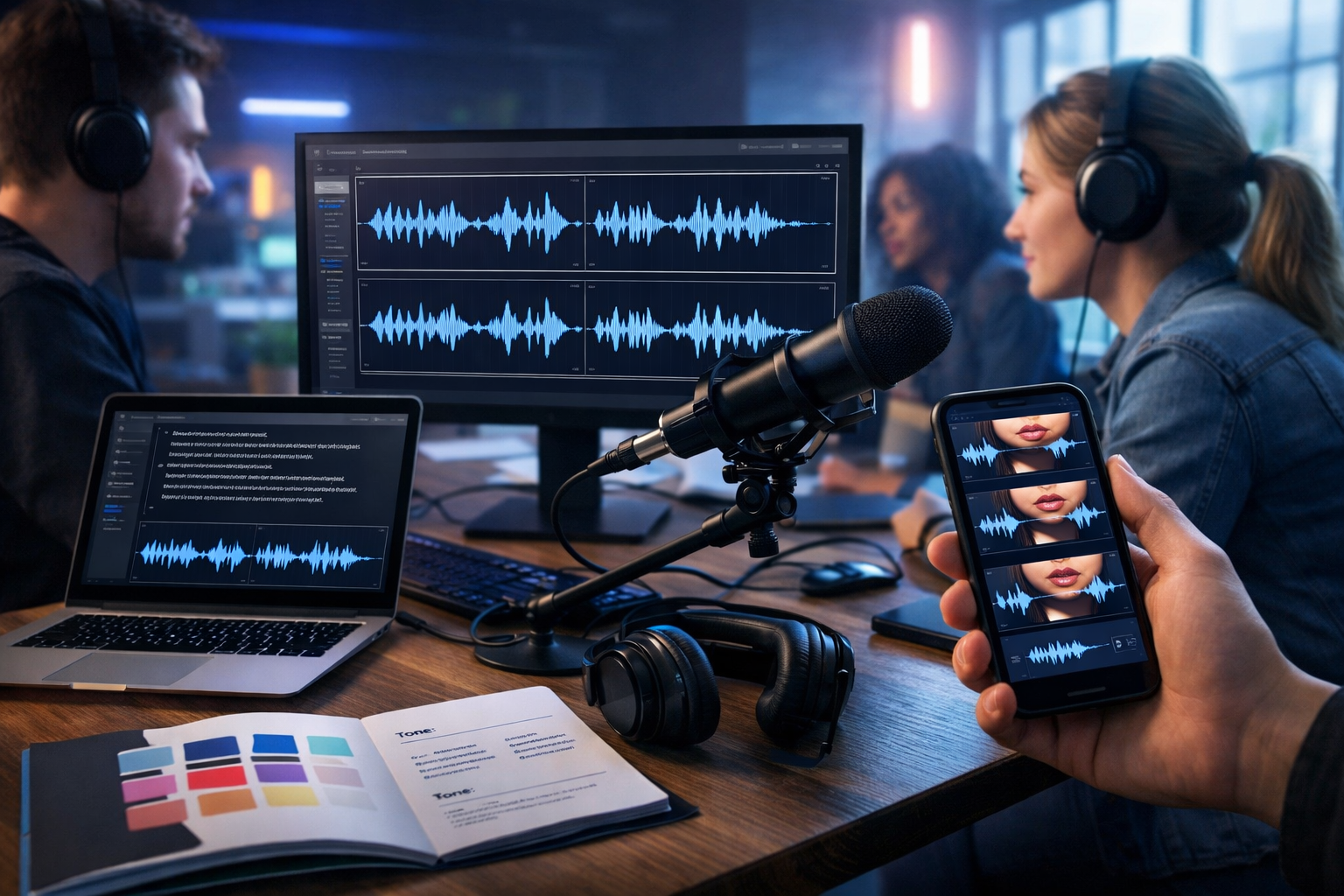
Keeping a brand “voice” consistent is harder than it sounds—especially when you publish across TikTok, YouTube, podcasts, paid ads, onboarding videos and product demos. AI voice cloning for brand consistency solves a real operational problem: it helps you deliver the same recognisable narration style every time, even when deadlines are tight, teams are small, or you need content in multiple formats and languages.
What is AI voice cloning (and what it is not)?
AI voice cloning creates a synthetic voice that closely matches a real speaker’s vocal characteristics—timbre, pacing, accent cues and intonation—so you can generate new speech from text. In practice, you supply a script, choose your cloned voice, and produce voice-overs that sound like your brand’s spokesperson, founder, presenter, or narrator.
It is not simply “text-to-speech”. Traditional TTS voices are generic and often recognisable as the same public voice used by other brands. Voice cloning aims for uniqueness: a distinct voice identity tied to your brand, used consistently across channels.
It is also not a licence to mimic people without permission. Ethical and legal use requires explicit consent and a governance process (covered below).
Why brand consistency depends on audio more than most teams realise
Most brand guidelines focus heavily on visuals: colours, logos, typography, layout. Yet the human brain is highly sensitive to voice. The same script read by different people can feel like different brands. When your audio varies week-to-week, audiences unconsciously perceive your content as less coherent and less trustworthy.
AI voice cloning supports brand consistency because it lets you standardise the parts of audio that are hardest to control at scale:
- Tone and personality: warm and reassuring vs punchy and direct.
- Cadence and pacing: consistent rhythm improves comprehension and recognisability.
- Pronunciation of product names: reduces “brand drift” (e.g., different staff saying your product differently).
- Content velocity: you can ship updates without re-booking studio sessions.
Where AI voice cloning for brand consistency delivers the biggest ROI
Voice consistency matters most in repeatable formats. If you produce any of the following regularly, you will feel the difference quickly:
- Paid social ads: keep the “sound” of your ads consistent even when creative concepts change.
- Product demos and onboarding: update one line in the script and regenerate audio instantly when UI changes.
- Explainer videos: maintain a stable narrator voice across a whole series.
- Podcasts and branded shows: consistent intros/outros and sponsor reads, even when hosts are unavailable.
- Multilingual marketing: combine consistent “character” with different languages or regional variants (where supported).
For small teams, the operational benefit can be even bigger than the cost benefit: fewer dependencies, fewer reshoots, and faster iteration.
How to set your brand up for voice consistency (before you clone anything)
The best results come from treating your voice like a brand asset. Before you generate a cloned voice, define an “audio identity” that can be measured and repeated.
1) Define your audio brand guidelines
Create a one-page audio guideline that your whole team can follow. Include:
- Voice persona: e.g., “confident, friendly, concise, never snarky”.
- Energy level: low, medium, high—by channel (ads vs onboarding vs help centre).
- Pacing: target words per minute (even a rough range helps).
- Pronunciation list: product name, founders’ names, feature names, industry terms.
- Do/Don’t examples: a few lines of approved and rejected reads.
2) Choose the right “source voice” for long-term use
The voice you clone becomes part of your identity. Choose someone who:
- Represents the brand well and is comfortable being the “sound” of the company.
- Can commit to a consent agreement that covers where and how the voice may be used.
- Has clear diction and a stable, natural speaking style (less variability means better cloning).
Many brands use a founder voice for authenticity, but a professional narrator can be a safer operational choice if founders’ availability or future involvement is uncertain.
A practical workflow: from script to consistent voice-over
A repeatable workflow prevents “voice drift” as your content library grows. Here is a process that works well for startups and small marketing teams.
Step 1: Write scripts in a consistent house style
Voice consistency starts with writing. If one script is formal and another is full of slang, even the same voice will feel inconsistent. Use a templated structure for recurring formats (ads, demos, reels).
With our AI content tools, you can generate and standardise scripts for multiple channels—blog-to-video scripts, ad variations, onboarding narration, and email copy—while keeping the same tone guidelines. A simple practice is to store a “brand voice prompt” that includes tone, sentence length, banned phrases, and vocabulary preferences.
Step 2: Create (or approve) a single canonical pronunciation sheet
Every brand has tricky words: product names, acronyms, non-English terms. Put the approved pronunciations in one place and update it whenever a new term is introduced. This reduces rework and helps new team members ship content quickly without guesswork.
Step 3: Generate the voice-over and test it against a quality checklist
When generating audio, don’t just ask “does it sound good?”. Ask “does it sound like us?”. Use a checklist:
- Brand tone: is it calm, helpful, confident—without sounding salesy or robotic?
- Pacing: does it match the channel? Ads often need faster pacing than onboarding.
- Emphasis: are the key benefits stressed naturally?
- Pronunciation: are brand terms correct and consistent?
- Noise and artefacts: no glitches, warbling, or clipped syllables.
If you notice repeated issues (for example, the voice consistently over-emphasises certain words), adjust your script punctuation and phrasing. Shorter sentences, clearer commas, and intentional line breaks often produce more natural results.
Step 4: Pair your audio with consistent visuals and video
Brand consistency is multi-sensory: your audio should match your visuals. If your narration is premium and minimal, your visuals should not be chaotic. Gen AI Last helps small teams move fast here because you can generate matching assets—scripts (text), voice-overs (audio), thumbnails/graphics (images), and reels/explainers (video)—from one workspace. That reduces the mismatch that happens when each asset is produced in isolation.
Step 5: Maintain a “voice library” for scale
Create a shared folder of reusable elements:
- Intro/outro lines for different series
- Call-to-action lines (subscribe, book a demo, download)
- Legal disclaimers and standard compliance lines
- Common feature descriptions (so every demo uses the same phrasing)
This is where brand consistency compounds: you stop reinventing your own messaging and your audio stays coherent across campaigns.
Examples: what “consistent” sounds like in real brand scenarios
Below are practical examples you can adapt. The goal is not to sound identical in every context, but to sound unmistakably like the same brand.
Example 1: SaaS onboarding (calm, clear, reassuring)
Script snippet: “Welcome back. In the next 30 seconds, we’ll show you how to create your first report and share it with your team. If you get stuck, you’ll find help tips on the right-hand side.”
Consistency cue: medium pace, low pressure, minimal hype, clear step-by-step delivery.
Example 2: Paid social ad (punchy, confident, benefit-led)
Script snippet: “Stop rewriting the same content every week. Generate blog posts, visuals, voice-overs and videos in minutes—without losing your brand style.”
Consistency cue: higher energy, shorter sentences, sharper emphasis—same voice identity.
Example 3: Podcast intro (warm, familiar, recognisable)
Script snippet: “You’re listening to [Show Name], where we share practical ways to grow with AI—without adding complexity. Let’s get into today’s episode.”
Consistency cue: same signature greeting, same pacing, same closing line, every episode.
Ethics, consent, and legal safety: non-negotiables
Voice cloning is powerful, which is exactly why brands must handle it responsibly. This section is about reducing risk and protecting trust.
Get explicit written consent
Always obtain permission from the person whose voice will be cloned. Your agreement should cover usage rights (channels, territories), duration, whether the voice can be used in paid advertising, and what happens if the person leaves the company.
Be transparent where appropriate
In many contexts—especially customer support, regulated industries, or sensitive topics—consider disclosing that narration is AI-generated. Transparency protects brand trust and reduces reputational risk.
Avoid impersonation and misleading content
Never use a cloned voice to mimic public figures, competitors, or anyone without consent. Also avoid using a familiar voice to imply a personal endorsement or “live” message when it is scripted content.
Secure your voice assets
Treat voice models and high-quality voice recordings like sensitive brand assets. Limit access, use strong account security, and keep an internal log of who generated audio and where it was published.
Common pitfalls (and how to fix them)
Even good voice cloning can fail brand consistency if the process is sloppy. Here are the most common mistakes.
Pitfall 1: Changing tone between scripts
Fix: Use a brand voice writing guide and a script template per channel. If you’re producing at volume, generate first drafts with consistent instructions and then edit for clarity.
Pitfall 2: Over-processing audio (or mixing inconsistent music)
Fix: Use a standard audio chain (volume targets, light compression) and a small set of approved background music tracks. If you produce video content, keep music levels consistent so the voice remains the hero.
Pitfall 3: Inconsistent pronunciation of brand terms
Fix: Maintain a pronunciation sheet and require a quick QA listen before publishing. One mispronounced product name repeated across ads can undo credibility fast.
Pitfall 4: Too many “near-identical” voices
Fix: Start with one primary brand voice. Add a second voice only when there is a clear purpose (e.g., a support voice vs an energetic ads voice). Document where each is allowed.
How Gen AI Last helps you produce consistent branded audio (and more)
Brand consistency rarely fails because of one tool—it fails because of fragmented workflows. Gen AI Last is designed as an all-in-one platform so your team can create cohesive campaigns without juggling multiple subscriptions.
- AI Text Generation: generate scripts, ad copy, product descriptions and email campaigns that match your brand’s tone.
- AI Audio Generation: produce voice-overs, narration and even background music to keep your audio identity consistent.
- AI Video Generation: turn your scripts and audio into explainers, product demos and social reels.
- AI Image Generation: create supporting visuals (thumbnails, social graphics, banners) that match your audio tone with consistent creative direction.
For startups and small teams, the key is that everything is available from $10/month with full access across text, image, audio and video—so you can build a consistent output without enterprise overhead. You can view pricing from $10/month and choose a plan that fits your publishing cadence.
A simple implementation plan (first 7 days)
If you want to operationalise AI voice cloning for brand consistency quickly, follow this lightweight plan.
- Day 1: Draft audio brand guidelines (persona, pace, pronunciation list).
- Day 2: Select your source voice and secure written consent.
- Day 3: Create three scripts: one ad, one demo, one onboarding clip—same tone rules.
- Day 4: Generate voice-overs and run the QA checklist; revise scripts where needed.
- Day 5: Produce one short video and one static social post to match the audio.
- Day 6: Build a small “voice library” of approved intro/outro and CTA lines.
- Day 7: Publish, measure retention/watch time, and document what worked.
FAQs: AI voice cloning for brand consistency
Will AI voice cloning make our content sound robotic?
It can if scripts are unnatural or you skip QA. The best results come from conversational writing, intentional punctuation, and a consistent style guide. Treat it like production, not a one-click shortcut.
Is it better to clone a founder voice or hire a narrator?
A founder voice can add authenticity; a narrator can add stability and long-term continuity. The best choice depends on your brand risk tolerance, content volume, and whether the founder wants their voice used in paid marketing.
How do we keep voice consistent across languages?
Start by keeping the same persona, pacing and structural script template across regions. Use native review for translations and maintain a regional pronunciation list for local terms and names.
Next steps: build a voice that scales with your brand
AI voice cloning for brand consistency is most effective when it is treated as a brand system: one voice identity, clear guidelines, reusable script patterns, and a QA process. Done well, it helps you ship more content without diluting trust.
If you want to put this into practice quickly, explore our AI content tools and align your scripts, audio and videos in one workflow. When you’re ready, you can start creating for free and test a consistent voice-over across your next campaign.
Ready to Create with Generative AI?
Join thousands of creators using Gen AI Last to generate text, images, audio, and video — all from one platform. Start your 7-day free trial today.
Start Free — Try 7 DaysQuick Links
Create AI content from $10/month
View Plans