AI Voice Cloning for Brand Consistency: A Practical Guide
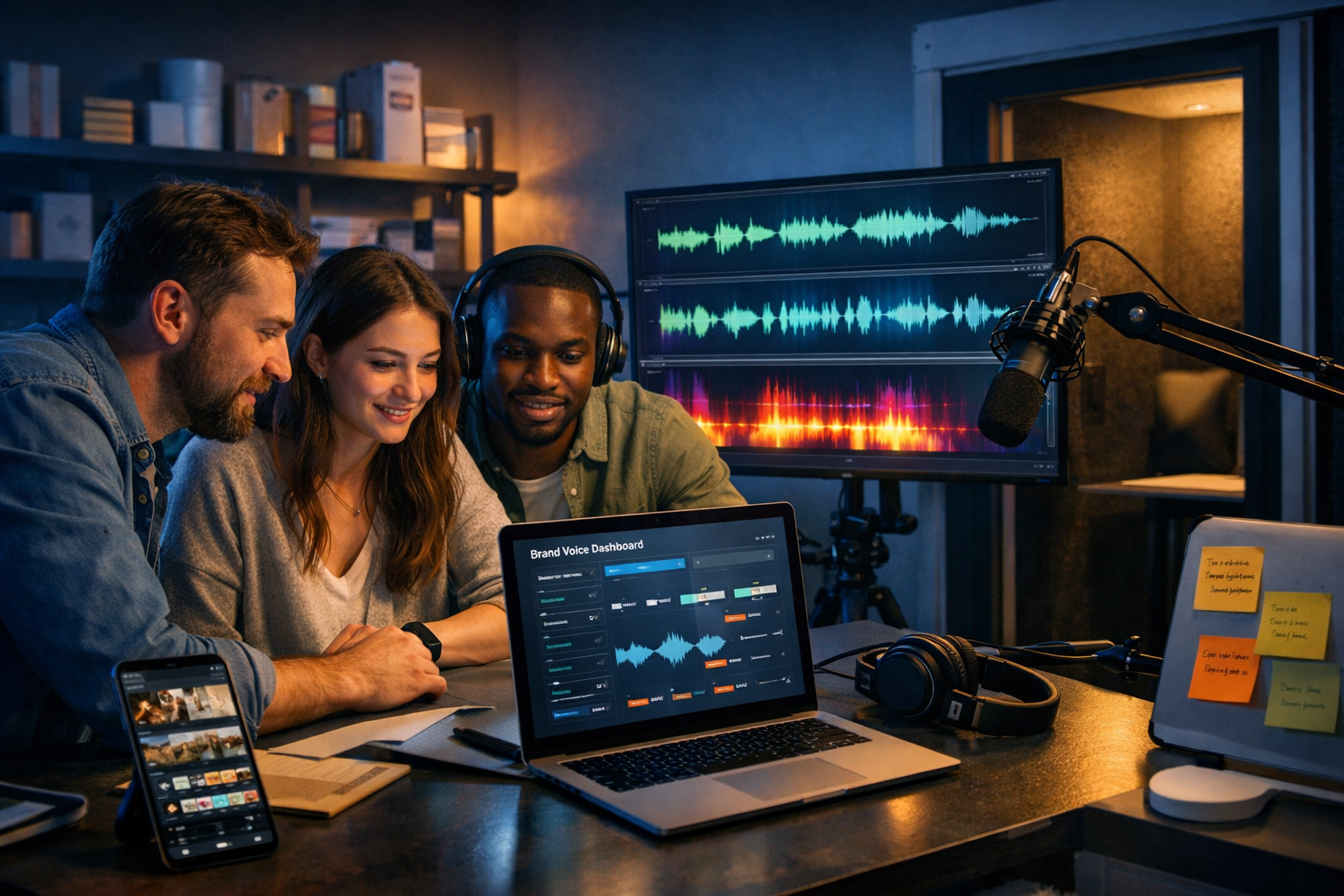
Brand consistency isn’t only visual. If your social reels sound like one person, your explainer videos sound like another, and your training content is narrated in a completely different style, audiences notice—even if they can’t explain why. AI voice cloning for brand consistency lets you create a dependable “sonic identity” so every piece of content (from ads to product demos) sounds like it comes from the same brand, without booking a studio session every time.
What is AI voice cloning (and what it isn’t)?
AI voice cloning uses machine learning to synthesise speech that matches the characteristics of a specific voice: tone, pacing, pronunciation, accent, and subtle vocal quirks. When used responsibly, it’s a production tool—similar to using a brand font—designed to keep output consistent across channels and teams.
What it isn’t: a shortcut to impersonate people without permission, or a “magic button” that guarantees perfect performance in every context. You still need strong scripts, clear pronunciation rules, and quality control.
Why brand voice consistency matters in 2026 marketing
Most brands now publish across multiple formats: landing pages, newsletters, short-form videos, podcasts, webinars, onboarding flows, help centre articles, and in-product walkthroughs. Visual brand systems are well established; audio branding is often an afterthought—until growth creates fragmentation.
AI voice cloning for brand consistency helps you:
- Maintain recognition across platforms, even when content is produced by different team members or agencies.
- Scale output without repeatedly scheduling a voice actor for every update, localisation, or A/B test.
- Reduce production friction for fast-moving campaigns where timing matters as much as quality.
- Support accessibility by adding narration to articles, product docs, and training materials.
Ideal use cases: where voice cloning improves consistency
Voice cloning shines when you need the same “speaker” repeatedly, with frequent updates. Common high-impact scenarios include:
- Marketing videos and social reels: consistent hooks, CTAs, and pacing across a whole campaign.
- Product demos and explainers: updated features can be narrated without rebooking talent.
- Podcast intros/outros: keep the show identity steady, even if episodes vary in format.
- Training and onboarding: consistent narration across modules, with easy revisions.
- Customer support content: narrated FAQs and troubleshooting walk-throughs that match your brand tone.
If your brand relies heavily on “founder voice” content, voice cloning can help scale that presence—provided you have explicit consent and a clear governance model.
The key ingredients of a consistent brand voice (audio edition)
Brand consistency isn’t only “same voice model”. It’s a repeatable set of choices:
- Vocal identity: one core voice (or a small set) aligned to your brand persona.
- Performance rules: pace, energy level, warmth, confidence, humour boundaries.
- Pronunciation standards: product names, competitor names, technical terms, acronyms.
- Script style: sentence length, rhythm, preferred transitions, call-to-action phrasing.
- Audio mix: loudness targets, EQ, compression, background music style and levels.
Voice cloning gives you the first ingredient (vocal identity) and makes the rest easier to standardise—if you build a workflow around it.
How to build a safe, repeatable workflow for AI voice cloning
A reliable workflow prevents the two most common failures: (1) “It sounds inconsistent across clips”, and (2) “We’re not sure we’re allowed to do this.” Use this production pipeline as a baseline.
1) Decide whose voice represents the brand
You have three common options:
- Founder/executive voice: strong authenticity, but higher risk if the person leaves the company.
- Employee spokesperson: good for product-led teams; ensure role continuity and consent.
- Commissioned “brand voice” talent: often the best long-term choice; contract can include voice-clone rights and renewal terms.
Whichever you choose, treat it like a brand asset with ownership, permissions, and a succession plan.
2) Capture clean source audio (quality in = quality out)
Your clone is only as good as the data used to create it. Aim for clean, dry recordings:
- Record in a quiet space (soft furnishings help reduce reverb).
- Use a decent microphone (even a good USB mic can work).
- Maintain consistent distance from the mic and stable input levels.
- Read a variety of sentences (short, long, questions, excitement, calm).
If you’re planning multilingual output, capture samples that cover likely phonetics, and document how the brand pronounces product names.
3) Write a “Voice Style Guide” (two pages beats none)
Create a simple guide your team can follow. Include:
- Persona adjectives: e.g., calm, knowledgeable, optimistic, not salesy.
- Pace: target words per minute (or example clips that match the tempo).
- Energy scale: 1–5 for different contexts (support vs. ads).
- Pronunciation dictionary: key terms and how to say them.
- Do/Don’t examples: preferred CTA phrasing and what to avoid.
This is the difference between “random AI narration” and genuine brand consistency.
4) Build scripts the voice can perform
Even the best model will sound robotic if the script reads like a legal disclaimer. For brand-consistent voice-overs:
- Write for the ear: shorter sentences, fewer parentheses, fewer stacked clauses.
- Use signposting: “First… Next… Finally…” to improve comprehension.
- Control emphasis: bold in script drafts (or add notes) for the one idea per sentence.
- Don’t overpack CTAs: one clear action beats three rushed actions.
Gen AI Last helps here because you can generate and iterate scripts quickly using AI text generation (blog-to-script rewrites, short-form hooks, variations for A/B tests) and then move straight into audio creation. Explore our AI content tools to keep text, audio, and video production in one place.
5) Add QA checks before anything goes public
Create a checklist that every exported audio clip must pass:
- Pronunciation: product names, people, locations, acronyms.
- Prosody: natural pauses, no rushed sections, no odd stress.
- Brand tone: matches the intended energy level.
- Compliance: required disclaimers are present and clearly spoken.
- Technical: no clipping, consistent loudness, clean ending.
For scale, assign one “audio owner” who reviews the first batch of clips for each campaign, then spot-checks thereafter.
Legal and ethical guardrails you should not skip
Voice cloning sits at the intersection of privacy, IP, consumer trust, and platform policy. The safest brands treat governance as part of the brand system.
Get explicit permission and document it
If the voice is based on a real person, obtain written consent that specifies allowed uses (ads, training, internal comms), geographic scope, duration, and what happens if the relationship ends. If you use paid talent, ensure the contract explicitly covers synthetic voice generation and reuse.
Be careful with “deepfake” risk
Avoid creating voice assets that can be used to mislead. Limit access to the voice model or voice settings to approved team members, and keep an audit trail of where audio is used. Consider adding internal policies that prohibit using the voice for personal messages, political content, or anything outside your agreed brand contexts.
Consider transparency
Depending on your industry, it may be wise (or required) to disclose that voice-overs are AI-generated, especially in regulated contexts. Even when not required, transparency can protect trust if customers later discover the content is synthetic.
Practical examples: voice cloning for consistent multi-channel campaigns
Example 1: A SaaS product launch
You’re launching a new feature and need: a 60-second explainer, three 15-second social ads, and an onboarding walkthrough. With voice cloning, you keep the exact same brand narrator across all assets. The script structure varies (short hooks for ads, deeper explanation for onboarding), but the vocal identity stays consistent.
- Use AI text generation to produce the explainer script plus short versions for each platform.
- Generate voice-over audio in the same style and pacing for each cut.
- Generate a matching video using consistent visuals and captions.
Keeping all steps in one workflow reduces turnaround time and helps smaller teams ship more consistently.
Example 2: An e-commerce brand with weekly promos
Weekly promotions often lead to inconsistent voice-overs because different creators, freelancers, or tools are used. A cloned brand voice solves that: your “promo narrator” remains stable while the products change. Combine this with a fixed music bed and loudness targets to make every ad feel like part of the same series.
Example 3: Training content for a growing team
Internal training libraries are notorious for mismatched quality. With voice cloning, your modules can share one calm, instructional voice. When processes change, you update a paragraph and regenerate that section rather than re-recording an entire video.
How Gen AI Last supports brand-consistent audio at startup-friendly cost
Brand consistency is hard when tools are scattered. Gen AI Last is designed as an all-in-one platform so your team can create scripts, visuals, audio, and videos from prompts—without juggling multiple subscriptions.
- AI text generation: create voice-over scripts, ad variants, email campaigns, product descriptions, and social copy that matches your tone.
- AI audio generation: produce narration, voice-overs, and podcast-style segments to keep output consistent.
- AI video generation: turn your narration into marketing videos, product demos, reels, and explainers.
- AI image generation: create supporting visuals and social graphics that match the same campaign identity.
All plans include full access to text, image, audio, and video generation, which makes it easier for startups and small teams to build a consistent content engine. You can view pricing from $10/month and scale as your output grows.
A step-by-step checklist to implement AI voice cloning for brand consistency
Use this as a practical rollout plan for your first 30 days.
- Define the goal: which channels must sound consistent first (e.g., paid social + product demos).
- Select the voice owner: founder, employee, or contracted talent.
- Get written consent: scope, duration, and approved use cases.
- Record source audio: clean, varied, labelled files.
- Create a voice style guide: energy levels, pacing, pronunciation dictionary.
- Build a script template: intro pattern, value prop, CTA, legal line if required.
- Generate 10 test clips: ads, explainer, onboarding, FAQs.
- Run QA: pronunciation, tone, loudness consistency, clarity on mobile speakers.
- Standardise the mix: set loudness target and music bed rules.
- Document and train: one-page SOP for marketers and editors.
Common pitfalls (and how to avoid them)
Most “it doesn’t sound like our brand” problems come from process issues, not the underlying tech.
- Pitfall: using too many voices. Fix: start with one primary brand voice and add a second only when you have clear roles (e.g., narrator + customer stories).
- Pitfall: inconsistent pronunciation. Fix: maintain a living pronunciation list and bake it into your script review.
- Pitfall: scripts written like blog posts. Fix: rewrite for spoken delivery—shorter sentences, clearer emphasis.
- Pitfall: no loudness standard. Fix: target consistent output levels so ads, demos, and reels feel cohesive.
- Pitfall: unclear permissions. Fix: contract/consent first; restrict access and define approved use cases.
Measuring success: how to know your brand voice is working
Brand consistency is measurable when you pick the right signals:
- Ad performance lift: improved thumb-stop rate and watch time when audio identity is consistent across a series.
- Production speed: fewer bottlenecks and faster iteration for new variants.
- Fewer revisions: reduced “re-record” requests due to stable tone and pacing.
- Brand recall: qualitative feedback that audiences recognise your narration style.
Treat your voice like any other brand asset: review quarterly, update guidelines, and keep a library of “approved” reference clips.
Getting started: create your first consistent voice-led campaign
If you want to test AI voice cloning for brand consistency quickly, start with a simple, repeatable content set: one 30–45 second explainer plus three 10–15 second cut-downs. Write scripts with a single tone target, generate narration, then pair it with visuals and short-form edits. Once the process feels stable, expand into onboarding, FAQs, and longer-form video.
To keep everything streamlined—scripts, visuals, narration, and video output—try Gen AI Last as your unified creation workspace. You can start creating for free and build a brand-consistent content pipeline before committing. When you’re ready to scale, view pricing from $10/month to unlock full access to text, image, audio, and video generation.
Done well, voice cloning doesn’t replace creativity—it removes repetition. That means more time for better ideas, tighter storytelling, and a brand presence people recognise instantly, even with their eyes closed.
Ready to Create with Generative AI?
Join thousands of creators using Gen AI Last to generate text, images, audio, and video — all from one platform. Start your 7-day free trial today.
Start Free — Try 7 DaysQuick Links
Create AI content from $10/month
View Plans