AI Voice Over Comparison: Natural vs Synthetic (2026 Guide)
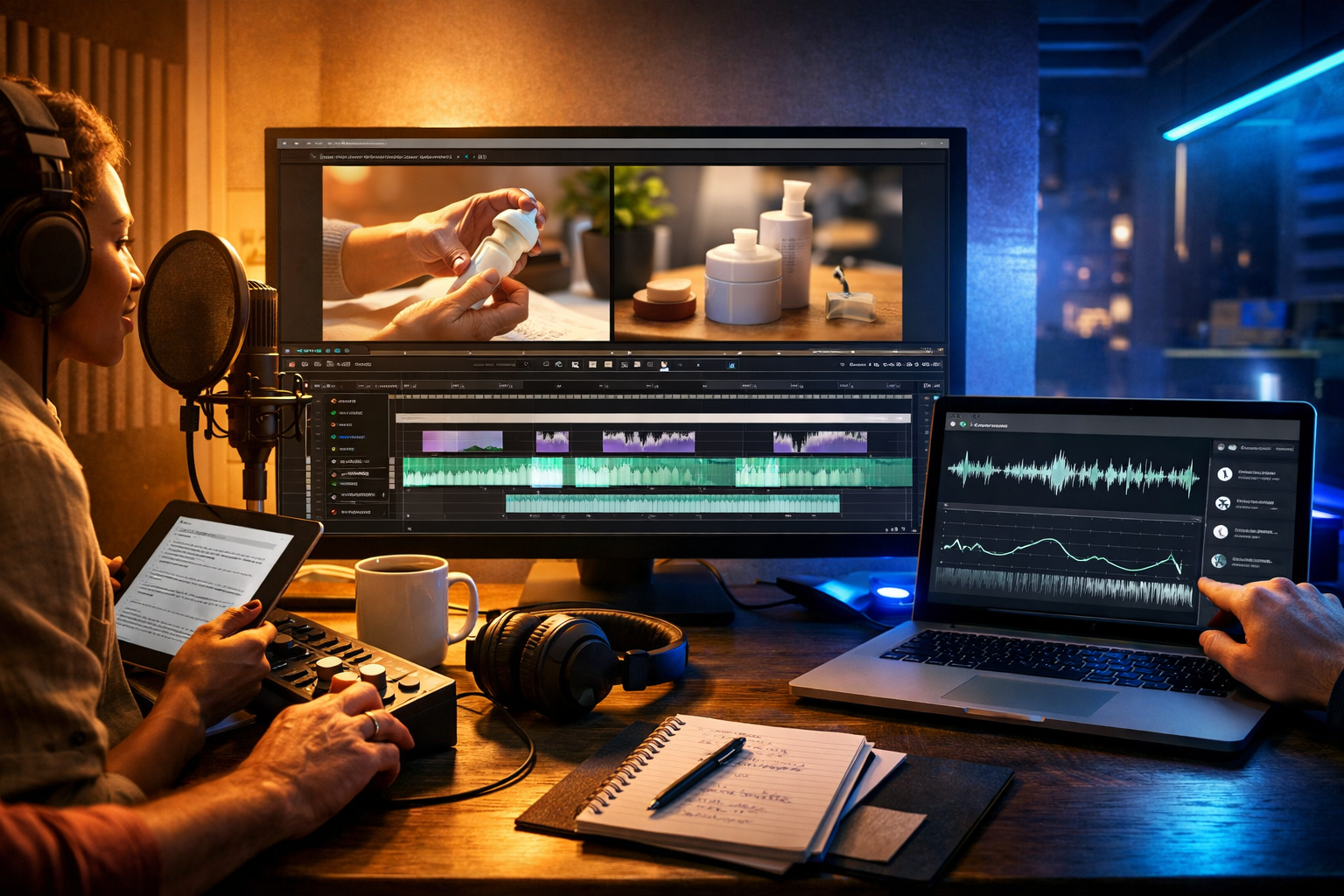
Choosing between a recorded human voice and AI text-to-speech isn’t just a taste decision—it affects budget, turnaround time, brand trust, and even legal risk. This AI voice over comparison (natural vs synthetic) breaks down what each option is best at, where it can fail, and how to decide quickly for marketing videos, e-learning, ads, podcasts, and product demos.
What “natural” and “synthetic” voice-overs really mean
In practice, teams use these terms in three different ways—so it helps to be precise before you compare quality.
- Natural (human-recorded) voice-over: A person records narration in a studio (or a treated home setup). Editing removes mistakes, breaths, and noise.
- Synthetic (AI) voice-over: Text-to-speech (TTS) generates audio from a script. Modern models can sound very human, but are still generated.
- Hybrid: A human voice is recorded for key brand moments (ads, hero videos), while AI voices cover localisation, versions, updates, or internal training.
Gen AI Last focuses on fast, professional creation workflows—meaning you can generate voice-overs, then pair them with AI video, images, and supporting text in one place via our AI content tools.
Quick decision guide: when natural wins vs when synthetic wins
If you need a shortcut, use this rule: go human when trust and nuance are the product; go AI when speed, scale, and iteration are the priority.
- Natural voice-over tends to win for: brand films, emotional storytelling, high-stakes ads, executive messages, character-driven content, premium audio drama.
- Synthetic voice-over tends to win for: product demos, explainer videos, app walkthroughs, internal training, rapid A/B testing, localisation, frequent updates.
AI voice over comparison natural vs synthetic: 10 factors that matter
1) Naturalness and “uncanny” moments
A strong human read has micro-variations—tiny timing shifts, emphasis, and breath patterns that sound effortless. Synthetic voices can sound impressively natural, but may still reveal themselves through slightly too-even pacing, odd emphasis on proper nouns, or a “polished” tone that feels generic.
Practical test: listen for three red flags: mis-stressed words (e.g., “reCORD” vs “REcord”), unnatural pauses around commas, and emotional tone that doesn’t match the sentence.
2) Emotion and persuasion
Human voice excels when the message relies on authentic emotion—apology statements, charity appeals, founder stories, or brand anthems. AI voices can express “moods”, but persuasion often comes from subtle imperfections and lived experience that listeners subconsciously trust.
- Use human: “We’re sorry”, “Here’s why we started”, “This matters”.
- Use AI: “Here’s how it works”, “Step 1–2–3”, “Feature highlights”.
3) Speed and iteration
Synthetic voice-over is built for iteration. If product details change weekly, re-recording humans becomes a scheduling and cost issue. AI lets you update a line, regenerate, and re-sync in minutes—ideal for growth teams testing hooks, CTAs, or offer wording.
With Gen AI Last you can generate the script (text), the narration (audio), and the visuals (image/video) in one workflow, which is especially valuable when you’re producing multiple variations for different channels.
4) Cost over time (not just per project)
A human session can be excellent value for a single high-impact asset. But the “total cost” rises with versioning: new languages, new product names, new compliance lines, seasonal edits, and platform-specific cuts.
- Human cost drivers: talent fees, studio time, revisions, pickups, usage/licensing terms, producer time.
- AI cost drivers: time spent polishing script and pronunciations, QA, and ensuring disclosures/consent where needed.
For startups and small teams, predictable pricing matters. Gen AI Last includes audio, video, images, and text in every plan—view pricing from $10/month—so you can scale content without negotiating separate tools.
5) Brand voice consistency
Humans vary slightly between sessions (energy, mic distance, room sound). That can be charming, but it can also create inconsistency across a library of tutorials. Synthetic voices are consistent by default—ideal for help centres, onboarding series, and documentation videos.
Tip: whichever route you choose, create a “voice style guide”: pace targets (e.g., 145–165 wpm), preferred vocabulary, pronunciation notes for product names, and a do/don’t list for tone.
6) Localisation and multi-language output
Localisation is where synthetic voice-over often dominates. Hiring native voice actors in ten markets is doable, but management heavy. AI can generate consistent voices per language and update every version when the product changes.
- Best for AI localisation: app walkthroughs, feature updates, internal training, knowledge base videos.
- Best for human localisation: brand campaigns where cultural nuance and humour are central.
7) Clarity and intelligibility
AI can be exceptionally clear because it avoids mumbling and keeps volume consistent. However, clarity isn’t only about enunciation—it’s also about emphasis. Humans naturally underline meaning; AI sometimes emphasises the wrong word, which can confuse instructions.
Fix: rewrite sentences to reduce ambiguity. Use shorter clauses, avoid stacked nouns, and put the key action near the start (e.g., “Click ‘Export’ to download your video”).
8) Control: direction, pacing, and revisions
Directing a human voice actor gives you rich control (“more smile”, “less salesy”, “pause longer before the benefit”). AI control is different: you control outcomes mainly through script structure, punctuation, and sometimes style settings.
- For human: provide a creative brief, reference examples, and clarify where to stress key phrases.
- For AI: format the script for speech—use contractions, add breath pauses with punctuation, and write numbers as you want them spoken.
9) Legal, consent, and disclosure considerations
This is a major differentiator in any AI voice over comparison (natural vs synthetic). With human talent, usage rights are typically handled via contracts (where, how long, and in what media you can use the recording). With AI, you must be careful about voice cloning, permissions, and local regulations around synthetic media and advertising disclosures.
- Do: use voices you have rights to, keep records of consent and licensing, and follow platform ad policies.
- Consider: disclosing synthetic voice in sensitive contexts (finance, health, politics) even if not strictly required.
- Avoid: imitating identifiable individuals without explicit permission.
Note: this is general information, not legal advice—check requirements for your region and industry.
10) Audience trust and context
The same synthetic voice can be accepted in a software tutorial and rejected in a memorial tribute video. Audience expectations matter. If your audience expects a real person (coaching, therapy, community-led brands), use natural voice. If they expect fast information (how-tos, product releases), synthetic voice is often welcomed—sometimes preferred.
Use-case recommendations (with examples)
Marketing ads (paid social, YouTube pre-roll)
Recommendation: Human for premium storytelling; AI for rapid testing.
Example workflow: generate 10 hook variations with AI text, produce 10 synthetic voice versions to test, then record one winning script with a human for the final high-spend campaign.
Product demos and explainer videos
Recommendation: Synthetic voice-over is usually the best fit.
Demos change frequently—UI updates, feature names, pricing, compliance lines. AI narration keeps your library current without rebooking talent. Pair narration with AI video generation and b-roll for a polished result.
E-learning and internal training
Recommendation: Synthetic for scale; human for leadership modules.
Use AI voices for consistent lessons and quick updates. Use a real human voice for culture, values, and leadership messaging where authenticity is central.
Podcasts and long-form narration
Recommendation: Human voice is still the trust default; AI is useful for segments.
Consider AI for intros, sponsor reads (where appropriate), or multilingual summaries—while the main episode remains human-led.
How to make synthetic voice-overs sound more natural (practical checklist)
Most “robotic” results come from scripts written for reading, not speaking. Fixing the script often improves naturalness more than switching voices.
- Write for speech: shorter sentences, one idea per line, fewer parentheses.
- Use contractions: “you’ll”, “we’re”, “it’s” (unless your brand is formal).
- Control pacing with punctuation: commas for micro-pauses, full stops for real beats.
- Spell out tricky words: product names, acronyms, and surnames; use phonetic hints if available.
- Remove tongue-twisters: swap similar-sounding word clusters that trip pronunciation.
- Check numbers: decide “twenty twenty-six” vs “two thousand and twenty-six”.
- Add intention: rewrite lines to imply emotion (“Here’s the good part…”) rather than forcing it.
A simple quality rubric you can score in 3 minutes
When comparing takes (human vs AI, or AI voice A vs B), score each from 1–5:
- Intelligibility: can you understand every word on phone speakers?
- Prosody: does emphasis land on the correct words?
- Tone-match: does it fit your brand (friendly, authoritative, calm)?
- Trust: does it feel credible for this topic?
- Editability: how painful is it to change one line?
If synthetic wins on 4 and 5 but loses on 2 and 4, consider a hybrid: keep AI for most lines, then re-record just the sensitive or emotional sections with a human narrator.
End-to-end workflow: script → voice-over → video (fast, consistent, on brand)
Here’s a practical workflow many small teams use to produce consistent content quickly—especially when they can’t afford separate tools, editors, and studios.
- Generate the first script draft: outline the goal, audience, and CTA. Create variants (friendly vs formal, short vs long).
- Rewrite for speech: simplify sentences, add pauses, and make instructions unambiguous.
- Create the AI voice-over: generate 2–3 voice styles, then choose the best rubric score.
- Build visuals: generate supporting images (thumbnails, b-roll stills) and produce a video cut for the platform (Reels, YouTube, LinkedIn).
- QA pass: listen on earbuds and phone speakers; check names, numbers, and claims.
- Publish and iterate: update the script when performance data shows drop-off; regenerate audio and swap in quickly.
Gen AI Last is designed for exactly this kind of integrated pipeline—text, audio narration, images, and video generation all in one. If you want to test it without committing, start creating for free.
Common mistakes to avoid (natural and synthetic)
- Overwriting the script: long sentences and stacked clauses sound worse in both human and AI narration.
- Ignoring room sound: human recordings with echo and noise feel less “pro” than a clean AI voice.
- Using the wrong energy level: tutorials need calm clarity; ads need momentum; finance needs restraint.
- Forgetting version control: keep a master script with timecodes so updates don’t break sync.
- No disclosure strategy: decide when and how you’ll mention synthetic audio for your audience and industry.
Which should you choose?
Use natural voice-over when the voice itself carries your credibility—high-emotion storytelling, sensitive topics, premium positioning, or when your brand identity is tightly linked to a real person. Use synthetic voice-over when you need speed, scale, and frequent updates—product demos, onboarding, training, localisation, and A/B testing.
For many teams, the best answer isn’t “either/or” but “both”: prototype and iterate with AI, then upgrade the highest-value assets with human performance. With Gen AI Last, you can create the script, narration, and accompanying visuals in one place using our AI content tools, and keep your production costs predictable as you grow—view pricing from $10/month.
FAQ: AI voice over comparison natural vs synthetic
Is synthetic voice-over “good enough” for marketing?
Often, yes—especially for direct-response ads, product explainers, and social content where speed and testing matter. For brand films and high-trust messaging, human narration still tends to perform better.
Will people notice it’s AI?
Some audiences won’t; others will, particularly if emphasis or pacing is off. The script quality and context matter as much as the voice model.
What’s the best way to improve AI voice realism?
Rewrite for speech, control pacing with punctuation, and avoid awkward phrasing. Treat the script like performance directions, not like an article.
Can I use AI voice-over for multiple platforms?
Yes. Create one master narration, then generate shorter cuts for Reels/TikTok, longer versions for YouTube, and variations for different audiences. Integrated tools make versioning far quicker.
Is there a safe “default” choice?
If you’re unsure, start with AI to prototype quickly, then switch to human narration for the assets that prove they drive the most revenue or brand impact.
Ready to Create with Generative AI?
Join thousands of creators using Gen AI Last to generate text, images, audio, and video — all from one platform. Start your 7-day free trial today.
Start Free — Try 7 DaysQuick Links
Create AI content from $10/month
View Plans