AI voice over comparison: natural vs synthetic (2026)
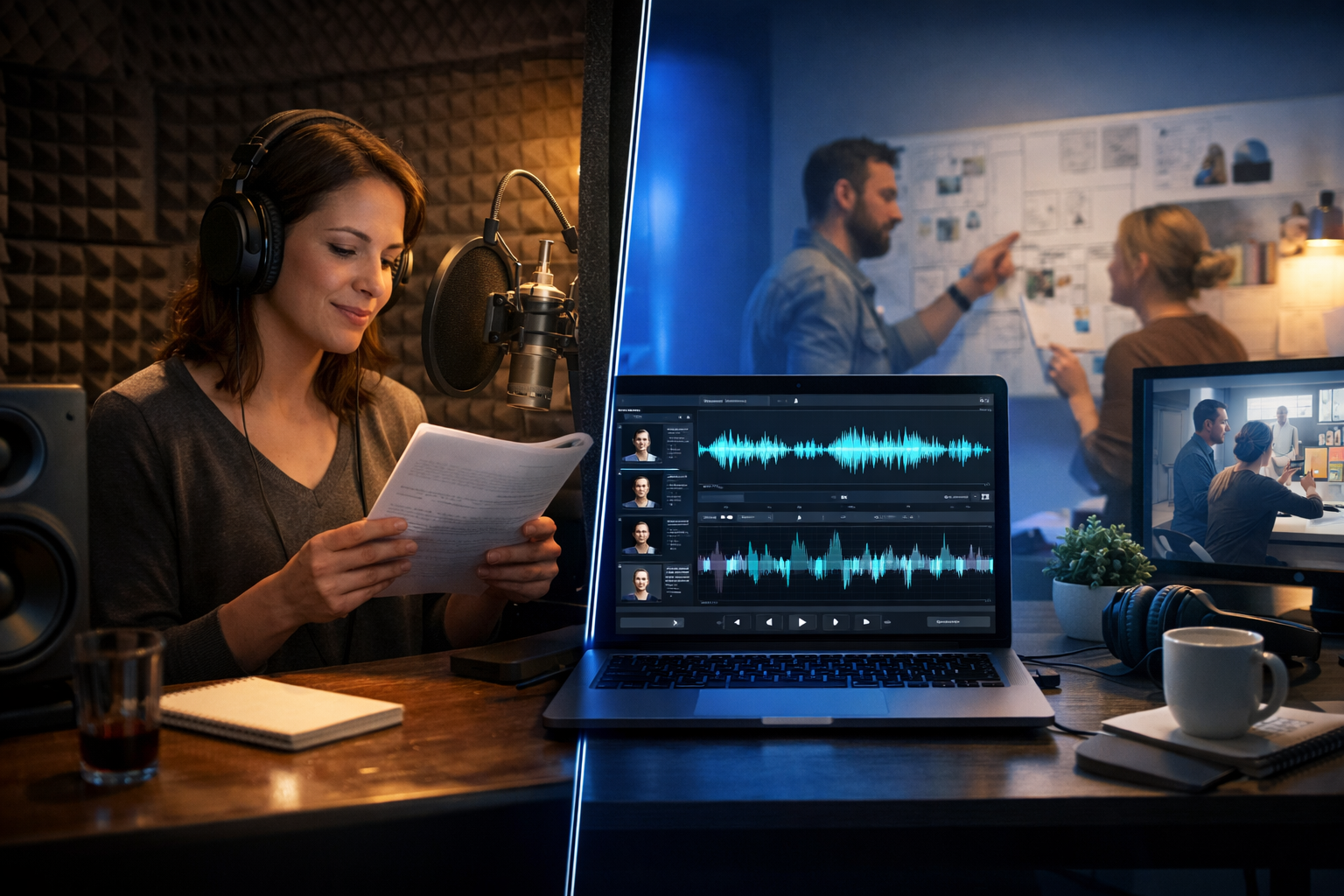
Choosing a voice for your next video, podcast intro, e-learning module or app onboarding isn’t just a creative decision—it affects trust, comprehension, brand identity and production speed. This AI voice over comparison of natural vs synthetic options will help you decide when a human voice is worth the studio time, when AI audio is the smarter choice, and how to get broadcast-ready results without overspending.
What “natural” and “synthetic” voice-overs really mean
In day-to-day production, “natural” usually refers to a human-recorded voice-over: a voice actor records in a studio (or treated home booth), then an editor cleans and masters the audio. “Synthetic” typically refers to AI-generated speech created from text, often called text-to-speech (TTS). Modern synthetic voices can sound remarkably human, but they are still generated—meaning you can change scripts instantly, swap voices in seconds and create multiple versions at scale.
There’s also a middle ground: some teams record a human voice to create a consistent voice model for future production (often called “voice cloning” or “custom voice”). Whether that’s appropriate depends on consent, contracts and how your audience might perceive it.
Quick AI voice over comparison: natural vs synthetic at a glance
Use this high-level overview to frame the decision, then dive into the sections below for practical guidance.
- Best for emotional nuance: Natural (human) voice
- Best for speed and iteration: Synthetic (AI) voice
- Best for tight budgets: Synthetic (AI) voice
- Best for brand control at scale: Synthetic (AI) voice (with consistent voice selection)
- Best for sensitive, trust-heavy messaging: Often Natural (but depends on audience and disclosure)
- Best for multi-language localisation: Synthetic (AI) voice
Sound quality and “human-ness”: what listeners actually notice
When people say a voice “sounds natural”, they usually mean a combination of pacing, emphasis, breath, micro-pauses, emotional timing and believable pronunciation. Human voice-overs naturally include subtle imperfections—tiny shifts in energy, slight breath noise, and organic rhythm—that make speech feel lived-in.
Synthetic voices have improved dramatically, but they can still struggle in specific situations:
- Complex brand names (especially with unconventional spelling)
- High-emotion scripts (apologies, heartfelt fundraising, sensitive healthcare topics)
- Fast comedic timing where micro-beats matter
- Dense technical narration that needs carefully shaped emphasis
That said, for many commercial use cases—product explainers, social ads, training snippets, app walkthroughs—AI audio can sound “natural enough” that the viewer’s attention stays on the message rather than the voice.
A practical test: can you spot the “join”?
One of the biggest giveaways in synthetic audio is inconsistency across sentences—where the tone subtly resets, or where emphasis lands oddly. Before publishing, listen for:
- Sudden changes in energy between sentences
- Odd emphasis on function words (“and”, “the”, “to”)
- Unnatural pauses around commas and parentheses
- Mispronunciation of names, acronyms or locations
Cost comparison: what you pay for (and what you don’t)
A human voice-over cost is more than the voice actor’s fee. You’re also paying for recording time, editing, revisions, project management and sometimes studio hire. Pricing varies widely by region, usage rights, duration, and talent experience.
AI voice-over flips the model: you typically pay a subscription or usage-based rate, and you can generate as many versions as needed without booking sessions. This is particularly valuable when scripts change frequently—think weekly product updates, seasonal promos, or A/B testing ads.
If you’re a startup or small team, controlling production spend matters. Gen AI Last bundles AI audio with text, image and video generation in the same platform, so you can build a complete creative pipeline without stacking multiple tools. You can explore view pricing from $10/month to see how an all-in-one plan compares with paying per project elsewhere.
Speed and iteration: the hidden advantage of synthetic voice
The biggest operational difference in this AI voice over comparison (natural vs synthetic) is iteration speed. Human voice-overs are “batch” work: you finalise the script, record, then revise if needed. AI voice-overs are “real-time” work: you can tweak one line, regenerate that line, and re-export in minutes.
This matters when you:
- Run ads across multiple audiences (different hooks, different CTAs)
- Need multiple durations (15s, 30s, 60s) for the same campaign
- Localise for different regions and pronunciations
- Update product features frequently
In practice, synthetic voice reduces the cost of being “wrong” in early drafts—because changing your mind is cheap.
Brand consistency: one voice across every channel
Consistency is a branding superpower. With human voice-overs, you typically rely on a single voice actor to keep tone consistent. If they become unavailable, you may need to recast—resulting in a noticeable brand shift.
With AI audio, you can keep the same chosen voice for months of content, across videos, podcasts, onboarding, and support tutorials. For small teams without an in-house producer, this consistency is often easier to achieve with synthetic voice.
Gen AI Last helps you keep creative assets aligned by generating your script (text), producing matching visuals (images), creating video edits (video), and then adding narration (audio) within one workflow. See our AI content tools if you want a single platform approach rather than stitching together multiple subscriptions.
Control and direction: where human voice still wins
A good voice actor is also a performance partner. You can direct them: “smile on this line”, “make it sound like a confident recommendation”, “add urgency without shouting”. They can interpret subtext, adjust pace to match visuals, and deliver multiple takes with different emotional intent.
Synthetic voice control is improving (pace, pauses, emphasis), but it’s not identical to directing a human. If your project depends on acting—brand films, documentary storytelling, premium commercials—human voice often delivers a higher ceiling of emotional credibility.
Use-case guidance: when to choose natural vs synthetic voice-over
Here’s a practical mapping you can use in your next project brief.
Choose a natural (human) voice-over when:
- Trust is central: crisis comms, medical guidance, finance disclaimers, charity appeals
- Emotion is the product: cinematic ads, brand storytelling, high-end lifestyle campaigns
- You need live direction: multiple takes, improvisation, nuanced emphasis
- Talent recognition matters: celebrity or known presenter voice
Choose a synthetic (AI) voice-over when:
- Speed matters: weekly content, frequent product updates, rapid prototyping
- You need volume: dozens of tutorials, large course libraries, many SKUs
- Budget is tight: early-stage startups, small marketing teams
- Localisation is required: multiple languages or accents at scale
- A/B testing is constant: different hooks and CTAs across paid campaigns
Quality checklist: how to make AI voice-overs sound more natural
If you choose synthetic voice, the script and production choices make a bigger difference than most people expect. Use this checklist to reduce “robotic” outcomes.
- Write for speech, not for reading. Shorter sentences, fewer nested clauses, clearer rhythm.
- Use punctuation intentionally. Commas for breathing, dashes for emphasis, and line breaks for beat changes.
- Spell out tricky words. If “SaaS” is misread, try “sass” or “S-A-A-S” depending on the tool’s behaviour.
- Add pronunciation notes in the script. Especially for names, product lines, and UK place names.
- Match tone to context. A bright retail voice can sound wrong for cybersecurity; a calm voice can feel flat for a flash sale.
- Don’t over-speed. Slightly slower often sounds more confident and more human.
- Master the audio. Light noise reduction, EQ and compression can make AI narration sit naturally with music.
Example: turning a “synthetic-sounding” line into natural speech
Before (written like a web page): “Our platform enables omnichannel content generation across modalities to accelerate marketing output.”
After (written for narration): “Create your content in one place—text, images, video and audio—so your marketing goes live faster.”
Even with the same synthetic voice, the second version typically sounds more human because the rhythm is clearer and the message is conversational.
Workflow comparison: from script to finished video
A realistic comparison needs to include the full workflow, not just the voice itself.
Natural voice-over workflow (typical)
- Finalise script
- Book talent (and studio if needed)
- Record takes
- Edit, clean, master
- Revisions (may require another session)
Synthetic voice-over workflow (typical)
- Draft script (then iterate quickly)
- Generate voice-over variants
- Choose best take, adjust pacing/pronunciation
- Export and place into your video timeline
- Regenerate single lines as the edit changes
If you’re building an explainer or product demo, an all-in-one platform can reduce handoffs. With Gen AI Last you can generate the script, create supporting visuals, produce video scenes, and add narration using the same workspace—ideal for small teams that need speed without sacrificing consistency.
Ethics, consent and disclosure: don’t skip this
AI voice technology can be misused. For E-E-A-T and brand trust, make sure your process is defensible and respectful.
- Consent: Never clone or imitate a real person’s voice without explicit, written permission.
- Usage rights: Confirm you’re allowed to use a chosen voice commercially and for your channels.
- Disclosure: Consider whether your audience should be informed that narration is AI-generated—particularly in sensitive sectors.
- Security: Store voice assets and scripts securely, especially if they contain personal data.
If your content is intended to build trust (health, finance, legal), your voice choice should align with transparency and audience expectations—not just cost or convenience.
Decision framework: choose the right voice in 5 minutes
When stakeholders disagree (“AI sounds fake” vs “We can’t afford voice talent”), use a simple scoring approach. Rate each factor from 1 (low) to 5 (high):
- Emotional nuance required
- Revision frequency
- Volume of content
- Compliance / sensitivity
- Need for localisation
If emotional nuance and sensitivity score highest, lean natural. If revisions, volume, and localisation score highest, lean synthetic. If it’s mixed, consider a hybrid approach: use human voice for flagship brand assets and AI voice for tutorials, updates, and experimentation.
Practical examples: what “natural vs synthetic” looks like in real projects
Example 1: SaaS onboarding videos
Challenge: The UI changes monthly, and each change affects the script.
Recommendation: Synthetic voice-over for onboarding and feature tours. You can update one line when a button label changes, without rebooking talent.
Example 2: Premium brand campaign
Challenge: The campaign relies on emotional resonance and credibility, with PR scrutiny.
Recommendation: Natural voice-over for the main hero video. Consider synthetic voice for internal versions, animatics, and early testing.
Example 3: E-learning course library
Challenge: Hundreds of lessons, frequent updates, and multiple languages.
Recommendation: Synthetic voice-over to scale production and localisation. Invest time in script formatting and QA listening passes.
How Gen AI Last helps you produce voice-overs that fit your content
A voice-over rarely exists on its own—it sits inside a larger content system. Gen AI Last is designed for that reality: you can generate the narration script, create visuals, produce video scenes, and generate AI audio in one place. That means fewer exports, fewer tool logins, and faster iteration when stakeholders request changes.
If you’re building a lean content engine, explore our AI content tools to see how text, image, video and audio generation work together. When you’re ready to test a full workflow, you can start creating for free and build a short voice-over sample for your next campaign.
FAQs: AI voice over comparison natural vs synthetic
Do synthetic voice-overs hurt conversion rates?
Not automatically. For direct-response ads and explainers, clarity and pacing often matter more than whether the voice is human. Test both versions where possible—AI makes A/B testing much cheaper.
Will people notice an AI voice?
Sometimes, especially with brand names or emotional scripts. If your voice-over must feel intimate or deeply empathetic, a human voice is still the safer choice. For practical tutorials, many audiences won’t mind if the delivery is clear and consistent.
Is it legal to use an AI voice that sounds like a celebrity?
Imitating a recognisable person can raise serious legal and ethical issues. Avoid anything that suggests endorsement or replicates a specific individual without explicit permission and the right contracts.
Bottom line: which should you choose?
In this AI voice over comparison (natural vs synthetic), the best choice depends on your goals. If you need emotional performance, credibility and directability, go natural. If you need speed, scale, frequent updates and predictable costs, go synthetic. Many modern teams use both: human voice for flagship brand moments, AI voice for everything that needs to move fast.
If you want to produce voice-overs alongside scripts, visuals and videos without juggling multiple tools, you can view pricing from $10/month and decide whether an all-in-one platform fits your production workflow.
Ready to Create with Generative AI?
Join thousands of creators using Gen AI Last to generate text, images, audio, and video — all from one platform. Start your 7-day free trial today.
Start Free — Try 7 DaysQuick Links
Create AI content from $10/month
View Plans