AI voice over comparison: natural vs synthetic (2026 guide)
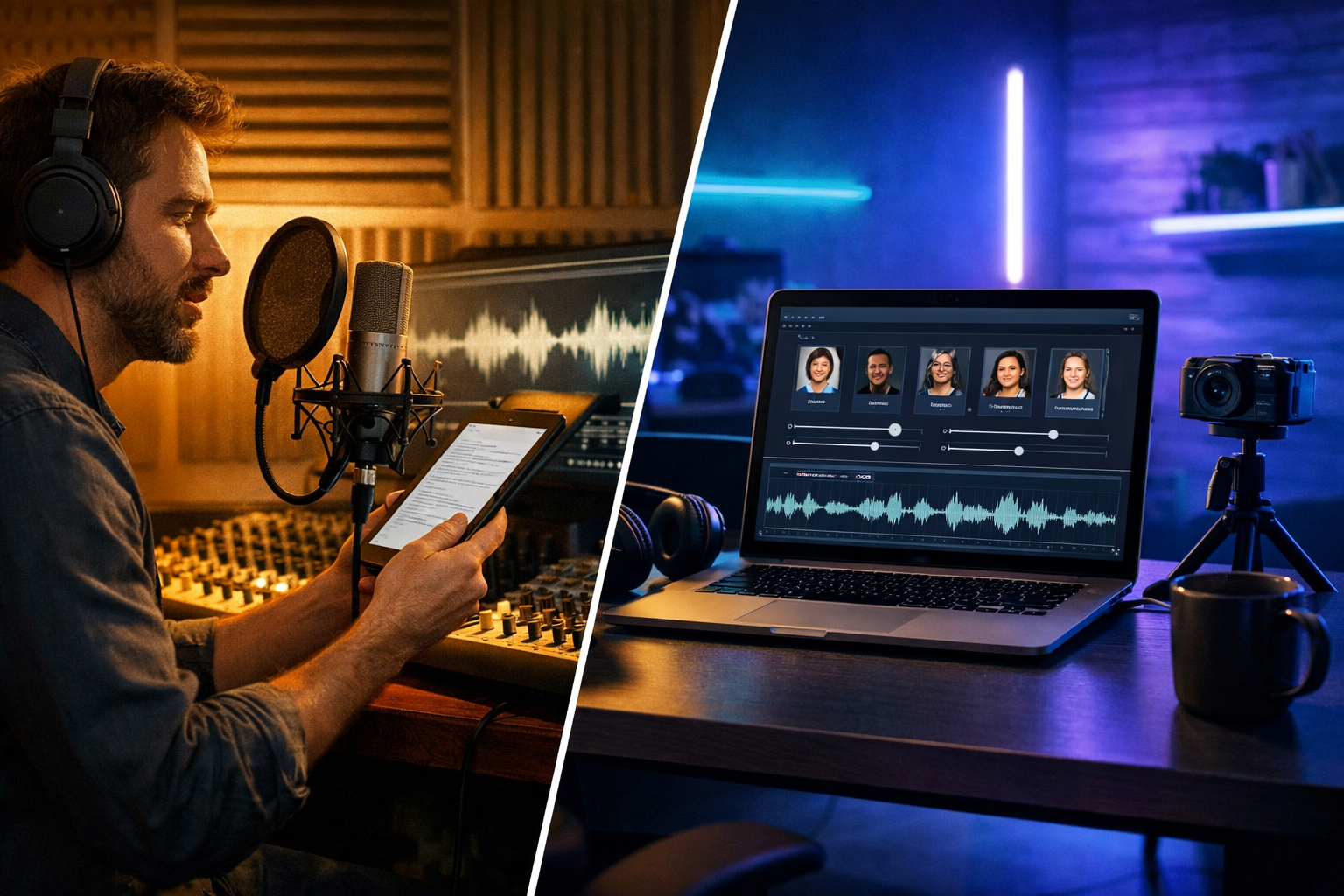
If you’re deciding between “natural” voice-over and “synthetic” AI narration, the real question isn’t which is better—it’s which is right for your audience, your budget, and the job your audio needs to do. This AI voice over comparison (natural vs synthetic) breaks down what each option delivers in realism, control, cost, turnaround, and compliance, then shows practical workflows for marketing, training and content production.
What “natural” and “synthetic” voice-over actually mean
The terms get used loosely, so let’s define them clearly:
- Natural voice-over: recorded by a human voice actor (either in a studio or remotely). Performance is captured directly, including breath, micro-pauses, emphasis, emotion and intentional imperfections.
- Synthetic voice-over: generated by AI (text-to-speech). The “voice” is produced from a model that converts text into audio using learned speech patterns. Modern systems can sound remarkably human, but it is still algorithmically constructed.
Many teams also use a blended approach: AI narration for drafts and internal videos, then natural VO for flagship campaigns. With an all-in-one platform like our AI content tools, you can build the script, generate the voice-over, and then repurpose it into visuals and video without bouncing between multiple tools.
AI voice over comparison: natural vs synthetic at a glance
Use this as a quick decision filter before you go deeper.
- Realism and emotion: Natural wins for high-stakes emotion, humour timing, and nuanced persuasion. Synthetic is strong for neutral, friendly, informative tones and is improving fast.
- Speed: Synthetic wins. You can iterate in minutes and re-render instantly after script changes.
- Cost: Synthetic usually wins, especially for frequent updates and long-form libraries. Natural can be cost-effective for a single polished asset, but revisions add up.
- Control: Synthetic offers granular control (pace, style, consistency across dozens of videos). Natural offers performance artistry, but consistency across sessions can vary.
- Brand and trust: Depends on audience expectations. Some audiences prefer clearly-human voices; others accept AI if it’s transparent and high quality.
- Compliance and permissions: Natural requires contracts and usage rights. Synthetic requires careful attention to licensing and ethical use, especially if cloning is involved.
Quality: what makes a voice-over sound “human”?
Most people judge “human-ness” through small cues rather than perfect pronunciation. Here are the markers that separate excellent VO (human or AI) from obviously artificial output:
- Prosody: the rise and fall of pitch that signals meaning (questions, emphasis, confidence).
- Rhythm: natural speech includes micro-pauses and varied pacing; robotic delivery is often too evenly timed.
- Stress and emphasis: humans stress different words to change intent. AI needs guidance via punctuation and phrasing.
- Breath and mouth sounds: too clean can sound synthetic; too much can sound unprofessional. Balance matters.
- Contextual pronunciation: brand names, acronyms and product terminology can trip both humans and AI.
In an AI workflow, you often “direct” the voice using writing rather than coaching. That makes scriptcraft crucial: short sentences, purposeful punctuation, and clarity beat cleverness. Gen AI Last helps here because you can draft and refine the script with AI text generation, then immediately test the narration using AI audio generation—no waiting on studio schedules.
Cost and turnaround: the practical differences
Budget isn’t just the invoice amount; it includes time, revisions, and the cost of being slow to publish.
Natural voice-over cost considerations
- Session fees (studio time, talent time) and potentially higher rates for commercial usage.
- Usage rights often depend on platform (web, TV, radio), region, and duration.
- Revisions can require re-booking, especially if the script changes after recording.
- Post-production (noise reduction, EQ, de-essing, mastering) may be extra if you need broadcast polish.
Synthetic voice-over cost considerations
- Predictable pricing: typically subscription-based, especially when bundled into a platform.
- Unlimited iteration: script changes don’t create scheduling costs; you regenerate audio.
- Scaling libraries: training catalogues, localisation, and frequent product updates become far more economical.
If you’re a startup or small team, the biggest advantage is speed. Gen AI Last includes AI audio generation alongside text, image and video tools from view pricing from $10/month, so you can publish more consistently without assembling a multi-vendor stack.
Brand consistency: the hidden reason teams choose synthetic
Consistency is hard with human VO across months of content. Even great voice actors will sound slightly different across sessions due to energy, health, microphone setup, and room acoustics. Synthetic voices, by contrast, can remain consistent across:
- weekly product updates
- multi-part explainer series
- support tutorials and onboarding videos
- in-app audio prompts or microlearning clips
That consistency can become a brand asset—your “audio identity”—especially if you publish at volume.
Where natural voice-over still clearly wins
Despite rapid progress, there are scenarios where a human performance is the safer bet:
- High-emotion storytelling: charity campaigns, founder narratives, sensitive topics, memorial-style pieces.
- Comedy and timing: humour relies on micro-beats and intentional “messiness” that’s hard to synthesise.
- Premium brand ads: luxury and heritage brands often want recognisable human warmth.
- Complex dialogue: multiple characters, interruption, overlapping emotion, or heavy improvisation.
A useful rule: if the voice is the main product of the piece (the performance itself), choose natural. If the voice is supporting clarity and speed, synthetic can be ideal.
Where synthetic voice-over often wins (and why)
Synthetic narration is often the best choice when content changes frequently or must be produced at scale:
- Product walkthroughs: every interface change can mean a script change; AI lets you update instantly.
- Training libraries: consistent voice, fast iteration, and uniform pronunciation across modules.
- Short-form social: speed matters more than perfection; you can test multiple hooks quickly.
- Localisation: create versions in multiple languages without re-hiring talent for each one.
- Prototyping: get stakeholder approval with AI VO, then optionally switch to human later.
Because Gen AI Last combines text, audio, image, and video generation, you can move from script to narrated marketing video in one workflow—especially useful for lean teams.
A practical decision framework (use this checklist)
When you’re stuck between natural vs synthetic, answer these questions in order:
- Is this asset revenue-critical? If yes (paid ads, homepage hero, flagship launch), lean natural or best-available synthetic with extra QA.
- How often will it change? If it will be updated monthly (or more), synthetic usually wins.
- How long is the content? Longer content increases the cost of human retakes; synthetic makes long-form edits painless.
- Do you need multiple versions? If you’ll A/B test scripts or localise, synthetic is typically far more efficient.
- What’s the audience expectation? A corporate training audience prioritises clarity; a cinematic audience expects performance.
- Can you be transparent? If you’re using AI, consider disclosure when relevant, and never imply a real person said something they didn’t.
How to make synthetic voice-overs sound more natural (script and production tips)
Most “synthetic” tells come from the script, not the voice model. Improve naturalness with these tactics:
1) Write for listening, not reading
- Keep sentences short (12–18 words is a good target for explainer VO).
- Use contractions where appropriate (we’re, you’ll, it’s) to reduce stiffness.
- Avoid stacked nouns and dense clauses; break them into two lines.
2) Direct the voice with punctuation
- Use commas for micro-pauses, and em dashes for intentional emphasis.
- Place key words at the end of sentences for a natural “landing”.
- Use question marks sparingly to avoid sing-song intonation.
3) Add pronunciation guidance for brand terms
If your product name is frequently mispronounced, adjust spelling or add phonetic hints in the script version used for narration (while keeping the on-screen text correct).
4) Master the audio like a pro
- Add light compression to even out volume.
- Apply gentle EQ (cut muddiness around low mids; add clarity carefully).
- Use subtle room tone or background music for realism, but keep speech intelligibility first.
With Gen AI Last, you can generate narration and also create background music via AI audio tools, helping your VO sit naturally in the mix without hunting for licensing.
Examples: choosing natural vs synthetic for common projects
Example 1: SaaS product explainer video (60–90 seconds)
Best fit: Synthetic (often). The product UI changes, and you’ll likely test multiple hooks. Use a clear, friendly voice; focus on pacing and clarity.
Workflow: Generate script with AI text → generate VO with AI audio → create supporting visuals with AI image generation → assemble an explainer with AI video tools. Explore the full workflow in our AI content tools.
Example 2: Paid social advert for a premium product
Best fit: Natural (often). You’re buying attention and trust. A human voice can land nuance, confidence, and brand positioning better.
Hybrid tip: Use synthetic VO to test five script angles quickly; once a winner emerges, record a human VO for the final cut.
Example 3: Internal training updates (weekly)
Best fit: Synthetic. You need consistency and speed, not cinematic emotion. Keep scripts direct, and regenerate whenever policies change.
Example 4: Podcast intro/outro and promo clips
Best fit: Depends. If the podcast is personality-driven, a natural host voice usually performs better. If you want consistency across many language versions or frequent promos, synthetic can be practical—especially for short ads and announcements.
Ethics, consent and compliance: what to get right
Audio is persuasive. That’s why governance matters, whether you use natural or synthetic VO:
- Never impersonate real people without explicit permission. Avoid celebrity-sounding voices designed to mislead.
- Check usage rights for human VO and licensing terms for AI voices used commercially.
- Disclose when appropriate, especially in sensitive contexts (health, finance, politics) or where audience trust is central.
- Protect customer data: don’t paste private information into any tool when generating scripts or VO.
A good practice is to maintain a simple “voice-over policy” for your organisation: approved voices, tone guidelines, disclosure rules, and a review checklist before publishing.
Best-practice workflow: from script to finished narrated video
Here’s a repeatable workflow that works well for small teams producing marketing and training content:
- Define the goal: one audience, one action, one core message.
- Draft the script: use a tight structure (hook → problem → solution → proof → CTA).
- Generate a synthetic VO draft: test pacing and clarity; adjust punctuation and sentence length.
- Create visuals: product images, scenes, or supporting graphics; keep them aligned to the narration beats.
- Assemble the video: match cuts to phrases; leave space for breathing room between points.
- Quality check: listen on phone speakers and headphones; fix mispronunciations and harsh “S” sounds.
- Publish and iterate: create alternate hooks and CTAs quickly, especially for ads.
Gen AI Last is designed for this end-to-end process: scripts (text), narration and music (audio), visuals (images), and assembled content (video) in one place. If you want to test it quickly, start creating for free.
FAQ: AI voice over comparison (natural vs synthetic)
Is synthetic voice-over “good enough” for customer-facing marketing?
Often yes—particularly for explainers, product updates, and social videos where clarity and speed matter. For premium brand ads or emotional storytelling, natural VO may still outperform.
Will audiences be able to tell it’s AI?
Some will, especially if pacing is too even or emphasis feels off. Strong scriptwriting, careful punctuation, and light audio mastering reduce the “AI” feel dramatically.
What’s the biggest mistake teams make with AI narration?
Using a written-style script full of long sentences and jargon. Write for the ear, then iterate quickly until it sounds conversational.
Conclusion: which should you choose?
In this AI voice over comparison (natural vs synthetic), the takeaway is simple: choose natural voice-over when performance, emotion, and brand perception are the main value. Choose synthetic voice-over when speed, scale, consistency, and frequent updates matter most. Many teams get the best results with a hybrid approach—AI for rapid testing and iteration, human VO for the final, high-impact cut.
If you want an affordable way to produce scripts, narration, visuals and videos in one workflow, explore view pricing from $10/month and build your next narrated asset with Gen AI Last.
Ready to Create with Generative AI?
Join thousands of creators using Gen AI Last to generate text, images, audio, and video — all from one platform. Start your 7-day free trial today.
Start Free — Try 7 DaysQuick Links
Create AI content from $10/month
View Plans