Generative AI Latest Developments: What Matters in 2026
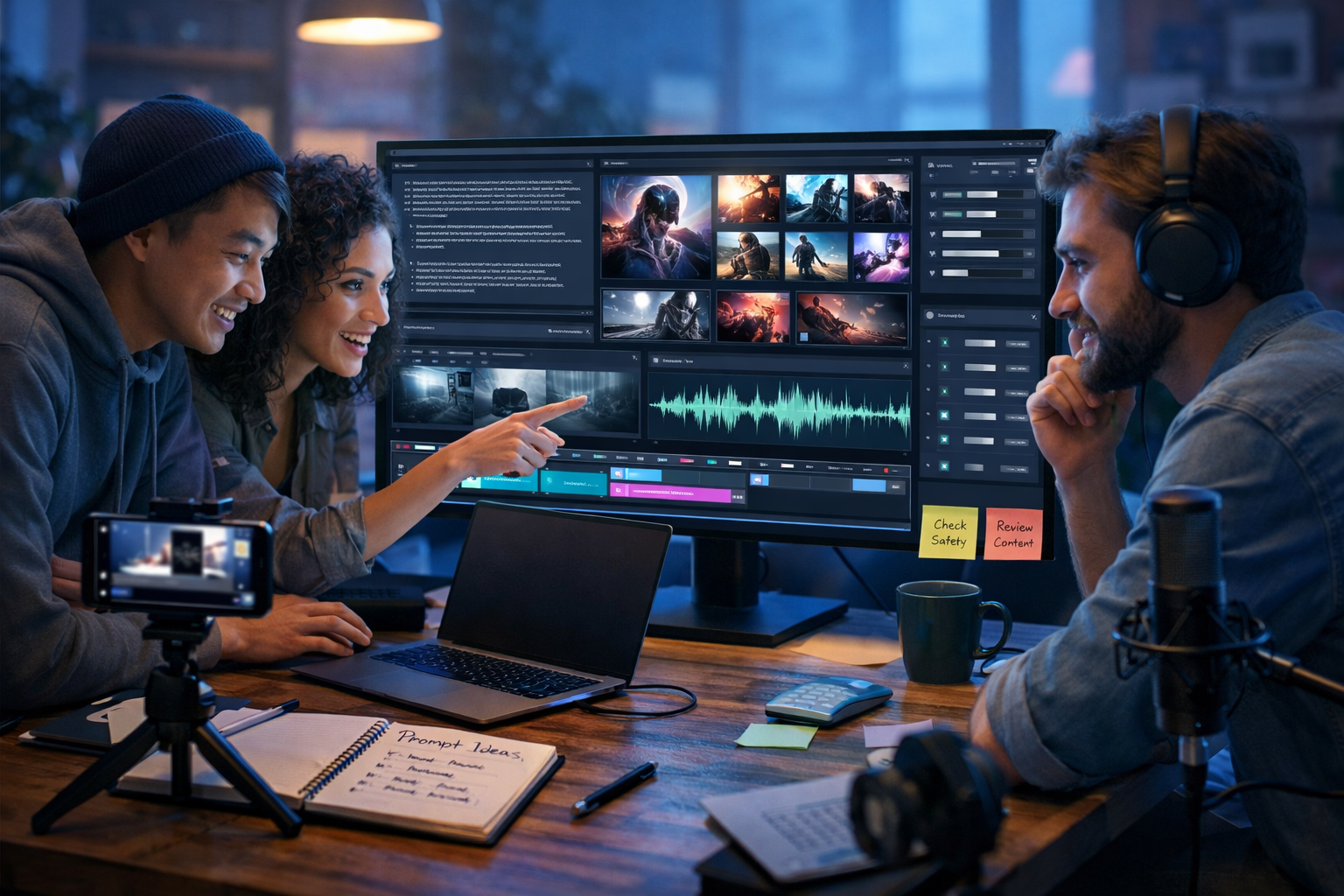
Generative AI has moved beyond “write me a blog post” and into full-funnel content production: one prompt can now produce copy, visuals, voice and even short-form video. This guide breaks down the generative ai latest developments that actually matter for marketers, founders and small teams—and shows how to turn them into repeatable workflows using an all-in-one platform.
1) Multimodal creation is now the default
One of the biggest generative ai latest developments is that models increasingly understand and produce multiple media types in a single workflow. Instead of treating text, images, audio and video as separate tools, modern platforms are converging: you can ideate in text, generate images for the same concept, then produce a narrated video cut using consistent messaging and style.
For small teams, the practical impact is speed and consistency. You can keep a single “source of truth” for your brand message and reuse it across formats without re-briefing different freelancers or switching between half a dozen subscriptions.
- Use one core prompt and adapt it into: landing-page copy, ad creatives, product visuals, a 20–30 second reel, and a voice-over.
- Maintain consistency by reusing the same product benefits, tone guidelines, and audience persona across outputs.
- Reduce feedback loops: if the hook changes, regenerate all assets from the updated brief.
Gen AI Last is built for this reality: you can generate professional text, images, audio, and video from simple prompts in one place via our AI content tools.
2) Video generation has become a marketing baseline
Another headline among the generative ai latest developments is the acceleration in AI video quality and ease of production. Short-form marketing videos, product demos and explainer clips are no longer “nice to have” because distribution channels reward video. AI reduces the friction: you can go from script to storyboard to visual scenes quickly—especially for social reels and ads.
What’s changed most is control. Tools increasingly let you guide structure (scene-by-scene), style (studio, lifestyle, minimalist), pacing, and sometimes even maintain a consistent look across shots. For brands, that means fewer random results and more reusable templates.
A practical 30-minute AI video workflow
- Write the script: hook (0–3s), problem (3–8s), solution (8–20s), proof (20–26s), CTA (26–30s).
- Generate supporting visuals: product shots, backgrounds, feature callouts (without on-image text if you plan to overlay later).
- Create voice-over: match tone to the channel (confident for ads, friendly for organic).
- Assemble video: align visuals to the script and add a short CTA.
If you want a single subscription that covers script, visuals, voice, and video generation, view pricing from $10/month and keep costs predictable.
3) Audio: voice, narration and brand sound are easier to scale
Audio is quietly one of the most commercial generative ai latest developments. AI voice-overs and narration allow teams to produce more video variations, localise content, and keep tone consistent—without booking studio time. AI-generated background music and podcast elements also make it easier to ship audio-first content.
The opportunity is not just “make a voice”. It’s building a repeatable audio identity: consistent pacing, pronunciation, energy level, and structure—so your content sounds like your brand.
- Video ads: generate 3 voice styles (calm, energetic, authoritative) and A/B test for conversion.
- Product demos: add narration to screen recordings to reduce drop-off.
- Podcasts: produce intro/outro, episode summaries, and background music cues.
4) AI “agents” and automation are moving from hype to workflows
A major theme in generative ai latest developments is the shift from single-turn generation to multi-step execution. Instead of only returning content, agent-like systems can follow a plan: research, draft, refine, and produce variants. Even when you are not using a fully autonomous agent, you can mimic the benefits by setting up structured prompts and checklists.
For marketing and content teams, the key is to keep humans in the loop. Treat AI as a production assistant that accelerates predictable tasks, while people handle positioning, differentiation, and final approvals.
Where automation helps most (and where it doesn’t)
- High impact: first drafts, variations, repurposing, formatting, caption options, email subject lines, product description templates.
- Medium impact: competitor summaries, content briefs, SEO outlines (must be checked).
- Low impact: true strategic differentiation, brand narrative, legal claims, medical/financial advice.
5) Retrieval, grounding and “cite your sources” expectations
As generative AI becomes mainstream, expectations around reliability have risen. Businesses want grounded outputs: content that aligns with product documentation, internal knowledge bases, and verified facts. While not every workflow requires citations, teams increasingly expect AI to stay within known boundaries—especially for regulated industries or claims-heavy marketing.
A practical approach for small teams is to provide the model with the necessary facts directly in the prompt (product specs, pricing, compliance wording, approved testimonials) and instruct it not to invent numbers.
Prompt pattern: grounded marketing copy
Include: audience, product, key features, approved claims, forbidden claims, and a “use only provided facts” instruction. Then request a structured output: headline options, benefit bullets, FAQ, and CTA variations.
6) Brand consistency: from “random outputs” to systems
One of the most useful generative ai latest developments is not a flashy model demo—it’s the operational mindset change. High-performing teams treat AI output as part of a system: reusable prompt templates, style guides, and defined review steps. That’s how you get consistent quality and avoid constantly “prompting from scratch”.
To make this real, create a simple Brand Prompt Pack and reuse it across text, images, audio and video.
- Brand voice: 5 adjectives (e.g., plainspoken, optimistic, practical, expert, friendly).
- Audience: role, industry, pain points, objections.
- Proof: outcomes, testimonials, key differentiators.
- Do/Don’t: banned phrases, compliance notes, claims to avoid.
- Format rules: headline length, reading level, CTA style.
7) Image generation: product-ready visuals and campaign variations
In the generative ai latest developments landscape, image generation is increasingly used for marketing production rather than novelty. The practical wins are speed and variation: you can generate multiple creative directions for ads, hero banners, social posts, and concept art without booking shoots for every idea.
For e-commerce and SaaS, the sweet spot is campaign imagery: lifestyle backdrops, feature illustrations, seasonal banners, and social-friendly graphics. (For highly precise product photography, many teams still combine AI with real photos for maximum accuracy.)
Example: generating campaign visuals for a product launch
- Generate 6 variations of a hero image: different settings (home office, gym bag, café table), lighting styles (soft natural light, golden hour, cool tech).
- Pick one direction and regenerate consistent variations for social (wide banner, square, vertical).
- Pair with 3 headline angles from your text generator: “save time”, “reduce costs”, “improve quality”.
8) Personalisation and localisation at scale
Personalisation is another of the generative ai latest developments that is quietly changing how small teams compete with bigger brands. Rather than writing one email sequence for everyone, you can generate versions by industry, use case, or funnel stage. The same applies to landing pages, ads, and even video scripts.
Localisation is becoming more accessible too: translate and adapt tone, not just words. The key is to localise offers and examples, not only language.
- Email: generate subject lines and intros for 5 personas (Founder, Marketing Manager, Ops Lead, Agency Owner, Creator).
- Ads: produce 10 hooks that match regional phrasing and cultural context.
- Video: adapt a script for TikTok vs LinkedIn by changing pacing and CTA.
9) Safety, copyright and disclosure: the new “quality control” layer
As the tooling improves, governance becomes one of the most important generative ai latest developments for real businesses. This isn’t about slowing down—it’s about protecting your brand. You need lightweight checks for claims, sensitive topics, and rights.
A simple AI content QA checklist
- Accuracy: are numbers, features, and timelines correct and sourced from your approved facts?
- Claims: does the copy avoid unverified “best”, “guaranteed”, medical/financial promises, or competitor defamation?
- Originality: does it sound like your brand, not generic AI?
- Image use: avoid generating misleading likenesses; keep creative assets on-brand.
- Disclosure: if required by policy or platform rules, disclose AI-assisted creation.
10) What to do next: build a repeatable “content engine”
If you want to benefit from the generative ai latest developments without chasing every trend, focus on one thing: a repeatable content engine. Your engine should turn one idea into multiple assets that serve different channels and funnel stages.
A 7-day content engine (simple and effective)
- Day 1: Create a brief: audience, offer, pain point, proof, CTA.
- Day 2: Generate a long-form article and an SEO outline for future updates.
- Day 3: Repurpose into 10 social posts and 3 LinkedIn carousels (copy + image concepts).
- Day 4: Produce a 30-second video script and storyboard prompts.
- Day 5: Generate video + voice-over + captions; publish 2 variations.
- Day 6: Create an email campaign: announcement, value email, offer email.
- Day 7: Review performance, feed learnings back into the brief, and regenerate variants.
Doing this with separate tools gets expensive and messy. With Gen AI Last, you can generate the text, images, audio, and video in one workflow. If you want to test it quickly, start creating for free.
Frequently asked questions
Are generative AI latest developments mainly about bigger models?
Not only. Bigger models help, but the biggest business value often comes from better workflows: multimodal creation, controllable outputs, faster iteration, and practical safeguards that make AI usable day-to-day.
What should a small business prioritise first?
Prioritise one revenue-linked workflow: e.g., product page + ad creatives + short video + email follow-up. Ship consistently for 30 days, then optimise prompts and templates based on results.
How do we keep quality high if AI generates so much content?
Use a “brief-first” process, provide verified facts, and implement a lightweight QA checklist. AI should accelerate drafting and variation, but humans should approve claims, brand voice, and final messaging.
Conclusion: focus on outcomes, not novelty
The generative ai latest developments are exciting, but the winners will be teams that turn them into reliable production systems: multimodal content, faster video, scalable voice, and grounded messaging with sensible safeguards. If you want a straightforward way to apply these developments today—without juggling multiple subscriptions—use our AI content tools and build a repeatable engine from one prompt to a full campaign.
Ready to Create with Generative AI?
Join thousands of creators using Gen AI Last to generate text, images, audio, and video — all from one platform. Start your 7-day free trial today.
Start Free — Try 7 DaysQuick Links
Create AI content from $10/month
View Plans