Generative AI Latest Developments: What’s New in 2026
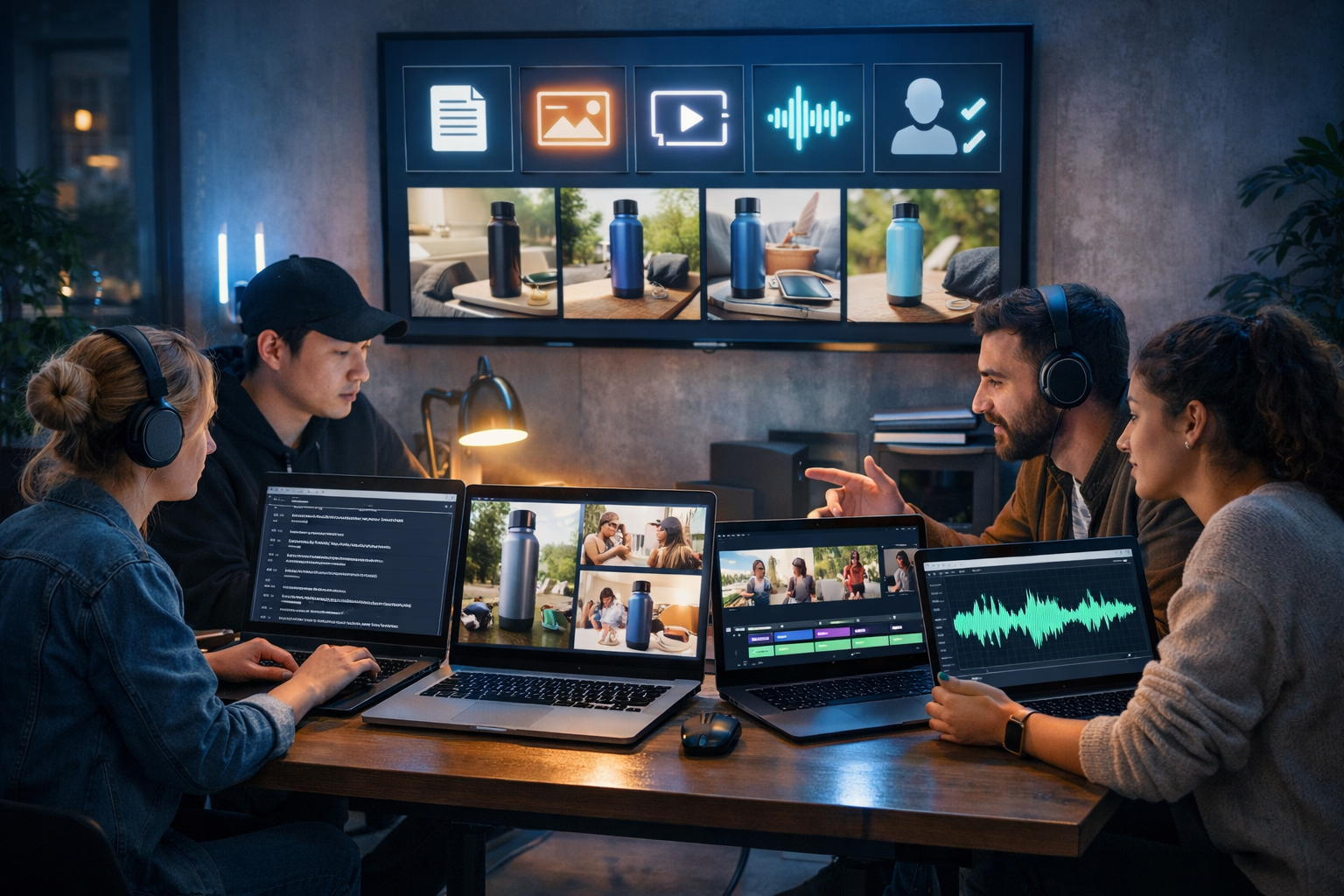
The generative AI latest developments are no longer just about writing faster blog posts. The biggest shift is that modern tools can create, edit and coordinate text, images, audio and video in a single workflow—often from one prompt—while businesses focus on governance, quality and real ROI. This article breaks down what’s changing right now, why it matters, and exactly how small teams can apply it without a big budget.
1) From single-purpose models to truly multimodal creation
One of the clearest generative AI latest developments is the move from “text-only” systems to multimodal models that understand and produce multiple formats. Instead of generating a caption and then separately creating an image and then separately producing a voice-over, you can increasingly plan and produce a complete campaign asset set as a connected bundle.
In practice, multimodality changes how teams brief creative work. You don’t just describe what you want to say; you describe the audience, the brand voice, the visual style, the desired pacing and the channel constraints (for example, a 9:16 reel, a 16:9 YouTube explainer, and a 1:1 social post). The model can keep those constraints consistent across outputs.
- A single product launch prompt can yield: landing page copy, hero images, a short demo video script, a voice-over, and supporting social posts.
- Edits become “cross-format”: changing your positioning statement can automatically adjust on-screen text, narration tone, and thumbnail concept.
- Consistency improves when the same brief drives every asset, reducing the “mismatch” between copy and visuals.
If you want a practical place to start, use our AI content tools to generate a campaign bundle: draft the messaging as text, then generate supporting visuals, then produce audio narration and a short video—all from the same core prompt.
2) Video generation is moving from novelty to marketing-ready output
Video is where many businesses feel the biggest gap between ambition and capacity. Another of the generative AI latest developments is the rapid improvement in video generation: better motion coherence, improved scene continuity, and more control over style and pacing. While there are still limitations (especially around precise brand details and complex interactions), the quality is increasingly suitable for product explainers, social reels, and simple demo sequences.
What’s changed most is controllability. Teams can now specify shot lists, camera movement, scene duration, and even storyboard-like structure. This reduces the risk of producing something that looks impressive but doesn’t communicate.
Practical workflow: turn one idea into a short reel
- Define the hook: one sentence that states the problem and the promise (e.g., “Create a full campaign asset pack in minutes”).
- Request a shot list: 5–7 short scenes with clear on-screen actions and visual cues.
- Generate the video: keep scenes short (1–3 seconds) and focus on clarity over complexity.
- Add narration: produce an AI voice-over matched to your brand tone.
- Export variations: 9:16 for reels, 16:9 for YouTube, and a silent-caption version for autoplay feeds.
Gen AI Last supports AI video generation alongside text, images and audio, so you can keep everything in one place rather than juggling multiple tools and inconsistent prompts. If budget is a concern, you can view pricing from $10/month to access the full suite.
3) Audio generation is becoming “production-like”
Another area of generative AI latest developments is audio: voice quality, natural pacing, and controllable emotion are improving. For businesses, that means fewer compromises when creating voice-overs for product demos, training, explainers, internal updates, and even podcast-style content.
The strategic shift is that audio is no longer an afterthought. When you can generate narration quickly, you can test multiple tones (friendly, authoritative, energetic), languages, and lengths—then pair the best version with your video.
- Voice-over for demos: create a 30-second version for social and a 2-minute version for the website.
- Podcast snippets: repurpose a blog post into a short audio summary and distribute it across channels.
- Background music: generate simple beds for intros/outros to make content feel finished.
A simple rule: write for the ear, not the eye. Shorter sentences, fewer clauses, and clearer signposting (“First… Next… Finally…”) make AI narration sound more human and easier to follow.
4) “Agentic” workflows: AI that plans and executes multi-step tasks
Beyond generation, one of the generative AI latest developments is the rise of AI agents: systems that can break a goal into steps, choose tools, and iterate until completion. In marketing terms, this looks like an AI that can propose a campaign structure, draft assets, suggest A/B variants, and produce a checklist for publishing.
For small teams, the real advantage is not replacing specialists; it’s reducing coordination overhead. A structured “agent-style” prompt can act like a mini project manager: it asks clarifying questions, produces options, and creates a repeatable process.
Example: an agent-style prompt you can reuse
Goal: launch a new feature announcement in 7 days.
Ask the AI to: (1) define audience + value proposition, (2) propose key messages, (3) draft landing page copy, (4) generate 5 social posts, (5) storyboard a 30-second reel, (6) create a voice-over script, (7) recommend KPI tracking.
Using our AI content tools, you can run this workflow end-to-end: generate text assets first, then create visuals, then assemble a video with narration and supporting audio.
5) Better editing and revision: “keep what works, change what doesn’t”
Earlier waves of generative tools often forced you to regenerate entire outputs. A key part of the generative AI latest developments is granular editing: revising a specific section of text, adjusting a single scene in a video, or iterating an image while keeping composition stable.
This matters because real content work is iterative. You might love the headline but need a different CTA; the voice-over might be perfect but too fast; the image could be right but the product angle is wrong. Fine-grained revisions reduce wasted time and make outputs more predictable.
- Text: “Keep the structure, reduce jargon, and add one practical example.”
- Images: “Keep lighting and framing; change background to a home office.”
- Video: “Replace scene 3 with a close-up product shot; keep total duration under 35 seconds.”
- Audio: “Slow pacing by 10% and add a more confident tone.”
6) The enterprise focus is shifting: safety, provenance and compliance
The generative AI latest developments aren’t only about quality. They also include governance: how to use AI responsibly, protect data, and reduce legal risk. Even if you’re not a large enterprise, these issues still apply—especially if you publish content under a brand name.
Key governance practices for small teams
- Use a human review step: check factual accuracy, claims, pricing, and compliance language.
- Maintain a “sources and assumptions” note: for any statistics or comparisons you publish.
- Be careful with likeness and brand assets: avoid generating content that implies endorsement or uses copyrighted imagery without rights.
- Document prompts for repeatability: keep a prompt library so quality doesn’t drift over time.
A practical approach is to treat AI as a first-draft engine plus a production accelerator. Your team still owns the final editorial decision, approvals and publishing standards.
7) Search and content strategy: originality, usefulness and brand voice win
As AI-generated content becomes widespread, search visibility is increasingly tied to usefulness and distinctiveness. The generative AI latest developments are pushing content teams to focus on: first-hand experience, clear examples, specific positioning, and content that genuinely helps users complete a task.
AI can help you produce more, but ranking performance depends on what you produce. Use AI to accelerate research synthesis and drafting, then add your real differentiators: your process, your results, your screenshots, your lessons learned, your product constraints, your customer questions.
A simple “helpfulness” checklist before publishing
- Does the content answer the query quickly and clearly?
- Are there actionable steps, templates, or examples (not just opinions)?
- Have you removed generic filler and added specific context?
- Is the brand voice consistent across text, visuals, and video?
- Have you checked claims, numbers and compliance?
8) Practical examples: applying generative AI latest developments by channel
Below are channel-by-channel examples you can implement immediately. Each one leverages the current direction of generative AI: multimodal, faster iteration, and cohesive asset creation.
Example A: E-commerce product launch pack
Inputs: product name, 5 features, target customer, price point, brand tone, any restrictions (e.g., “no medical claims”).
- Text: product description, FAQ, email campaign (welcome + launch + last chance), 10 social captions.
- Images: lifestyle hero image, 3 feature callouts, 1 banner sized for your website.
- Video: 20–30 second product teaser with 5 quick scenes.
- Audio: voice-over for the teaser + short background music loop.
You can build this inside Gen AI Last without paying for separate tools—everything is included from $10/month, which is designed to be workable for startups and small teams. If you’d like to test the workflow, start creating for free.
Example B: B2B SaaS explainer in one afternoon
Step 1: Ask for a 60–90 second explainer script with a clear problem–solution–proof structure.
Step 2: Generate a storyboard: scene-by-scene visuals aligned to each line.
Step 3: Produce the video and match it with a confident, mid-paced voice-over.
Step 4: Create cut-downs: 15 seconds (hook only) and 30 seconds (hook + core benefit).
This takes advantage of improved controllability in video generation and the increased realism of AI audio. The result is a coherent asset family rather than a one-off video that’s hard to repurpose.
Example C: Content repurposing system (blog → social → audio → video)
- Generate a blog outline that targets one query and includes a unique point of view.
- Draft the article and add a “quick-start” section with steps readers can follow.
- Create 6–10 social posts: 3 educational, 2 opinionated, 1 case-study style.
- Generate a 2-minute audio summary for busy audiences.
- Produce a 30–45 second video using the audio summary as narration.
The key is consistency: the same core message should show up in every format. Multimodal tools make that easier, but you still need a single source of truth—your positioning statement and offer.
9) Prompting that works in 2026: specificity beats cleverness
With the generative AI latest developments, prompting has become less about “magic words” and more about clear constraints. The best prompts read like a creative brief: audience, goal, tone, format, length, examples of what good looks like, and what to avoid.
A high-performing prompt template (copy and adapt)
Context: We are a [type of business] selling [product/service] to [audience].
Objective: Create [asset] that drives [conversion/action].
Key message: [single sentence].
Proof points: [3 bullets].
Tone: [e.g., direct, friendly, authoritative].
Constraints: [length, platform, banned claims, compliance].
Output format: [headings, bullets, script format, shot list].
Variations: Provide 3 options with different hooks.
Using this template across text, image, audio and video helps you create a consistent brand presence. It also makes it easier to delegate: anyone on your team can run the same brief and get predictable results.
10) What to watch next (and how to prepare)
If you’re tracking generative AI latest developments for business advantage, focus on changes that reduce production time while increasing control and trust. The near-term direction is clear: more multimodal creation, better editing, stronger agent-like planning, and more emphasis on provenance and safety.
- More control: expect tighter tools for pacing, brand consistency and reusable “styles”.
- Better personalisation: generating variants by audience segment and funnel stage will become standard.
- Higher expectations: customers will notice generic content; your edge will be specificity and genuine insight.
- Workflow integration: the winners will build repeatable systems, not just one-off outputs.
To prepare, build a small “AI production playbook”: your core prompts, brand voice rules, compliance checks, preferred visual styles, and a publishing checklist. Then run the same process weekly and measure outcomes.
Final takeaway: turn developments into a repeatable advantage
The generative AI latest developments are exciting, but the real win is operational: producing more high-quality, on-brand assets with fewer bottlenecks. Multimodal creation, improved video and audio, and agent-like workflows mean small teams can compete with larger ones—if they focus on clear briefs, strong review standards, and consistent messaging.
If you want to apply these developments immediately, explore our AI content tools and build a complete text–image–audio–video workflow for your next campaign. When you’re ready to scale, view pricing from $10/month for full access across every feature.
Ready to Create with Generative AI?
Join thousands of creators using Gen AI Last to generate text, images, audio, and video — all from one platform. Start your 7-day free trial today.
Start Free — Try 7 DaysQuick Links
Create AI content from $10/month
View Plans