Generative AI Marketing Trends Reshaping Advertising in 2026
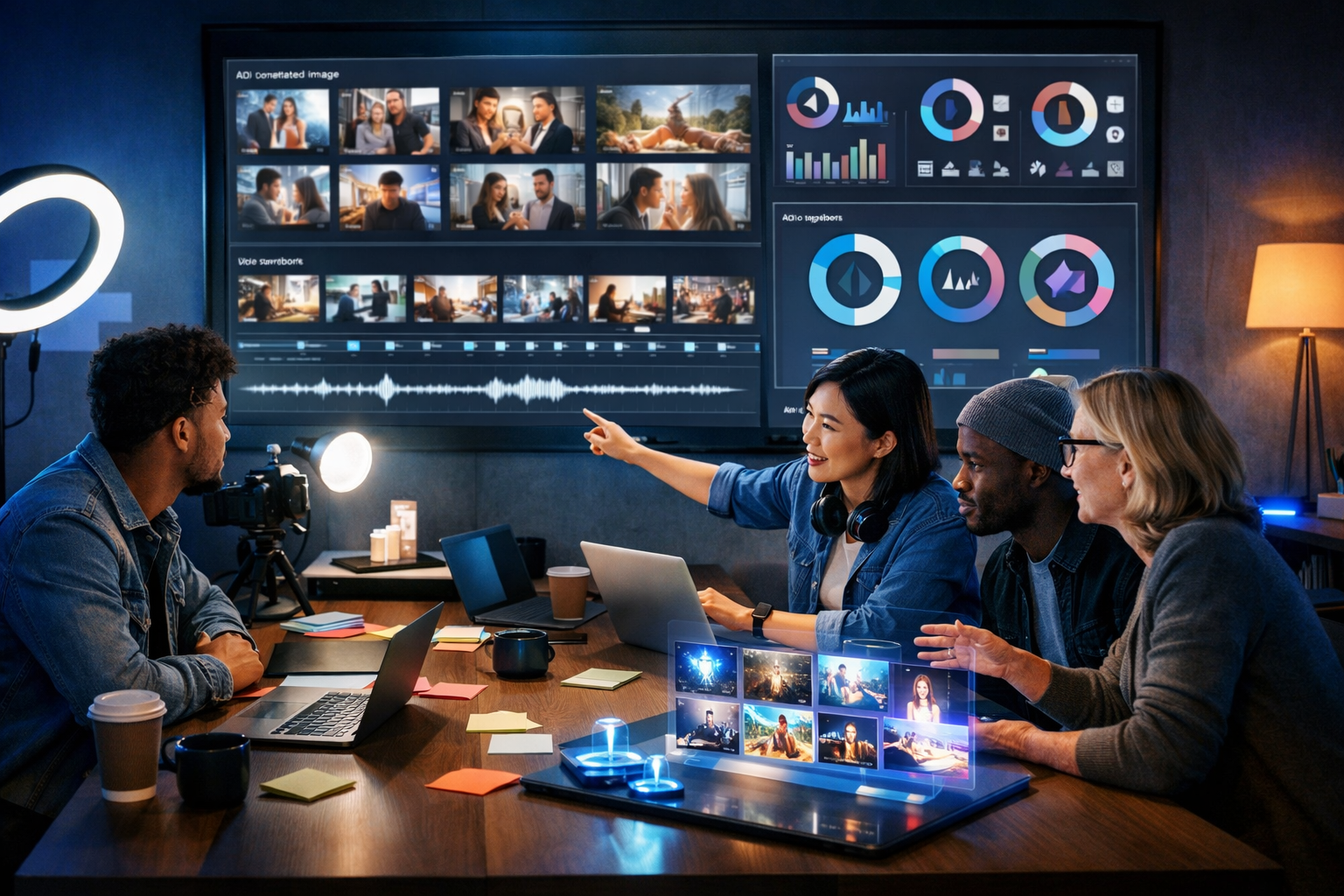
The biggest shift in advertising for 2026 isn’t a new platform or a fresh format—it’s the speed at which brands can create, test, and personalise campaigns using generative AI. Teams that used to ship one “hero” concept now ship dozens of tailored variants across audiences, channels, and languages, often in days rather than weeks. But the winners won’t be the brands that generate the most content; they’ll be the ones that build trustworthy, brand-safe workflows that turn AI output into measurable commercial impact.
What “generative AI marketing” means in 2026
Generative AI marketing uses models that create new content—copy, images, video, audio—from prompts and inputs such as product information, brand guidelines, and performance data. By 2026, the conversation has moved beyond “Can AI write an ad?” to “How do we design a creative system that reliably produces on-brand assets at scale, with proper approvals, privacy controls, and measurement?”
This matters because media is fragmented and attention is expensive. Creative is now the main lever you can scale without simply increasing spend. The trends below reflect how leading teams are reshaping their workflows and where budgets are moving.
1) Synthetic creative at scale: from one campaign to a content engine
In 2026, high-performing advertisers treat creative as an always-on system. Instead of building one set of assets per quarter, they operate a “content engine” that continuously produces new hooks, visuals, and short-form videos based on what is working right now.
Generative AI makes this feasible for small teams: it can output multiple ad angles, alternate headlines, new product shots, and fresh variations for different placements (stories, reels, feeds, display) without restarting from scratch.
- Practical example: a skincare brand generates 20 image variations of the same product (different bathroom settings, lighting moods, and demographics) and pairs them with 10 copy angles (sensitive skin, dermatologist-tested, winter dryness). They then test combinations across platforms.
- Execution tip: plan for modular assets—one product image can drive a carousel, a banner, a landing page hero, and a 6-second bumper when designed with consistent framing.
With an all-in-one toolset like our AI content tools, teams can generate text, images, video, and audio from a single brief, keeping creative direction consistent across formats.
2) Personalisation shifts from “segmentation” to “generative variations”
Personalisation used to mean: pick 3–5 segments, write 3–5 ads, and hope each segment responds. In 2026, generative AI enables far more variations—without the operational burden of manually producing them.
The trend is “personalisation-by-creative”: messaging and visuals change based on context (location, season, intent signals, previous engagement), while staying within strict brand and compliance boundaries.
- Practical example: a home fitness company runs winter-themed creatives in colder regions with cosy indoor scenes, while using bright outdoor lifestyle scenes in warmer areas—without changing the offer.
- Actionable step: define a personalisation matrix (audience x intent x offer x format). Then generate variations inside each cell and test systematically.
The key constraint: personalisation must not feel creepy. In 2026, brands win by being helpful and relevant, not by implying they know too much about the user.
3) AI video becomes the default performance format
Short-form video was already dominant, but 2026 is when AI video production becomes accessible enough that “we don’t have the budget” stops being a valid excuse. Brands can rapidly generate product demos, explainer videos, UGC-style clips, and social reels from simple prompts—then iterate based on performance.
The most effective AI-driven video ads tend to be:
- Hook-first (the first 1–2 seconds contain the main benefit or tension).
- Built from modular scenes (swap a scene without redoing the whole video).
- Versioned for placement (9:16, 1:1, 16:9) and attention span (6s, 15s, 30s).
If you can generate the script, visuals, and voice-over in one workflow, you ship faster. Gen AI Last supports text, image, video, and audio generation in the same platform, which is ideal for performance teams that need constant iteration without complex handovers.
4) Audio and voice: brand identity expands beyond visuals
As more users consume content hands-free (commutes, workouts, smart devices), brands are investing in consistent audio identity: voice-overs for ads, product walkthroughs, podcast snippets, and background music for reels.
Generative AI audio in 2026 is less about novelty and more about production efficiency: clean narration, multiple language versions, and quick re-records when offers or compliance lines change.
- Practical example: a SaaS brand produces the same 20-second product teaser in five languages, with consistent pacing and tone, then pairs each version with localised captions.
- Actionable step: create a “voice style guide” (pace, warmth, pronunciation notes, do/don’t phrases) so AI voice-overs remain recognisably you.
5) AI-assisted creative strategy: faster research, sharper positioning
A major 2026 trend is using generative AI before production begins: synthesising reviews, competitor messaging, FAQs, and call transcripts into clear positioning and creative angles. This is where teams unlock quality, not just quantity.
High-impact uses include:
- Mining customer language for hooks (“I just want…” phrases).
- Turning product features into benefit-led claims with proof points.
- Generating A/B testing hypotheses (what to test, why, and expected outcomes).
For small teams, this closes the gap with larger agencies: you can build a solid creative brief quickly, then generate assets against it in the same environment.
6) Brand safety and compliance move into the prompt
As AI-generated content becomes common, differentiation shifts to governance: how reliably you can stay on-brand, avoid prohibited claims, and maintain approvals. In 2026, “prompt discipline” is a real marketing skill.
A practical approach is to treat your prompt like a mini contract:
- Include brand voice rules (tone, banned phrases, reading level).
- Include compliance constraints (no medical promises, no guaranteed results, include disclaimers where required).
- Include factual anchors (ingredients, pricing, delivery times) to reduce hallucinations.
- Request output formats that support review (claim checklist, sources to verify, variant table).
Teams that operationalise these rules create fewer risky assets and spend less time on rework.
7) Creative measurement becomes more granular (and more creative-led)
By 2026, advertisers track not just “which ad won” but why it won: hook type, value proposition, primary colour palette, pace, presenter style, offer framing, and even music energy. The aim is to feed learnings back into the next generation of assets.
To make this work, label your variations consistently. For example:
- Hook: problem vs aspiration vs curiosity
- Proof: review quote vs stat vs demo
- Visual style: studio packshot vs lifestyle vs UGC
- Offer: free trial vs bundle vs limited time
This is where generative AI shines: once you know your winners, you can quickly generate “adjacent” variations that preserve the winning structure while changing one element at a time.
8) Search and shopping ads get more visual (and more conversational)
In 2026, shopping experiences blend search, social, and video. Product discovery is increasingly visual, while pre-purchase questions are answered in conversational interfaces. That pushes advertisers to build content that can travel across surfaces: product descriptions, FAQ snippets, comparison tables, short demos, and imagery that communicates benefits instantly.
What this means in practice:
- Optimise product narratives, not just product pages (use cases, objections, “who it’s for”).
- Create image sets that show context (scale, use, before/after where compliant).
- Produce micro-videos that answer one question (setup time, fit, durability, results timeline).
9) The new agency model: small teams, bigger output
Generative AI is reshaping agency economics. In 2026, clients expect more variants, faster turnaround, and broader format coverage. Agencies respond by building lean pods that can ideate, produce, and iterate with AI—while reserving human time for strategy, creative direction, and client relationships.
For startups and small in-house teams, this is good news: you can achieve an “agency-like” volume of assets without an agency retainer. Tools matter here, especially when budgets are tight. You can view pricing from $10/month and still access text, image, video, and audio generation in one place.
10) Trust, provenance, and ethical advertising become competitive advantages
As synthetic content becomes mainstream, audiences and regulators increasingly care about truthfulness and transparency. In 2026, reputable brands differentiate with clear internal standards: what can be generated, what must be verified, and what must be disclosed.
Consider adopting lightweight policies such as:
- No fabricated testimonials, reviews, or endorsements.
- No misleading before/after transformations, especially in health and finance categories.
- Human review for regulated claims and comparative advertising.
- Documented sources for statistics and product assertions.
Ethics isn’t just risk management—it’s also performance. Trust reduces friction and improves conversion.
A practical 2026 workflow: create, test, and scale in 7 steps
- Write a one-page creative brief: audience, pain points, promise, proof, offer, tone, mandatory disclaimers.
- Generate concept angles: 10–20 hooks and narratives (problem/solution, myth-busting, “3 reasons”, founder story).
- Produce asset bundles: for each angle, generate copy + images + a 15-second video script + a voice-over.
- Run a compliance and brand check: verify claims, remove absolutes, confirm pricing and availability.
- Launch structured tests: change one variable per batch (hook, offer, visual style) to learn faster.
- Analyse and label winners: document the “winning pattern”, not just the winning ad.
- Scale with controlled variation: generate adjacent variants that keep the pattern and explore new audiences/placements.
If you want to build this without juggling multiple subscriptions, you can start creating for free and generate your first set of multi-format assets quickly.
Prompt examples you can use (and adapt) today
1) Performance ad copy (3 angles, brand-safe)
Prompt: “Write 3 paid social ad variants for [PRODUCT] targeting [AUDIENCE]. Tone: [BRAND VOICE]. Each variant must include: 1 hook line, 2 benefit bullets, 1 proof point, and a CTA. Avoid: guaranteed results, medical claims, and the phrases [BANNED PHRASES]. Keep each variant under 80 words. Provide a checklist of claims that require verification.”
2) Image generation brief (lifestyle + packshot set)
Prompt: “Generate 6 photorealistic marketing images of [PRODUCT]. 3 studio packshots on clean background with soft shadows, 3 lifestyle scenes in [SETTING]. Show diverse hands/people using the product. Keep product labels generic (no readable text). Lighting: mix warm natural and cool modern. Composition suitable for social ads.”
3) 15-second video script + voice-over
Prompt: “Create a 15-second vertical video script for [PRODUCT]. Structure: 0–2s hook, 2–10s demo/benefits, 10–15s offer + CTA. Provide on-screen text suggestions (short phrases) and a natural voice-over script. Include 2 alternative hooks for A/B testing.”
Common mistakes to avoid in 2026
- Flooding channels with low-quality variants: more assets only helps if you have a testing plan and quality control.
- Ignoring differentiation: AI makes “average” easy. Your edge is positioning, proof, and creative direction.
- Letting tools dictate your brand voice: codify tone and vocabulary so outputs sound like you.
- Skipping verification: treat every statistic and claim as untrusted until checked.
- Not designing for reuse: build modular assets that can be adapted across placements and formats.
What to prioritise if you’re a startup or small team
You don’t need an enterprise stack to benefit from the generative AI marketing trends reshaping advertising in 2026. You need a repeatable system.
- Pick one product or offer and build a variation library around it (hooks, visuals, objections, proof).
- Start with 3 formats: a landing page section, 5 paid social ads, and 2 short videos.
- Measure weekly: keep a simple dashboard of CTR, CVR, CPA, and creative tags.
- Invest in consistency: a basic brand kit (tone, colours, do/don’t) beats endless random experimentation.
Because Gen AI Last includes text, image, video, and audio generation from just $10/month, it’s a realistic way to run multi-format creative testing without stretching a small budget.
Conclusion: 2026 rewards systems, not one-off campaigns
Generative AI is reshaping advertising in 2026 by turning creative into a scalable, testable lever. The brands that win will combine rapid production with strong strategy, clear governance, and a measurement loop that turns insights into better variations. Build a content engine, protect trust, and iterate fast—then let the data tell you which messages deserve to scale.
Ready to put these trends into practice? Explore our AI content tools or start creating for free and build your first 2026-ready campaign system.
Ready to Create with Generative AI?
Join thousands of creators using Gen AI Last to generate text, images, audio, and video — all from one platform. Start your 7-day free trial today.
Start Free — Try 7 DaysQuick Links
Create AI content from $10/month
View Plans