Generative AI marketing trends reshaping advertising in 2026
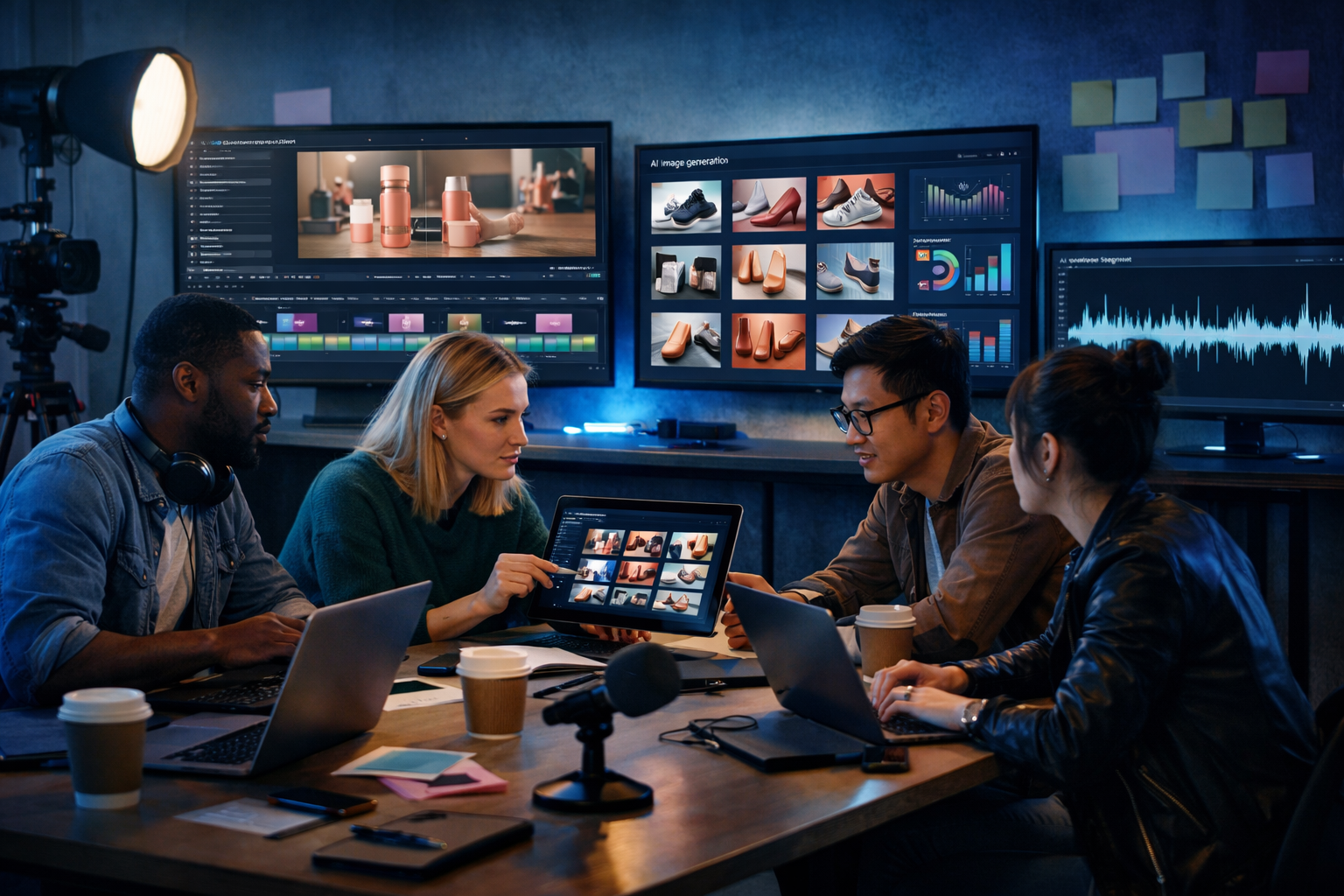
Advertising in 2026 is less about producing a single “perfect” campaign and more about running an always-on creative system: hundreds of tailored assets, tested in real time, with brand safety and consent built in. The biggest shift is that generative AI now sits inside that system—helping teams create, localise, personalise, and iterate across text, images, video, and audio at a pace traditional workflows cannot match.
Why 2026 is a turning point for generative AI in advertising
Generative AI has been used for “quick copy” and concept visuals for a few years, but 2026 is different for three reasons: (1) distribution channels reward volume and variety (short-form video, social commerce, retail media), (2) creative performance depends on relevance to micro-audiences rather than broad personas, and (3) governance is catching up—brands are expected to prove how assets were created, what data was used, and whether content is compliant.
The practical result: marketing teams are building repeatable AI-assisted pipelines. If you’re a startup or small team, you can compete by adopting the right processes early—especially using an all-in-one platform that covers multiple formats. Gen AI Last supports AI text, image, video, and audio generation in one place, which matters when your “campaign” is actually a connected set of assets across channels. Explore our AI content tools to see how this can look end-to-end.
1) Hyper-personalised creative at scale (without breaking your brand)
Personalisation in 2026 goes beyond inserting a first name into an email. Generative AI enables creative personalisation: different value propositions, visuals, formats, and calls-to-action for different segments—sometimes down to region, device, intent, or lifecycle stage.
What’s new in 2026: brands are combining first-party data (consented behaviours, CRM insights) with AI-generated variations, then optimising based on performance signals. The winning teams don’t “handcraft” dozens of ads; they define guardrails and let AI produce controlled variations.
- Create 5–10 audience micro-segments (e.g., “price-sensitive first-time buyer”, “repeat buyer looking for upgrades”, “gift shopper”).
- For each segment, generate a set of messaging angles (benefit-led, proof-led, urgency-led) and match them to channel formats.
- Use a brand style guide prompt (tone, banned claims, preferred terms) to keep outputs consistent.
Example prompt (text ad variations): “Write 12 paid social captions for a vegan skincare serum. Segment: sensitive skin first-time buyer. Tone: calm, clinical, British spelling. Must include: fragrance-free, dermatologist-tested. Avoid: ‘cure’, ‘miracle’. Include 3 hooks, 3 proofs, 3 objections handled, 3 urgency angles.”
With Gen AI Last, you can generate the captions, then create matching images and short videos for the same segment—keeping the message aligned across formats.
2) Creative becomes a “living” multivariate system
In 2026, the best-performing advertisers treat creative as an evolving system: multiple hooks, multiple visuals, multiple lengths, multiple CTAs. Generative AI accelerates this by producing structured variation—without losing the core concept.
Trend to adopt: build a creative matrix. For each campaign, define:
- Hooks: problem, aspiration, comparison, contrarian, social proof.
- Visual frames: product-only, lifestyle use, before/after (where compliant), UGC-style demo, instructional.
- Formats: 6–10s, 15s, 30s video; square vs 9:16; story vs feed; carousel; static.
- CTAs: “Try it today”, “See ingredients”, “Get a sample”, “Compare plans”.
Then you use AI to generate combinations quickly, test, and keep only what performs. The key is not “infinite variation”—it’s disciplined experimentation.
3) AI video dominates acquisition (and gets cheaper to produce)
Video is the default language of attention in 2026, especially for social commerce, retail media placements, and creator-led discovery. The bottleneck has always been production time and cost. Generative AI removes much of that friction—turning scripts into explainer-style videos, creating product demo sequences from prompts, and producing multiple cuts for different platforms.
What’s reshaping advertising:
- Rapid iteration: test three opening hooks in the first 2 seconds without reshooting.
- Localisation: adapt the same video for UK, EU, and MENA audiences with culturally appropriate scenes and copy.
- Format-first production: generate 9:16 reels, 1:1 feed, and 16:9 YouTube cuts from the same creative concept.
Practical workflow: write a 120–150 word script, generate a 15-second version and a 30-second version, then create platform-specific captions and thumbnails. Gen AI Last helps you keep this in one ecosystem so your script, visuals, and variations stay consistent.
4) Synthetic voice and audio branding becomes mainstream
Audio is no longer an afterthought. In 2026, brands use audio across podcasts, short-form video voice-overs, in-app explainers, and product tours. Generative AI audio makes this scalable: you can produce consistent narration, adapt pace and tone per audience, and create background music that fits a mood without expensive licensing complexity.
How this reshapes advertising: you can test whether a calm educational voice converts better than a fast energetic voice, or whether subtle ambient music increases completion rates—without booking studios.
- Use one “brand voice” style across ads, onboarding, and support content.
- Create multiple voice-over lengths for different placements (6s bumper vs 15s reel vs 30s explainer).
- Pair voice-over with captions for accessibility and silent autoplay environments.
5) Retail media + generative AI = faster product creative cycles
Retail media networks keep growing, and they demand high volumes of product-ready assets: clean product images, lifestyle shots, feature callouts, A+ content blocks, and short demos. In 2026, generative AI speeds up these cycles—especially for small brands that can’t afford constant shoots.
Use case: launch a new product and generate:
- 10 product description variants (benefit-led vs spec-led)
- 5 hero images in different settings (kitchen counter, gym bag, bathroom shelf)
- 3 short product videos (unboxing, how-to, comparison)
- A voice-over track for each video
If you’re trying to do this with separate tools and freelancers, you’ll lose time coordinating. An all-in-one platform reduces that overhead. You can view pricing from $10/month and plan content production like a system rather than a series of one-off tasks.
6) “Prompt-to-campaign” bundles replace one-off asset creation
One of the most important generative AI marketing trends reshaping advertising in 2026 is the move from generating isolated assets (a single post, a single image) to generating connected campaign bundles. A bundle includes positioning, landing page copy, ads, email sequences, visuals, and video scripts that share the same message architecture.
How to do it: start with a “campaign brief prompt” that acts like a mini creative strategy document. Then derive every asset from it.
- Inputs: audience, problem, promise, proof, offer, objections, tone, compliance constraints.
- Outputs: 1 landing page structure, 6 ads, 3 emails, 1 short video script, 1 image direction list.
Tip: version your brief. When performance data comes back, adjust the promise or proof, then regenerate downstream assets quickly—without reinventing the whole campaign.
7) Brand safety, provenance, and compliance are non-negotiable
As AI-generated ads become common, scrutiny increases. In 2026, the question isn’t “Did you use AI?” but “Can you explain how this content was made, and is it truthful?” Expect stricter internal reviews, platform policies, and regulatory expectations—especially in health, finance, and targeting-related claims.
What to implement:
- Claim discipline: require sources for performance, medical, or comparative claims; avoid absolutes.
- Prompt guardrails: include banned words, required disclaimers, and tone constraints in your base prompts.
- Human review: create a sign-off checklist for legal/compliance-sensitive categories.
- Asset tracking: keep notes on the prompts and inputs used for each final asset (useful for audits and consistency).
A useful mindset: AI speeds up production, but accountability stays human.
8) Search + social converge into “answer-first” advertising
Consumers in 2026 expect instant, specific answers: “Is this safe for sensitive skin?”, “Will it work with my existing setup?”, “What’s the total cost over 12 months?” Generative AI helps advertisers create answer-first content across paid search, SEO, and social—using consistent language and structured FAQs.
Actionable tactic: build an objection library. List the top 20 questions prospects ask, then generate:
- short-form answers for ads
- long-form answers for landing pages
- 30–45 second video scripts answering one question each
- voice-over variants for the same scripts
This approach improves conversion rates because it reduces uncertainty before the click becomes a purchase.
9) AI-assisted creative strategy: faster insights, not just faster output
A subtle but powerful trend in 2026 is using generative AI to support strategy: summarising campaign results, identifying winning themes, and translating performance insights into the next round of creative briefs.
Try this weekly routine:
- Export top-performing ads and key metrics (CTR, CVR, CPA, watch time).
- Ask AI to categorise winners by hook, offer, proof type, visual style, and CTA.
- Generate 10 new hypotheses: “If proof-led hooks win for segment A, test expert quotes vs user stats.”
- Regenerate assets for the top 3 hypotheses and run controlled tests.
This is where small teams gain leverage: you don’t need a large insights department if your process is tight and repeatable.
10) The rise of micro-influencer “creative cloning” (done ethically)
Creator-style ads keep outperforming polished commercials, but creator supply is limited. In 2026, brands increasingly build creator-inspired templates: UGC-style scripts, shot lists, and editing rhythms that can be reproduced across products and markets. Generative AI accelerates this by producing new scripts and storyboard directions that match proven patterns.
Important: avoid impersonation or misleading “deepfake” endorsements. Ethical creator-inspired advertising means using general formats (hook patterns, pacing, structure) and original visuals or properly licensed content—not copying a specific person’s identity.
- Build 3–5 “creator ad templates” (tutorial, review, unboxing, comparison, myth-busting).
- Generate scripts per template for different segments.
- Produce multiple edits: fast-cut for TikTok/Reels, slower for YouTube Shorts, explanatory for product pages.
A practical 2026 playbook: implement these trends in 7 days
If you want to act on generative AI marketing trends reshaping advertising in 2026 without getting overwhelmed, follow this one-week rollout.
- Day 1: Define guardrails. Create a one-page brand prompt: tone, vocabulary, claims policy, mandatory disclaimers.
- Day 2: Build a campaign brief prompt. Audience, offer, proof, objections, channel mix, creative matrix.
- Day 3: Generate the text bundle. Ads, emails, landing page sections, FAQs.
- Day 4: Generate image directions and assets. 6–10 visuals for key segments and placements.
- Day 5: Generate video scripts and edits. 6–15 second and 15–30 second variants.
- Day 6: Add audio. Voice-over variants and optional background music.
- Day 7: Launch controlled tests. Keep variables limited; track outcomes; feed learnings back into the brief.
You can run this workflow inside a single platform, which reduces handoffs and keeps your messaging consistent. If you want to try it immediately, start creating for free and build your first prompt-to-campaign bundle.
Common mistakes to avoid in 2026 AI-driven advertising
- Chasing volume without a hypothesis: more assets won’t help if they’re not designed to test a specific angle.
- Weak prompts: if you don’t specify audience, offer, and constraints, the output will be generic.
- Inconsistent brand voice: fix this with a reusable style prompt and a lightweight review checklist.
- Risky claims: AI can hallucinate; never publish factual claims without verification.
- Ignoring accessibility: add captions, ensure readable overlays, and consider audio alternatives.
How Gen AI Last supports 2026-ready advertising teams
The 2026 advantage comes from connecting formats: a headline should match the first frame of your video; your voice-over should reinforce the same proof points as your landing page; your images should reflect the same audience context as your captions. Gen AI Last is built for that connected reality—letting you generate professional text, images, video, and audio from simple prompts under one roof.
- AI Text Generation: ads, emails, product pages, social copy built from a shared brief.
- AI Image Generation: campaign visuals, banners, social graphics, concept-to-asset iteration.
- AI Video Generation: short demos, reels, explainers, multi-length variants for testing.
- AI Audio Generation: voice-overs, narration, and audio elements to lift completion rates.
Crucially, it’s accessible for lean teams: full access starts at $10/month, so you can put an always-on creative engine in place without enterprise budgets.
Final thoughts: win 2026 by building a repeatable creative machine
The generative AI marketing trends reshaping advertising in 2026 all point to the same conclusion: speed matters, but systems matter more. The brands that outperform will be those that operationalise AI—creating clear guardrails, producing connected campaign bundles, testing disciplined variations, and maintaining trust through compliance and transparency.
If you want a simple next step, create one campaign brief prompt and use it to generate your first bundle: ads, images, a short video, and a voice-over. Then test, learn, and iterate. That loop is what modern advertising looks like now.
Ready to Create with Generative AI?
Join thousands of creators using Gen AI Last to generate text, images, audio, and video — all from one platform. Start your 7-day free trial today.
Start Free — Try 7 DaysQuick Links
Create AI content from $10/month
View Plans