How AI Is Transforming Email Marketing in 2026
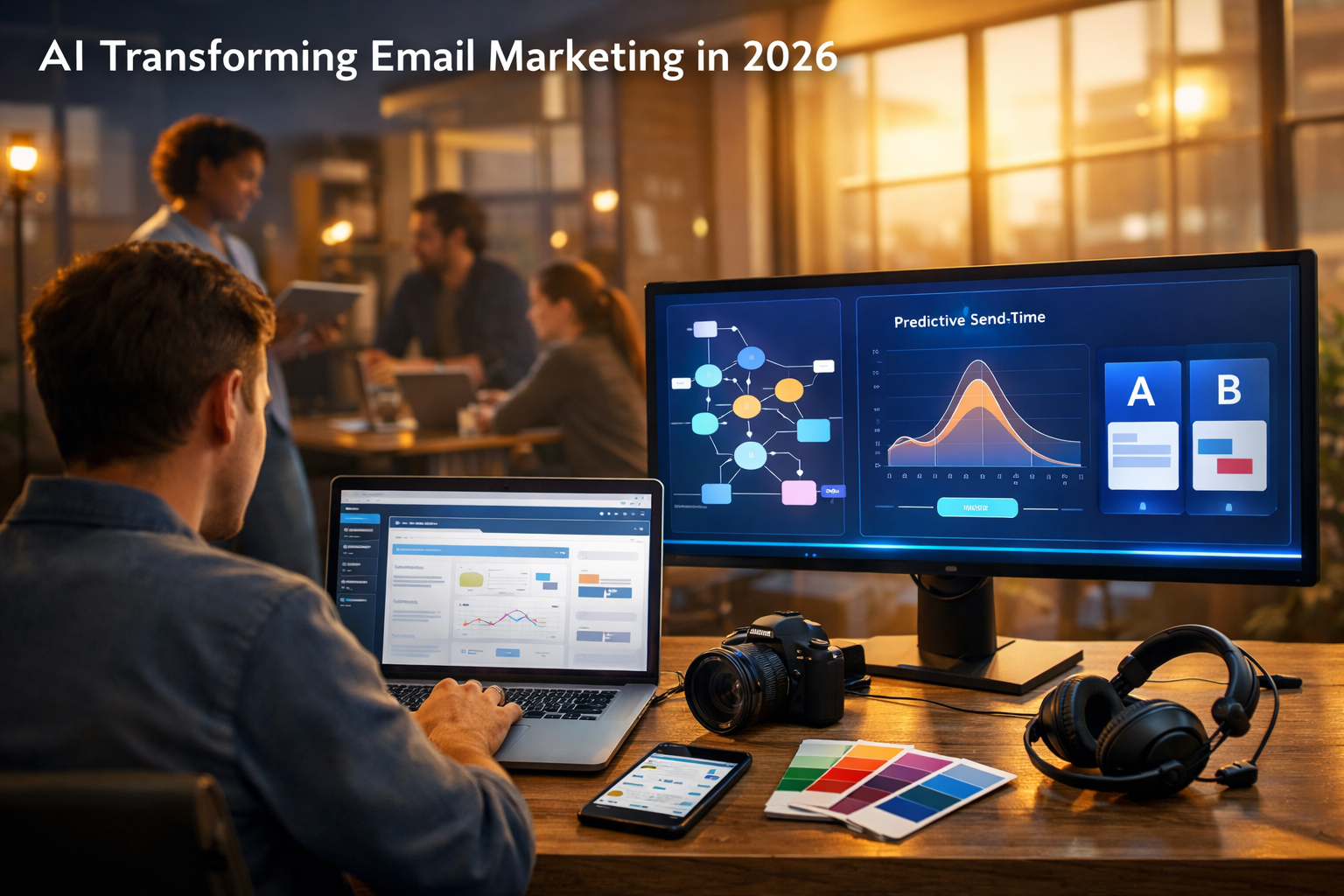
Email is still the highest-intent channel most businesses control—and in 2026, AI is changing how it’s planned, written, designed, tested, delivered and measured. The shift isn’t just “write faster subject lines”. It’s predictive personalisation at scale, automated creative production across formats, and smarter decisions that reduce waste while improving customer experience.
Why 2026 is a turning point for email marketing
Marketers have used automation for years, but 2026 is different for three reasons:
- AI models can now generate and adapt content to audience context (intent, lifecycle stage, product interest), not just insert a first name.
- Inbox ecosystems are stricter: deliverability and engagement signals matter more, and AI helps you keep quality high while staying compliant.
- Creative expectations have risen: customers want clear value, better visuals, and multi-format experiences (image, video, audio) that are consistent across touchpoints.
When you combine these trends, the winners are teams that can produce targeted campaigns quickly without sacrificing brand standards or trust.
1) Hyper-personalisation moves from “segments” to “micro-moments”
In 2026, the biggest change is how personalisation is defined. Traditional segmentation (e.g., “new subscribers”, “returning customers”) still matters, but AI enables micro-moment personalisation: messages that adapt to what someone is likely to do next, not only what they did last.
What this looks like in practice
- Intent-based content: AI predicts whether a subscriber is researching, comparing, ready to buy, or at risk of churn—and adjusts the CTA and proof points.
- Offer and angle matching: Instead of a single discount, AI selects the best incentive (free shipping, bundle, extended trial, bonus content) for each profile.
- Dynamic creative: The email’s hero image, product set, testimonials and FAQs can change based on predicted interests.
Actionable steps to implement this (even with a small team)
- Define 5–7 “decision states” (e.g., exploring, evaluating, ready-to-buy, post-purchase, repeat, dormant, churn-risk).
- Map one job-to-be-done per state (what the reader wants to achieve right now).
- Create a content bank (headlines, offers, proof points, objections) that AI can mix intelligently.
- Use AI to draft variants quickly, then apply brand and compliance checks before sending.
With Gen AI Last, you can generate the content bank in one place—copy, visuals, even short explainer videos—using our AI content tools to keep creative consistent across campaigns.
2) AI-generated copy becomes a controlled, repeatable system
By 2026, most teams have tried AI copywriting—but the results vary. The transformation happens when AI becomes a system, not a one-off “write me an email” prompt.
What a controlled system includes
- Brand voice rules: tone, banned phrases, preferred vocabulary, readability targets.
- Compliance guardrails: claims policy, regulated terms, unsubscribe placement, data usage principles.
- Templates by intent: welcome, browse abandonment, cart abandonment, winback, post-purchase education, renewal.
- Testing strategy: what to test (subject line, CTA, offer framing), and how often.
Practical prompt examples you can reuse
Welcome email (value-first): “Write a welcome email for [brand] to a new subscriber interested in [topic]. Keep it warm and concise in British English, avoid hype, include 3 bullets on what they’ll get, and one CTA to [next step]. Provide 3 subject lines and 2 preview text options.”
Cart abandonment (objection handling): “Draft a cart abandonment email for [product] priced at [£]. Focus on resolving 3 likely objections, include social proof, and a clear CTA. Create two versions: one friendly and one more direct. Keep under 170 words.”
Teams using Gen AI Last often build a small library of prompts per lifecycle stage, then iterate based on performance. Because all plans include full access from view pricing from $10/month, it’s realistic for startups to run a professional workflow without adding headcount.
3) Visuals in emails become faster, more personalised, and more consistent
Email has always been visual, but 2026 pushes you to do more with less attention. AI image generation helps you produce on-brand assets at speed—especially for product-led campaigns and seasonal launches.
Where AI visuals make the biggest difference
- Campaign hero images: create variations for different segments (e.g., outdoors vs city lifestyle) without organising a full shoot.
- Offer callouts and banners: keep style consistent across weeks and promos.
- Product context shots: show how an item fits into real life when you don’t have photography for every use case.
Actionable advice: keep deliverability and load speed in mind
- Export appropriately compressed images and use responsive sizes—big, heavy emails reduce engagement signals.
- Avoid text-heavy images; assume some clients block images by default and ensure the message still works in plain text.
- Write strong alt text that matches the email’s intent (also improves accessibility).
A practical workflow is to generate 3–5 visual options with Gen AI Last, choose one, then create a secondary version for a different segment (e.g., first-time buyers vs loyal customers) while keeping layout consistent.
4) AI transforms testing: from A/B to “always-on optimisation”
Classic A/B tests are slow: you pick one variable, run it, then hope the result applies next month. In 2026, AI makes testing more continuous by generating structured variants and learning faster from engagement.
What to test in 2026 (high impact first)
- Offer framing: “save £20” vs “free delivery” vs “bundle and save”.
- Primary CTA language: action verbs, risk reversal, clarity (“Get my plan” vs “View options”).
- Information order: proof before features, or features before proof.
- Send-time strategy: behaviour-based vs time-zone-based.
How to structure AI-assisted testing so it stays trustworthy
- Change one core idea at a time (e.g., offer framing) even if the AI produces multiple wordings.
- Keep a “control” that runs regularly so you can spot seasonal noise.
- Track downstream metrics (refunds, churn, unsubscribes), not just clicks.
5) Deliverability becomes more proactive with AI
In 2026, inbox providers increasingly reward positive user signals (reads, replies, low complaint rates). AI helps reduce deliverability risks by improving relevance and spotting patterns earlier.
Where AI helps deliverability the most
- Engagement-based sending: suppress or down-weight dormant recipients until they re-engage, rather than blasting everyone.
- Content risk checks: flag overly promotional phrasing, misleading urgency, or claim-heavy language that can trigger spam complaints.
- List hygiene insights: identify segments with rising unsubscribe or complaint rates and adapt frequency.
Quick checklist: deliverability-friendly AI emails
- Be specific about who the email is for and why it’s being sent (relevance beats cleverness).
- Avoid bait-y subject lines; match subject, preview and body.
- Keep a clean text-to-image balance and include a plain-text version where possible.
- Make unsubscribing easy—reducing complaints protects the whole programme.
6) Lifecycle automation becomes smarter (and less annoying)
The “set and forget” drip sequence is fading. AI-driven lifecycle programmes in 2026 adapt to behaviour in near real time—without feeling like surveillance—because messages are grounded in clear customer value.
High-performing AI-driven flows in 2026
- Education-first onboarding: AI selects the next lesson based on what the customer has used (or ignored).
- Post-purchase “reduce regret”: reassurance, setup help, FAQs, and a quick-start video.
- Renewal and retention nudges: value recap plus personalised milestones (“You saved X hours” / “You completed Y sessions”).
Using multi-format content to increase engagement
Email doesn’t have to be only text. In 2026, top campaigns blend formats:
- Short video demos (hosted on your site) to explain “how it works” quickly.
- Audio snippets for thought leadership, founder notes, or podcast-style updates.
- Images that show outcomes, not just aesthetics (before/after, step-by-step, product in context).
Gen AI Last supports text, image, video and audio generation in one platform, making it easier to keep the whole lifecycle consistent—without juggling multiple subscriptions.
7) Customer data, privacy and ethics: what changes in 2026
As AI gets more capable, customers become more sensitive to how you use their data. The best email programmes treat privacy as a competitive advantage, not a constraint.
Principles that keep AI email marketing trustworthy
- Use data customers expect you to use: preferences they gave you, purchases they made, and actions on your site/app.
- Avoid “creepy” inference: don’t reference sensitive categories or overly specific behavioural conclusions.
- Explain benefits: “We personalise recommendations so you see fewer irrelevant emails.”
- Offer control: preference centres (topics, frequency) reduce unsubscribes and complaints.
A simple 2026 AI email workflow (weekly cadence)
Here’s a repeatable workflow small teams can run in 2–4 hours per week, depending on approvals:
- Pick one objective: revenue, activation, retention, lead nurturing.
- Choose one audience state: exploring, evaluating, ready-to-buy, post-purchase, dormant.
- Generate 3 copy angles (problem-led, outcome-led, proof-led) and select one.
- Create 2–3 subject lines + previews aligned to the chosen angle.
- Generate one hero visual + one alternate for a secondary segment.
- Set one test (CTA or offer framing), keep everything else stable.
- Review with a checklist: clarity, accuracy, compliance, accessibility, unsubscribe link, image weight.
- Send, then capture learnings: what worked, what didn’t, and one hypothesis for next week.
You can run most of this inside Gen AI Last, using our AI content tools to generate copy and creative together—then export your final assets into your email platform.
Realistic examples: how different businesses use AI in 2026
E-commerce: smarter product storytelling
Instead of the same product grid for everyone, AI selects a small set of items based on browsing and purchase patterns, then generates benefit-led descriptions and a lifestyle image that matches the segment. The result is fewer products shown, higher relevance, and cleaner design.
SaaS: activation emails that actually activate
AI identifies the “next best action” (connect an integration, invite a teammate, complete setup). Each email focuses on one action, includes a 30-second demo video and a short checklist. Engagement improves because the email is instructional, not promotional.
Professional services: nurturing without sounding generic
AI drafts industry-specific insights, reframes a case study to the reader’s sector, and suggests a consultation CTA that matches the lead stage. A short audio note (hosted on the website) can add a human feel without extra production time.
Common mistakes when adopting AI for email marketing
- Letting AI decide everything: you still need strategy—who, why, and what value.
- Sending more because it’s easier: AI should reduce irrelevant volume, not increase it.
- Ignoring brand voice: inconsistent tone across campaigns erodes trust quickly.
- Over-personalising: relevance is good; creepiness is expensive.
- Measuring only opens: focus on clicks, conversions, replies, churn, and complaint rates.
Getting started: a 7-day plan
- Day 1: document brand voice + compliance rules (one page).
- Day 2: pick two lifecycle emails to improve (welcome + post-purchase, or winback + renewal).
- Day 3: generate 3 variants for each email and choose the strongest structure.
- Day 4: generate two matching visuals and write alt text.
- Day 5: set up one A/B test (CTA or offer framing).
- Day 6: run deliverability and accessibility checks; tighten copy.
- Day 7: launch, then log learnings and update your prompt library.
If you want an affordable way to produce the copy, images and supporting media for these emails, you can start creating for free and scale when you’re ready.
Conclusion: what “good” looks like for AI email in 2026
How AI is transforming email marketing in 2026 can be summarised in one sentence: it helps you send fewer, better emails that feel tailored to the reader’s moment. The brands that win will treat AI as a capability layered onto strong fundamentals—clear value, respectful personalisation, consistent creative, and disciplined testing—rather than a shortcut.
Build a small system, measure what matters, and let AI handle the heavy lifting: drafting, iterating and producing multi-format assets. That’s how you turn email into a compounding growth channel in 2026.
Ready to Create with Generative AI?
Join thousands of creators using Gen AI Last to generate text, images, audio, and video — all from one platform. Start your 7-day free trial today.
Start Free — Try 7 DaysQuick Links
Create AI content from $10/month
View Plans