How Marketers Use Generative AI in 2026: Real Examples
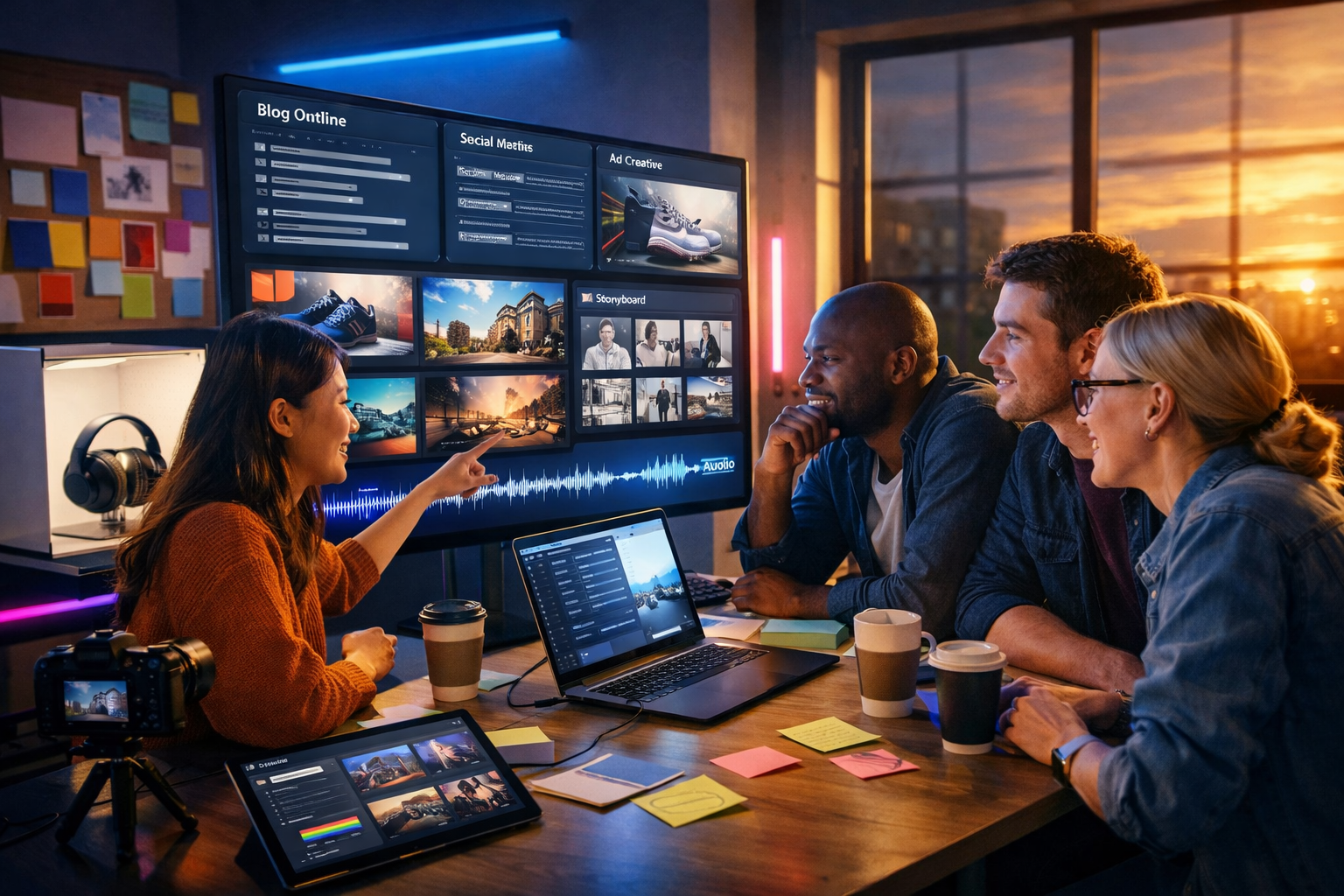
Generative AI is no longer a “nice to have” for marketing teams in 2026—it’s infrastructure. Marketers are using it to ship campaigns faster, personalise at scale, repurpose content across formats, and produce visuals, audio and video without ballooning budgets. Below are real, practical examples of how teams are using generative AI right now, plus workflows and prompts you can copy to achieve the same results with our AI content tools.
What “generative AI marketing” looks like in 2026
In 2026, the most effective marketing teams treat generative AI as a production system, not a one-off copywriter. They build repeatable workflows where AI supports strategy, creation, iteration and distribution. The difference between average and high-performing teams is rarely “better prompts” alone—it’s having clear inputs (audience, offer, positioning, brand voice), a QA process, and a content pipeline that turns one idea into many assets.
Four shifts are shaping how marketers use generative AI in 2026:
- AI outputs are increasingly multi-format: text → images → video → audio, all from a single creative brief.
- Teams optimise for speed with control: templates, brand rules, and approval gates.
- Personalisation is expected, but governed: brands balance relevance with privacy and consent.
- AI is used to test more ideas (angles, hooks, creatives), then humans double down on winners.
Real examples: how marketers use generative AI in 2026
The examples below are organised by common marketing outcomes: demand generation, conversion, retention, creative production and brand building. Each example includes a workflow and a sample prompt you can run using Gen AI Last’s text, image, video and audio generation.
Example 1: “Campaign-in-a-day” product launch for a SaaS startup
Scenario: A two-person SaaS marketing team needs a launch campaign for a new feature, but cannot hire multiple freelancers for copy, design and video.
How they use generative AI in 2026: They start with one brief, generate a consistent set of assets, then iterate with A/B variants. Gen AI Last helps by producing the full stack—landing page copy, email sequence, social posts, hero images, short product demo video and voice-over—from the same positioning.
- Text: landing page sections, FAQs, 5-email launch sequence, 12 social posts.
- Images: hero banner, feature callout graphics, ad creatives sized for social.
- Video: 30–45s vertical reel + 90s explainer for the website.
- Audio: confident voice-over and subtle background music for the explainer.
Prompt to try: “You are a SaaS launch strategist. Create a complete launch kit for [feature] for [ICP]. Include: landing page outline with copy blocks, 5-email sequence, 10 LinkedIn posts, 6 ad headlines, and a 45s video script. Brand voice: [3 adjectives]. Include 3 unique angles and suggested CTAs.”
Example 2: E-commerce creative factory for paid social
Scenario: A DTC brand needs fresh ad creatives weekly to avoid fatigue on Meta/TikTok, but photoshoots are expensive.
How they use generative AI in 2026: Marketers generate product lifestyle images and variations (different backgrounds, props, lighting styles), then convert the best concepts into short video ads and story formats. They pair each creative with multiple hooks and captions, making testing cheaper and faster.
- Image generation: lifestyle scenes (kitchen, gym bag, bedside table), seasonal variants, colour-themed collections.
- Text generation: 20 hooks, 20 primary texts, 10 CTAs, and product benefit bullets.
- Video generation: montage ads from stills + animated overlays (kept minimal and brand-safe).
Prompt to try (image): “Photorealistic lifestyle product shot of [product] used by [persona] in [setting]. Show natural interaction, realistic shadows, shallow depth of field, premium look. Lighting: [warm/cool]. Include props: [list]. 16:9, no text.”
Prompt to try (ad copy): “Write 15 paid social hooks for [product] aimed at [persona]. Mix formats: question, contrarian, ‘before/after’, mini-story. Avoid hype. Keep each under 12 words.”
Example 3: Hyper-relevant email personalisation without creepy data use
Scenario: A B2B company wants higher email engagement but must respect privacy and reduce reliance on third-party tracking.
How they use generative AI in 2026: Instead of personalising with invasive behavioural data, they personalise by context: industry, job role, known pain points, and content preferences captured via opt-in forms. AI generates tailored subject lines, intros and examples per segment while keeping the offer consistent.
- Create 6–10 segments (role × industry × goal).
- Generate one core email, then AI rewrites intros and proof points per segment.
- Human QA checks compliance, claims, and brand voice before sending.
Prompt to try: “Rewrite this email for 6 segments: [list segments]. Keep the offer and CTA identical. Adjust opening, examples and objections to match each segment. Tone: helpful, direct, British English. Return in a table.”
Example 4: SEO content operations built for topical authority
Scenario: A services business wants organic growth, but publishing consistently is difficult.
How they use generative AI in 2026: They plan topic clusters, create outlines with SME review, then generate first drafts fast. The winning approach is not “AI writes everything”; it’s “AI accelerates structure and first-pass writing, humans add expertise, evidence and differentiation”. With Gen AI Last, teams create long-form posts, supporting landing pages and social repurposing in one workflow.
- Build a cluster: pillar page + 10 supporting articles + FAQs.
- Use consistent internal linking and a brand style guide.
- Repurpose each article into LinkedIn posts, newsletter blurbs and short video scripts.
Prompt to try: “Create a topical authority plan for [niche]. Provide: 1 pillar page title, 12 supporting article titles, search intent per title, recommended internal links, and an outline for the pillar page. Include E-E-A-T notes: where to add first-hand experience, examples, and practical steps.”
Example 5: Sales enablement assets that stay consistent across teams
Scenario: Marketing produces collateral, but sales teams adapt messaging inconsistently, creating a brand and compliance risk.
How they use generative AI in 2026: Marketing creates a “message library” (positioning, approved claims, proof points). AI then generates role-based one-pagers, call scripts and objection-handling notes that stay within those boundaries.
- Generate one-pagers per vertical (healthcare, finance, logistics).
- Create discovery question sets and follow-up emails.
- Update collateral quickly after product changes.
Prompt to try: “Using only the approved claims below, create a one-page sales sheet for [vertical]. Include: headline, 3 outcomes, 3 proof points, common objections with responses, and a 30-second pitch. Approved claims: [paste].”
Example 6: Local business marketing that looks like a full agency made it
Scenario: A local clinic or trades business needs a steady stream of content but has a small budget.
How they use generative AI in 2026: They create monthly themes (seasonal offers, common questions, local events). AI produces blog posts, Google Business Profile updates, simple explainer videos and voice-overs. With an all-in-one tool, the business avoids paying separately for copywriting, design and video editing.
- 4 weekly content topics generated from FAQs.
- Before/after-style visuals (where appropriate and consented) or illustrative images.
- 30–60s “what to expect” videos with narration.
Prompt to try: “Create a 4-week content calendar for a [business type] in [location]. Include: one blog topic, two social posts, and one short video script per week. Keep language compliant and friendly. Add suggested CTAs and hashtags.”
Example 7: Creator-style short-form video production without a full studio
Scenario: A founder-led brand wants to publish reels consistently, but filming and editing takes too long.
How they use generative AI in 2026: They turn a single idea into a short-form series: AI writes hooks, structures a 30-second script, generates B-roll prompts, and produces voice-over options. Marketers then assemble variations quickly and test different openings.
- Generate 10 hook variants for the first 2 seconds.
- Create a storyboard with 6–8 shots (A-roll + B-roll).
- Produce voice-overs and background music that match the pacing.
Prompt to try: “Write a 30-second vertical video script on [topic] for [persona]. Provide: 10 hooks, a 7-shot storyboard, on-screen actions, and a voice-over script. Tone: confident, practical. End with a soft CTA to [offer].”
The 2026 workflow: one brief, four outputs (text, image, video, audio)
A reliable way to scale production is to standardise the brief. Here’s a simple “one-brief system” used by modern teams:
- Define: audience, problem, promise, proof, and CTA.
- Generate text: long-form page + short-form variants (ads, social, email).
- Generate images: 3–5 art directions that match the campaign angle.
- Generate video + audio: one explainer and one short reel, each with voice-over.
- QA: fact-check, compliance check, brand voice check, accessibility.
- Measure and iterate: keep winners, kill losers, refresh creative.
If you’re building this from scratch, the easiest path is using an all-in-one platform rather than stitching together separate tools. With Gen AI Last, you can create text, images, video and audio in one place—then keep everything consistent across formats. Explore our AI content tools to set up your workflow.
Practical prompt patterns marketers rely on in 2026
In 2026, prompts are more like mini-briefs. These patterns consistently produce usable marketing assets:
- Constraints: “Write 5 subject lines under 45 characters, no exclamation marks.”
- Voice guide: “Brand voice: calm, expert, minimal fluff, British English.”
- Audience specificity: “For ops managers at 50–200 person logistics firms.”
- Proof-first: “Use these case study facts only: [paste].”
- Variant generation: “Give 10 angles: fear, aspiration, curiosity, ROI, speed.”
Tip: save your best prompts as reusable templates. Consistency beats novelty when you’re publishing every week.
Quality control: how teams avoid “AI slop” and protect the brand
The biggest risk in 2026 isn’t using generative AI—it’s publishing unchecked content that sounds generic, makes unverified claims, or mismatches your brand. High-performing teams use a lightweight QA checklist:
- Accuracy: Verify product details, pricing, features, and any statistics.
- Originality: Add first-hand insight (what you tested, what you saw, what worked).
- Brand voice: Remove clichés, overpromises, and buzzword stacking.
- Compliance: Check regulated claims, testimonials, and disclosures.
- Accessibility: Clear headings, short paragraphs, readable CTAs.
A strong habit: use AI for drafting and variation, then apply human judgement for truth, taste and trust.
Budget reality: why all-in-one matters for small teams
Many 2026 marketing stacks are bloated: one tool for copy, one for images, one for video, one for voice-over, plus subscriptions for prompts and templates. Startups and small teams win by consolidating—especially when output consistency matters (same positioning, same look, same story).
Gen AI Last bundles text, image, video and audio generation in every plan, starting at an accessible price. If you’re comparing options, view pricing from $10/month and map it against what you currently spend on freelancers and multiple tools.
Getting started: a 7-day plan to implement generative AI marketing
If you want results quickly, follow this one-week rollout used by small teams:
- Day 1: Write a one-page brand voice and “approved claims” sheet.
- Day 2: Build one campaign brief (audience, offer, proof, CTA).
- Day 3: Generate landing page copy + email sequence.
- Day 4: Generate 10–15 social posts and 6 ad variations.
- Day 5: Generate 3 image directions and pick one “look”.
- Day 6: Generate a 45–90s video script + voice-over + basic video.
- Day 7: QA, publish, then document what performed best.
To run this plan end-to-end in one place, start creating for free and generate your first campaign kit in an afternoon.
FAQs: how marketers use generative AI in 2026
Is generative AI replacing marketers in 2026?
It’s replacing repetitive production tasks, not strategic marketing. The best teams use AI to move faster, test more ideas, and spend more time on positioning, customer research, creative direction and measurement.
What’s the most profitable use of generative AI for marketing?
Usually: rapid iteration. Generating more angles, hooks and creative variants—and then scaling what works—tends to outperform one “perfect” campaign.
How do you keep AI-generated content on-brand?
Use a consistent brief, a brand voice guide, and an approval checklist. Ask the AI to follow constraints (tone, length, banned phrases) and to only use verified facts you provide.
Conclusion: the winning advantage in 2026 is a repeatable AI workflow
The real examples above show a clear pattern: marketers who win with generative AI in 2026 don’t just “generate content”—they build a system that turns one insight into many assets, across text, image, video and audio. If you want to adopt the same approach without an enterprise budget, Gen AI Last gives you the full toolkit in one affordable platform. When you’re ready, our AI content tools can help you ship faster, test smarter, and keep your creative consistent.
Ready to Create with Generative AI?
Join thousands of creators using Gen AI Last to generate text, images, audio, and video — all from one platform. Start your 7-day free trial today.
Start Free — Try 7 DaysQuick Links
Create AI content from $10/month
View Plans