How Marketers Use Generative AI in 2026: Real Examples
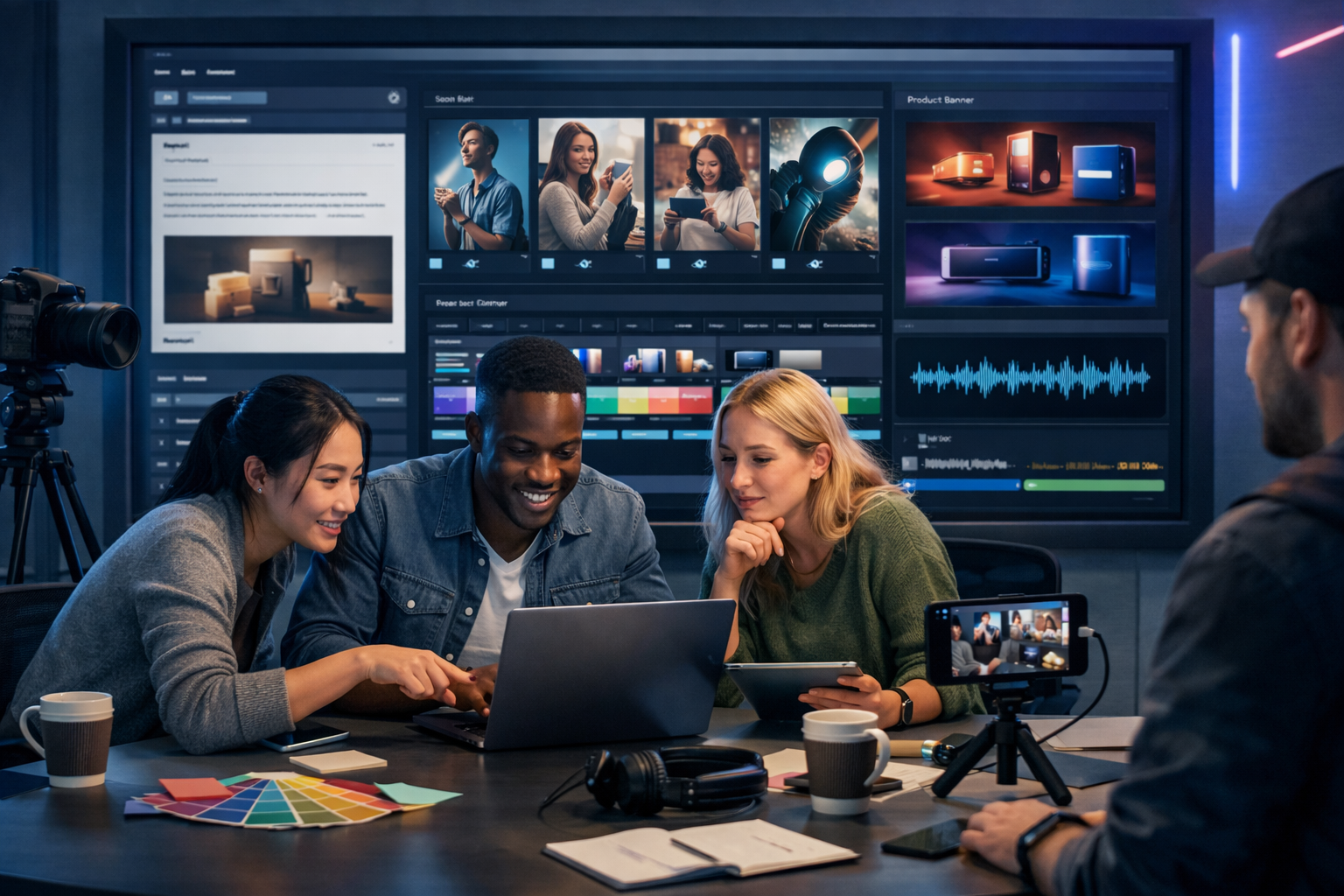
Generative AI isn’t a “nice-to-have” in 2026—it’s the backbone of how lean marketing teams plan, produce, personalise and ship campaigns at speed. The shift isn’t just about writing faster: it’s about generating complete asset kits (copy, images, video and audio), testing variants automatically, and tailoring creative to specific audiences without ballooning budgets. Below are real, practical examples of how marketers use generative AI in 2026, plus workflows and prompts you can adapt using our AI content tools.
What “generative AI marketing” means in 2026
In 2026, marketers typically use generative AI for four connected jobs: (1) ideation and strategy support, (2) asset production across formats, (3) personalisation at scale, and (4) optimisation through rapid variant testing. The best teams treat AI as a production system with guardrails—brand voice, compliance rules, and a human QA layer—rather than a one-off copy machine.
A practical way to think about it is “one brief in, many outputs out”: a single campaign brief becomes blog posts, landing pages, email sequences, ad variations, social visuals, short videos and voice-overs—built to a consistent message but tailored to channel and audience.
Real example #1: One-person startup launches a product in 7 days
Scenario: A solo founder is launching a niche SaaS tool. Budget is tight, time is tighter, and they need a complete launch kit.
How AI is used: The marketer (also the founder) creates a single positioning brief, then generates and refines channel-specific assets.
- AI text: landing page sections, FAQs, onboarding emails, and 10 ad headlines per audience segment.
- AI images: hero banner concepts, feature illustrations, and social promo graphics in consistent style.
- AI video: a 30-second product teaser, plus a 60-second explainer for paid social.
- AI audio: voice-over for the explainer and short cut-downs for reels.
Workflow you can copy: Start with a “message house” (target user, core pain, key proof points, and CTA). Generate first drafts, then tighten claims and add product-specific detail. With Gen AI Last, you can produce text, images, video and audio in one place—particularly useful when you’re working alone.
Prompt to adapt (text): “You are a UK-based SaaS copywriter. Create a landing page structure for [product] aimed at [persona]. Include: hero, 3 benefit blocks, 6 feature bullets, 4 objections with answers, and a clear CTA. Brand voice: [3 adjectives]. Avoid overclaiming; include practical outcomes.”
Real example #2: E-commerce brand generates weekly creatives without a studio
Scenario: A small e-commerce team needs fresh creative every week for Meta/TikTok, but can’t afford constant photoshoots.
How AI is used: They combine product photography they already have with AI-generated lifestyle variations and rapid copy testing.
- AI images: lifestyle backgrounds (kitchen, gym bag, office desk), seasonal variants (summer, autumn), and colourway mock-ups.
- AI text: 20 hook lines for short-form video, 10 primary texts, and 5 offer angles (bundle, subscription, free shipping).
- AI video: short reels using a consistent template: hook → problem → product in use → offer → CTA.
What changes in 2026: Instead of choosing one “best” creative direction, teams ship 10–30 decent variants fast, let performance data guide winners, then polish the top 2–3 with human review and higher production value.
Tip: Build a creative library with reusable components: product close-ups, brand colours, icon style, and approved phrasing. AI then fills the gaps (new compositions, new hooks) without reinventing your brand each week.
Real example #3: B2B SaaS personalises account-based marketing at scale
Scenario: A B2B SaaS company runs ABM for 100 target accounts across multiple industries. Historically, personalisation was too slow and inconsistent.
How AI is used: Marketers generate industry-specific narratives and sales enablement packs while maintaining strict guardrails.
- AI text: tailored email sequences, LinkedIn message drafts, one-page “why us” summaries, and webinar landing pages per vertical.
- AI images: vertical-specific hero visuals (e.g., logistics dashboard scene, healthcare ops team, fintech compliance setting).
- AI video: personalised intro videos for each vertical: the same structure, different story and examples.
Guardrail that matters: Use a “facts-only” section in your prompt: approved claims, verified metrics, and disallowed language. This reduces risk and keeps sales, legal and marketing aligned.
Prompt to adapt (ABM email): “Write a 4-email sequence to [job title] at [industry] organisations about [problem]. Use these approved facts: [facts]. Do not mention competitors. Tone: direct, helpful, not hype. Add a subject line and 2 preview text options per email.”
Real example #4: Local service business uses AI to compete with big brands
Scenario: A local accounting firm wants consistent content and lead generation but has no in-house marketing team.
How AI is used: They produce educational content and repurpose it across channels, improving trust and local search visibility.
- AI text: monthly blog posts, Google Business Profile updates, and a quarterly newsletter.
- AI video: short explainer videos answering common questions (“What counts as a deductible expense?”).
- AI audio: narration for videos and a simple “ask the accountant” podcast format.
This is where an all-in-one platform is particularly practical: the firm can turn one topic into a blog post, 5 social posts, a 45-second video and a voice-over without juggling multiple tools. If you’re cost-sensitive, view pricing from $10/month and compare that to outsourcing even one blog post.
Real example #5: Agencies deliver “content kits” instead of single assets
Scenario: A small agency needs to improve margins while increasing client output. Clients want more content, more channels, and faster turnaround.
How AI is used: The agency sells a repeatable package: one campaign concept produces a full kit.
- 1 blog post + 1 landing page section + 1 email sequence
- 10 social posts + 5 image variations (thumbnails, banners, carousel panels)
- 2 short videos (15s and 30s) + voice-over variants (energetic vs calm)
In 2026, agencies that win aren’t the ones that “use AI”; they’re the ones with a clear production system: intake template, brand kit, review steps, and performance feedback loop. Gen AI Last supports that system because you can generate text, images, video and audio from a single creative direction inside our AI content tools.
Where generative AI has the biggest impact (2026 playbook)
1) Creative testing and iteration
Marketers use AI to create structured variations: hooks, offers, visual styles and CTAs. The key is to vary one element at a time so you can learn what drives performance. AI is the engine; experimentation design is the skill.
- Hooks: curiosity, direct benefit, problem agitation, social proof, “myth vs reality”.
- Offers: trial, demo, bundle, annual discount, free audit.
- Formats: static, carousel, UGC-style video, talking-head explainer.
2) Personalisation without creepy targeting
The best 2026 personalisation is contextual and helpful rather than invasive: industry language, role-specific outcomes, and relevant examples. AI makes it easy to adapt the same truth to different audiences—without inventing claims.
3) Repurposing long-form into multi-channel assets
A single webinar or blog post becomes a month of content: short clips, quote graphics, email snippets, and a narrated version for podcast-style consumption. This is especially valuable for small teams: you get consistency without content burnout.
Practical prompts: copy-and-paste templates for 2026 marketing
Campaign brief prompt (the “one brief in”)
Use this first. Everything else should reference its outputs.
- Prompt: “Act as a senior UK marketing strategist. Build a campaign brief for [product/service] targeting [persona] in [market]. Include: positioning statement, top 3 pains, top 3 desired outcomes, key proof points, objections and responses, brand voice rules, and a 2-week channel plan (email, paid social, organic social, blog, video). Keep claims realistic and measurable.”
Blog-to-social repurposing prompt
- Prompt: “Turn this blog post into: 8 LinkedIn posts, 6 X posts, 2 Instagram carousels (panel-by-panel copy), and 5 short video hooks (under 8 seconds). Maintain brand voice: [rules]. Avoid jargon; include one practical tip per post.”
Short-form video script prompt (15–30s)
- Prompt: “Write a 25-second vertical video script for [audience] about [topic]. Structure: 0–3s hook, 3–15s problem and insight, 15–22s solution with example, 22–25s CTA. Include on-screen text suggestions and B-roll ideas. Tone: confident, friendly, UK English.”
How to implement this with Gen AI Last (small-team workflow)
A simple, repeatable workflow for small teams in 2026 looks like this:
- Define your guardrails: brand voice, approved claims, prohibited phrases, compliance notes.
- Generate the core brief: positioning, audiences, angles, and a channel plan.
- Produce text assets: landing page sections, emails, ad variants, social captions.
- Produce visuals: banners, thumbnails, social graphics; keep style consistent across the campaign.
- Produce video + audio: scripts → video versions → voice-overs; create 2–3 tone variants.
- QA and publish: factual checks, tone check, accessibility basics (captions, readable contrast).
- Measure and iterate: keep winners, kill losers, generate the next batch based on data.
Because Gen AI Last includes text, image, video and audio generation in every plan, you don’t have to stitch together tools as you scale. If you want to test the workflow quickly, start creating for free.
Common mistakes marketers still make in 2026 (and how to avoid them)
Mistake 1: Publishing “AI-sounding” content
Fix it by feeding the model specifics: real constraints, real numbers, real examples, and the exact audience context. Then edit for clarity, not just grammar.
Mistake 2: Letting AI invent proof
Never outsource truth. Provide approved facts, case study details, and measurable outcomes. If you don’t have proof, write honestly about what you can and can’t claim.
Mistake 3: Creating assets without an experimentation plan
If you generate 30 variants but don’t know what changed between them, you won’t learn. Decide your test variables (hook, offer, visual style) before you generate.
E-E-A-T in the age of generative AI: what Google and customers reward
In 2026, strong marketing content still wins on fundamentals: real expertise, clear experience, trustworthy sourcing, and transparency. AI helps you express those qualities faster—but it can’t replace them. Add the human layer: practical steps, screenshots or process descriptions, real customer questions, and accurate, verifiable statements.
- Show experience: include what you tested, what changed, and what you learned.
- Be specific: audiences, constraints, timelines, budgets, and trade-offs.
- Be consistent: one message house across text, images, video and audio.
Conclusion: the 2026 advantage is speed with discipline
The marketers getting outsized results in 2026 aren’t using generative AI to spam the internet—they’re using it to build better campaigns: faster iteration, richer multi-format storytelling, and more relevant personalisation. Start with a clear brief, generate across formats, and keep a tight QA loop. When you’re ready to build your own end-to-end workflow, explore our AI content tools and view pricing from $10/month.
Ready to Create with Generative AI?
Join thousands of creators using Gen AI Last to generate text, images, audio, and video — all from one platform. Start your 7-day free trial today.
Start Free — Try 7 DaysQuick Links
Create AI content from $10/month
View Plans