Plain English vs AI-Generated Content: Which Builds More Trust?
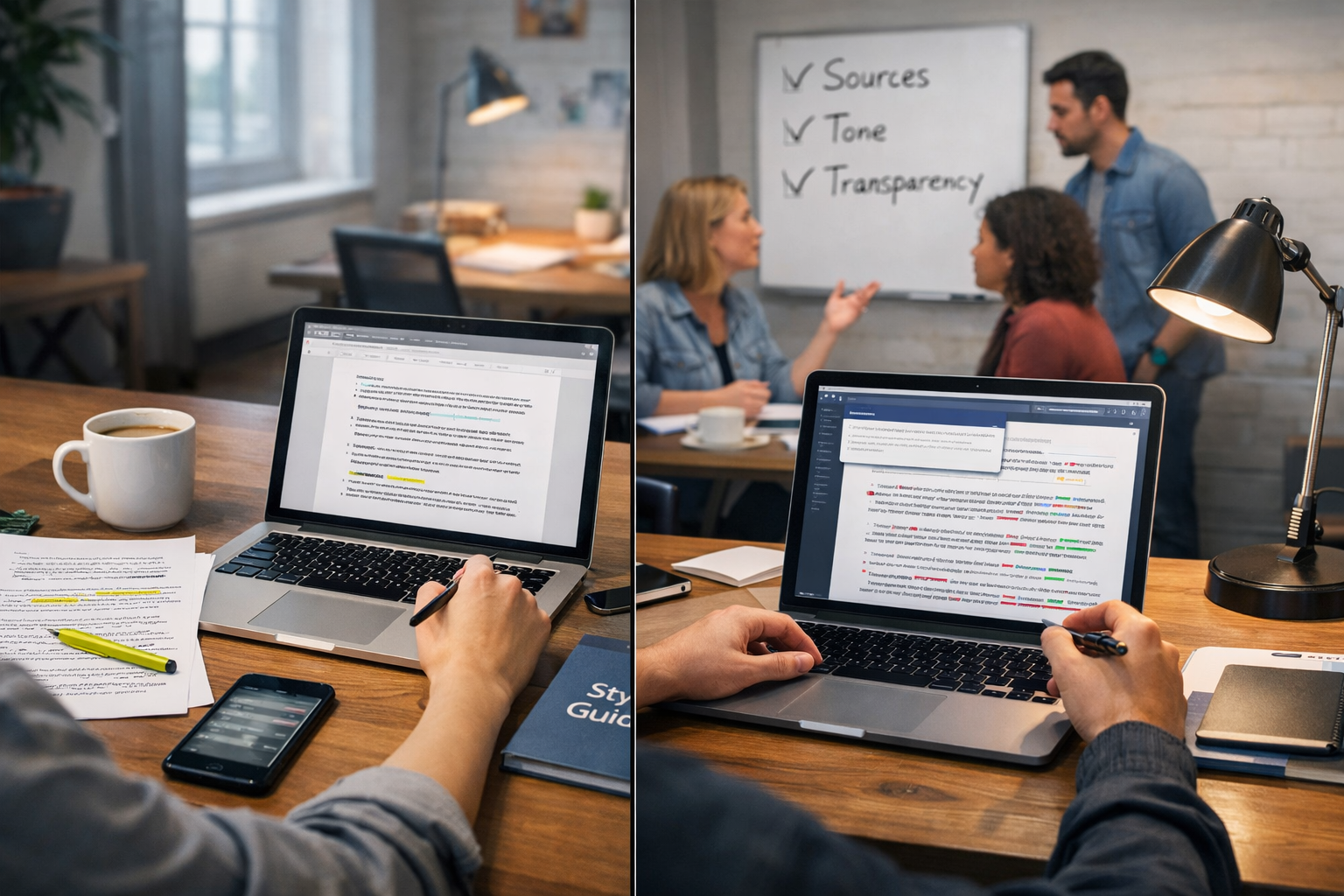
If you want customers to believe you, clarity beats cleverness. But speed matters too, and AI can help you publish more consistently. So when it comes to plain English vs AI-generated content which builds more trust, the real answer is not “either/or” — it’s how you combine human clarity with AI efficiency while proving accuracy, intent, and accountability.
What “trust” means in content (and why people lose it fast)
Trust is not a vibe — it is a judgement readers make in seconds, then confirm (or withdraw) as they scan. In practice, trust usually comes from four signals:
- Clarity: “I understand what you mean and what you want me to do.”
- Competence: “You sound like you know this subject.”
- Honesty: “You’re not hiding the catch, and you’ll own mistakes.”
- Consistency: “Your claims match your actions, pricing, and past content.”
When content feels over-polished, evasive, or stuffed with buzzwords, readers assume you are selling rather than helping. When content feels generic or oddly phrased, readers suspect automation or low effort — even if the information is correct.
Plain English: why it earns trust (when it’s done properly)
Plain English is not “dumbed down”. It is writing that respects the reader’s time: shorter sentences, specific words, and a straightforward structure. It builds trust because it reduces cognitive load and makes intent obvious.
Trust advantages of plain English
- Lower friction: readers don’t have to decode jargon, so they feel more in control.
- Fewer hidden meanings: ambiguity is where scepticism grows (“What are you not saying?”).
- Better decision-making: clear terms, clear pricing, clear steps = less buyer’s remorse.
- Accessibility: non-native speakers and busy readers can still understand you.
Where plain English can fail
Plain English builds trust only when it stays accurate. Oversimplifying can make you sound unqualified (“It’s easy!”) or can create legal/compliance risks if you omit important conditions. The goal is clarity with completeness: explain the hard thing in simple language, and include the necessary details.
AI-generated content: why it can feel less trustworthy (and when it actually helps)
AI-generated content is often distrusted for one main reason: readers have learned to recognise patterns of generic phrasing, broad claims, and a lack of verifiable specifics. That said, AI can increase trust when it helps you be more consistent, more responsive, and more helpful — especially if you use it to enhance plain English rather than replace it.
Common trust issues with AI-generated content
- Generic tone: content sounds like it could belong to any company.
- Overconfidence: definitive statements without evidence, nuance, or caveats.
- Factual drift: small errors in dates, features, or terminology break credibility quickly.
- No lived experience: readers look for real-world detail: what failed, what changed, what you learned.
When AI can increase trust
AI can improve trust when it is used for:
- Consistency: keeping terminology, tone, and brand promises aligned across pages.
- Speed to clarity: producing multiple drafts fast so you can choose the clearest.
- Coverage: answering common customer questions you previously never had time to write up.
- Localisation: rewriting into simpler English for different regions or audiences.
With an all-in-one platform like Gen AI Last, teams can generate and refine content across formats — text, images, audio, and video — while keeping a consistent message. Explore our AI content tools to see how text and creative assets can be built from the same core briefing.
Plain English vs AI-generated content: what actually builds more trust?
Trust is not determined by whether a human or AI typed the first draft. Trust is determined by whether the final output is:
- Clear about what it means (plain English structure).
- Specific about what it claims (numbers, constraints, examples).
- Grounded in evidence (sources, screenshots, policies, processes).
- Accountable (who wrote it, how it was reviewed, when it was updated).
In other words: plain English is the language of trust. AI is a production method. When AI is used to create plain-English content that is carefully checked and tailored, the trust gap narrows dramatically.
A practical trust framework: the “CLEAR” test for every page
Use this quick checklist to decide whether your content will be trusted — regardless of how it was drafted.
- C — Concrete: Does it include specific details (pricing, timeframes, limits, examples) rather than vague benefits?
- L — Logical: Is the structure obvious (problem → solution → proof → next step)?
- E — Evidence-led: Do you link to policies, documentation, case studies, or show your working?
- A — Audience-first: Is it written in the reader’s words, addressing their real objections?
- R — Reviewed: Has a subject-matter owner checked claims, and is there an update date?
How to write AI-assisted content that still reads like plain English
If you publish AI-generated drafts “as-is”, they often sound smooth but not trustworthy. The fix is a workflow that forces specificity, verification, and human perspective.
Step 1: Start with a plain-English brief (not “write me a blog post”)
Before you generate anything, write a short brief in everyday language:
- Who is this for?
- What decision are they trying to make?
- What are they worried about?
- What must we be careful not to overpromise?
- What proof can we include (screenshots, process, figures, policies)?
Then use AI to draft within those guardrails. In Gen AI Last, you can generate multiple text variations quickly (blogs, product pages, emails, social copy) from the same brief, which helps keep your claims consistent across channels.
Step 2: Force specificity with “show your working” prompts
Trust increases when content shows how conclusions were reached. Ask for:
- Assumptions and constraints (“This applies if…”, “This won’t work if…”).
- Step-by-step processes rather than broad advice.
- Examples with realistic context (industry, team size, budget range).
Step 3: Edit for plain English (a quick rewrite checklist)
Use this fast edit pass to turn an AI draft into trustworthy plain English:
- Cut filler: remove “In today’s fast-paced world”, “unlock”, “revolutionise”, “delve into”.
- Shorten sentences: aim for one idea per sentence.
- Prefer verbs: “We deliver weekly reports” instead of “We provide the delivery of reports”.
- Replace vague claims: “improves engagement” → “reduced bounce rate by X% in our last campaign” (only if true).
- Add boundaries: include what you don’t do, who it isn’t for, or typical timelines.
Step 4: Add human signals that AI can’t fake well
If you want readers to trust you, include details that show real experience:
- Decision rationale: “We tested A vs B and chose B because…”
- Trade-offs: “This approach is slower, but it reduces errors.”
- Specific failure modes: “If your product has 50+ variants, watch out for…”
- Ownership: name the team/role responsible for reviews (even if it’s just “Reviewed by Customer Support Lead”).
Examples: making AI content more trustworthy with plain English
Example 1: Product page copy
Less trustworthy (generic): “Our platform delivers cutting-edge solutions to streamline your workflow and maximise productivity.”
More trustworthy (plain English): “Gen AI Last helps you create text, images, audio, and video from a single prompt. Plans start at $10/month and include full access to every generator — no feature tiers.”
Notice what changed: specific features, a concrete price point, and a clear promise without hype.
Example 2: Customer support article
Less trustworthy: “If you experience issues, try troubleshooting your account settings.”
More trustworthy: “If your export fails, check (1) file format, (2) length limits, and (3) your browser permissions. If it still fails, send the error message and the time it happened.”
Example 3: Marketing email
Less trustworthy: “Limited time offer — don’t miss out!”
More trustworthy: “Try the full platform from $10/month. If you’re a small team, the 6-month plan ($50) usually works out best when you’re publishing weekly.”
Trust across formats: text, images, audio, and video must match
A common trust killer is inconsistency: your blog says one thing, your video implies another, and your pricing page reads differently again. One advantage of an all-in-one platform is that you can keep the same core message across formats.
- Images: use realistic visuals that match the claim (avoid overly “stock-like” mismatches). If you promise a simple workflow, show a simple workflow.
- Video: demonstrate the product or process rather than relying on abstract promises. Product demos build trust faster than slogans.
- Audio: clear narration with straightforward language can feel more human than polished marketing copy — especially for explainers and onboarding.
Gen AI Last supports AI text, image, video, and audio generation in one place, which makes it easier to keep your claims aligned across every touchpoint. If you want to build consistent assets without enterprise pricing, view pricing from $10/month.
Should you disclose AI use? A trust-first approach
There’s no single rule that fits every industry, but the trust-first approach is simple: be transparent where it materially affects the reader.
- High-stakes topics (health, finance, legal): add stronger review notes, sources, and disclaimers. If AI assisted, ensure a qualified human has checked it.
- Low-stakes marketing content: disclosure is often less important than accuracy, clarity, and being able to support your claims.
- Customer support and policies: always prioritise correctness and clear ownership; consider an “updated on” date and who reviewed it.
If you do disclose, keep it plain: “Drafted with AI assistance and reviewed by our team.” Over-explaining can look defensive; under-explaining can look evasive.
A simple workflow for trustworthy AI-assisted writing (small teams)
You don’t need a massive editorial department. Use this lightweight process:
- Brief (10 minutes): plain-English problem, audience, proof, boundaries.
- Generate (5 minutes): create 2–3 drafts with different structures and tones using our AI content tools.
- Verify (15 minutes): check every number, feature, quote, and claim. Replace “best” with evidence or remove it.
- Humanise (10 minutes): add experience, trade-offs, and a clear recommendation.
- Publish + update: add “last updated” and revisit regularly, especially for pricing/features.
Quick self-audit: does your content sound human or just fluent?
Fluency is not credibility. Ask these questions before you hit publish:
- Could this page belong to any competitor if you swapped the name?
- Do you state constraints, not just benefits?
- Do you show proof (process, screenshots, examples), or only promises?
- Is the next step clear and low-pressure?
- Would a sceptical reader feel you answered their objections?
Conclusion: the trust winner is plain English — with responsible AI
If you’re choosing between plain English and AI-generated content, choose plain English as your standard — then use AI to produce it faster, more consistently, and across more formats. The brands that win trust don’t hide behind buzzwords or automation; they communicate clearly, verify claims, and show their work.
If you want to create plain-English blogs, product copy, visuals, voice-overs, and videos without juggling multiple tools, you can start creating for free and scale when ready with affordable plans.
Ready to Create with Generative AI?
Join thousands of creators using Gen AI Last to generate text, images, audio, and video — all from one platform. Start your 7-day free trial today.
Start Free — Try 7 DaysQuick Links
Create AI content from $10/month
View Plans