The Future of AI Content Creation Trends 2026 (What’s Next)
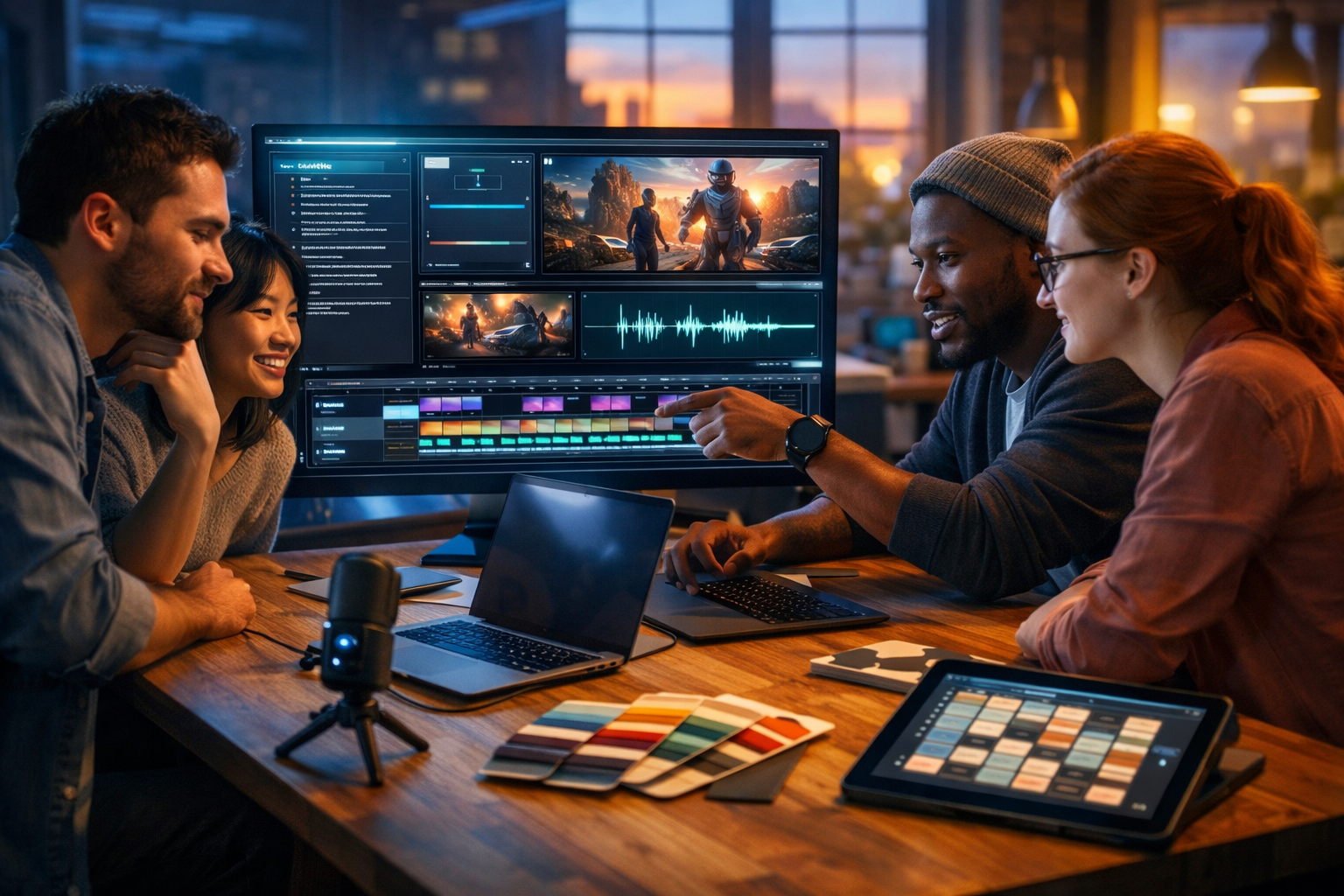
The future of AI content creation trends 2026 is less about “writing faster” and more about building reliable, brand-safe systems that can generate text, images, video and audio in one joined-up workflow. Teams that win in 2026 will treat AI as a production pipeline—governed by strategy, quality standards and compliance—rather than a novelty tool. This guide breaks down the most important trends to watch and exactly how to prepare.
1) Multimodal content becomes the default (text + image + video + audio)
In 2024–2025, many teams experimented with separate AI tools for copy, visuals and voice. In 2026, the expectation is a single workflow where one brief produces multiple formats: a blog post, a hero banner, a product demo video, and a narration track—consistent in tone, style and messaging.
This shift is driven by two realities: audiences consume content across channels, and marketing teams are under pressure to produce more variations with fewer people. Multimodal production cuts handoffs, reduces inconsistencies, and makes it easier to maintain brand coherence.
- Plan “content families”: one idea becomes a long-form article, 5 social posts, a 30-second reel, and an email sequence.
- Create shared creative constraints: tone, target reader, visual style, CTA, and compliance notes.
- Standardise approval: one checklist for factual accuracy, brand fit and claims.
If you want to operationalise this quickly, centralise production in our AI content tools so your team can generate text, images, video and audio from the same brief—without juggling multiple subscriptions.
2) “Brand voice systems” replace one-off prompting
By 2026, the differentiator will not be whether you use AI, but whether your AI output sounds unmistakably like you. The trend is moving from ad-hoc prompts to repeatable “brand voice systems”: structured inputs that define vocabulary, sentence rhythm, positioning, and approved claims.
What a 2026-ready brand voice system includes
- Voice pillars: e.g., practical, direct, optimistic; avoid hype; use British English spelling.
- Message map: core value propositions, proof points, and common objections with approved responses.
- Do/Don’t list: banned phrases, risky claims, competitor references, regulated terms.
- Examples library: 5–10 “gold standard” pieces that the AI can imitate stylistically.
Practical tip: treat prompts like product requirements. Save the best-performing instructions, reuse them, and iterate based on results (CTR, time on page, conversions), not gut feeling.
3) Video-first content marketing accelerates (and AI makes it feasible)
One of the most impactful AI content creation trends for 2026 is the continued shift to video-first publishing. Short-form reels and explainers are not replacing written content—they’re becoming the distribution engine that pulls people into deeper articles, landing pages and product demos.
The challenge has always been production time and cost. AI changes that by helping small teams produce multiple video variants: different hooks, aspect ratios, voice-overs, and cutdowns for specific platforms.
A 2026 “content ladder” that works
- Start with a pillar article answering a high-intent query.
- Generate a 60–90 second explainer summarising the key insight.
- Cut into 3–5 short clips with different hooks and CTAs.
- Add voice-over + captions for silent autoplay and accessibility.
- Retarget viewers with an email capture or product demo.
With Gen AI Last you can generate marketing videos and pair them with AI audio voice-overs in the same place, making “video-first” realistic even if you’re a two-person marketing team.
4) AI-generated images move from “pretty” to “purpose-built”
In 2026, successful creative teams will stop generating random visuals and start producing images that match intent: conversion-focused banners, product photo variations, consistent social templates, and visuals that support a narrative.
Expect more emphasis on art direction: lighting, composition, context and audience cues (for example, a home office for solo founders, a studio for premium products, or a café setting for lifestyle apps). This is also where brand consistency matters—colours, styling and recurring motifs.
Actionable checklist for 2026 image prompts
- Specify the use case (hero banner, product shot, social square, blog header).
- Define setting + props that match the customer’s world.
- Lock lighting style (soft natural light, neon accents, moody studio, etc.).
- Avoid visual ambiguity: call out camera angle, depth of field, and composition.
- Add constraints: “no text, no logos, no watermarks” for cleaner assets.
If your team is building a faster pipeline, generate campaign-ready visuals alongside the copy using our AI content tools, then keep a small library of reusable prompt templates per channel.
5) Audio becomes a growth channel again (voice, podcasts, narration)
Audio is returning as a practical channel for busy audiences: narrated articles, snackable podcast segments, and product walkthroughs. In 2026, AI audio generation makes this accessible without studio time—especially for brands that need consistent voice across dozens of assets.
The key trend is “audio repurposing”: turning existing written content into narration, then distributing it on-site, in newsletters, and across podcast platforms.
Where AI audio fits best in 2026
- On-page narration to reduce bounce and improve accessibility.
- Podcast-style summaries of weekly articles.
- Voice-overs for product demos and reels.
- Background music for short marketing videos (where appropriate).
6) Quality, originality and trust signals matter more than volume
As AI-generated content becomes ubiquitous, search engines and users will reward content that demonstrates experience, specificity and usefulness. In practice, that means: clear opinions backed by reasoning, real examples, and content that actually answers the query better than the alternatives.
For the future of AI content creation trends 2026, treat AI as a first draft assistant—not your final editor. Human review still matters for nuance, accuracy, and context. Your competitive edge is not “more posts”; it is better posts that readers trust.
Practical ways to raise trust quickly
- Add first-hand process detail: what you tried, what happened, what changed.
- Use numbers carefully: only include metrics you can stand behind or label them as examples.
- Include decision frameworks (checklists, scoring, step-by-step methods).
- Tighten claims: remove “best”, “guaranteed”, “instant” unless you can prove them.
7) Compliance and content governance become non-negotiable
A defining 2026 trend is governance: knowing what went into a piece of content, who approved it, and whether it meets brand and legal standards. This is especially important in regulated industries (finance, health, education) but it’s increasingly relevant everywhere due to reputational risk.
A lightweight governance model for small teams
- Define risk tiers: low-risk social posts vs high-risk landing pages with claims.
- Create an approval checklist: accuracy, tone, claims, IP, privacy.
- Centralise prompts: store “approved prompt templates” for repeatability.
- Maintain a changelog: what was edited and why (even a simple doc).
This approach keeps speed while reducing risk—exactly what small teams need when they’re publishing across multiple channels.
8) Personalisation shifts from “Hi {FirstName}” to content variants by intent
In 2026, personalisation is less about superficial tokens and more about intent-based variants: different messaging for “researching”, “comparing”, and “ready to buy”. AI makes it practical to produce multiple versions of the same asset without doubling workload.
Example: one product, three intent variants
- Top of funnel: educational blog post + short explainer video.
- Mid funnel: comparison page copy + feature-focused visuals.
- Bottom of funnel: demo script + voice-over + onboarding email sequence.
The operational trick is to write one master brief, then generate channel-specific and intent-specific variants—keeping the same proof points and brand voice.
9) AI augments creative teams instead of replacing them
Despite the headlines, 2026 is about role evolution, not replacement. The most valuable skills shift towards: creative direction, audience research, editing, and distribution strategy. AI handles the repetitive drafting and variation production; humans make the work meaningful and effective.
New “must-have” capabilities in 2026
- Prompt engineering as documentation: clear inputs that others can reuse.
- Editorial judgement: what to publish, what to cut, what to verify.
- Creative direction: consistent visual and narrative style.
- Distribution craft: hooks, packaging, and testing.
10) Cost efficiency becomes a competitive advantage (especially for startups)
As the market matures, many AI tools raise prices or charge separately for text, images, video and audio. For startups and small teams, predictable pricing and full-stack capability can be the difference between experimenting and actually building a repeatable content engine.
Gen AI Last includes text, image, audio and video generation in every plan, starting at $10/month—useful if you want a single platform to support the entire funnel. You can view pricing from $10/month and map it against your current tool stack.
How to prepare now: a 30-day plan for 2026-ready AI content
Trends are only useful if they translate into action. Here’s a practical 30-day plan to build a production system that matches the future of AI content creation trends 2026.
Days 1–7: Build your foundation
- Write a one-page brand voice guide (tone, do/don’t, examples).
- Pick 3 priority audiences and list their top 10 questions.
- Define content families (pillar + derivatives) for each audience.
Days 8–14: Create templates and checklists
- Create prompt templates for: blog outline, email sequence, social hooks, video script, image art direction, voice-over.
- Create an approval checklist (accuracy, claims, brand, accessibility).
- Set a naming system for assets (campaign/date/channel/version).
Days 15–21: Produce one full campaign
- Generate a pillar article and publish it.
- Generate 3–5 supporting visuals and a hero banner.
- Generate a 60–90 second explainer video plus 3 cutdowns.
- Generate narration/voice-over and optional background music.
Days 22–30: Measure, iterate, and scale
- Track outcomes: search impressions, CTR, time on page, leads, video retention.
- Refine the templates based on what performed best.
- Repeat the campaign process for the next audience segment.
If you want to run this plan without piecing together separate tools, you can start creating for free and build your first end-to-end campaign inside one platform.
Frequently asked questions: AI content creation in 2026
Will AI-generated content still rank on Google in 2026?
Yes—if it’s helpful, accurate, and demonstrates real value. AI is best used to speed up drafting and variation, while humans ensure originality, experience, and trust signals.
What is the biggest risk with AI content in 2026?
Publishing confident but incorrect information, or making claims your business can’t support. Governance (checklists, risk tiers, approvals) reduces that risk without slowing you down.
What should small teams prioritise first?
A repeatable workflow: one brief → multimodal assets → distribution → measurement. Cost-effective, all-in-one platforms help you scale without operational sprawl.
Conclusion: what “future-ready” looks like in 2026
The future of AI content creation trends 2026 points to a clear destination: multimodal production, brand voice consistency, video-first distribution, and stronger compliance. The teams that outperform won’t be the ones generating the most; they’ll be the ones with the best system—turning ideas into on-brand assets quickly, safely, and repeatedly.
If you’re building that system now, consolidate your workflow, create templates, and focus on measurable outcomes. Gen AI Last gives startups and small teams a practical way to do it—text, images, audio and video in one place, from $10/month.
Ready to Create with Generative AI?
Join thousands of creators using Gen AI Last to generate text, images, audio, and video — all from one platform. Start your 7-day free trial today.
Start Free — Try 7 DaysQuick Links
Create AI content from $10/month
View Plans