The Future of AI Content Creation Trends 2026 (Guide)
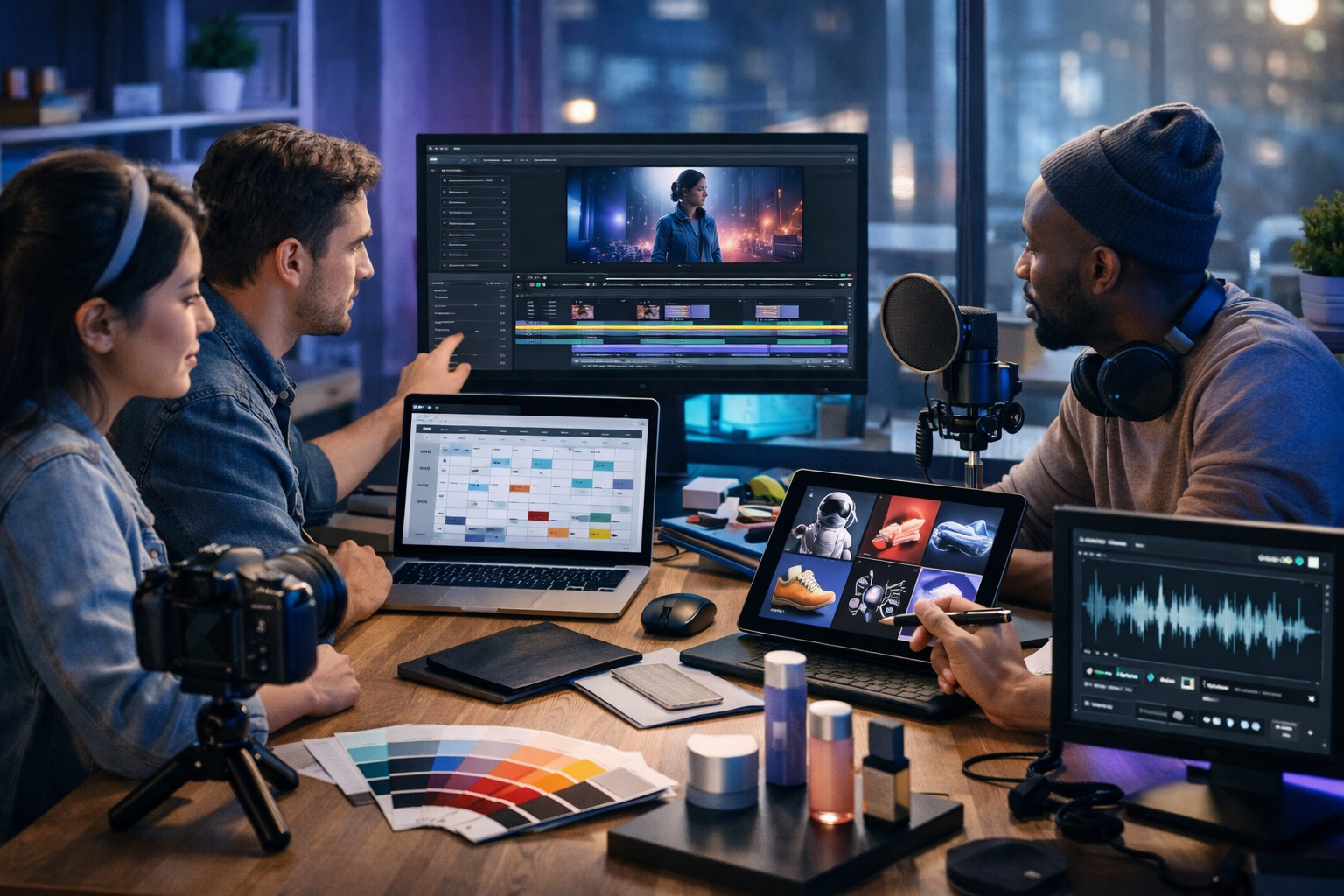
The future of AI content creation trends 2026 will be defined by one thing: multimodal production at scale—where text, images, video and audio are generated together from a single brief, then refined with brand controls and real performance feedback. For startups and small teams, this is less about “doing more content” and more about building a faster, safer pipeline that consistently produces assets customers actually engage with.
Why 2026 is a turning point for AI content creation
AI content tools have moved beyond novelty. By 2026, competitive advantage will come from systems: how you brief, generate, review, publish, measure, and iterate. The winners will treat AI as an always-on production layer—supporting marketing, sales enablement, customer education, product documentation, and internal comms—without sacrificing trust or brand consistency.
Three forces are accelerating this shift:
- Multimodal models that handle text + visuals + audio + video as one workflow.
- Search and social fragmentation pushing brands to publish in more formats (short video, carousels, podcasts, email sequences).
- Higher trust expectations (accuracy, sourcing, transparency, and brand safety).
An all-in-one platform becomes particularly valuable here, because coordinating tools across multiple subscriptions quickly creates friction, inconsistent outputs, and duplicated effort. With our AI content tools, teams can generate professional text, images, video, and audio from simple prompts in one place—while keeping a consistent creative direction across formats.
The future of AI content creation trends 2026: 12 shifts to watch
1) “One brief, many assets” becomes the default
In 2026, the core content unit won’t be “a blog post” or “a video”. It will be a campaign brief that generates a bundle: landing page copy, product images, short-form videos, voice-over, social captions, email nurture sequences, and ad variations—each adapted to platform constraints.
Practical example: A SaaS startup launches a new feature. One prompt produces:
- A 1,200-word blog explainer (SEO-led)
- A 30-second product demo reel (vertical)
- Three banner concepts for retargeting
- A voice-over and background music bed for the reel
- Two email sequences: trial users vs. prospects
Gen AI Last supports this shift because you can generate text, image, video and audio outputs from simple prompts, then keep your messaging aligned across every asset type.
2) Multimodal brand consistency becomes a competitive moat
In 2026, brands won’t stand out by producing more. They’ll stand out by producing content that looks and sounds unmistakably like them across formats: consistent tone, visual style, pacing, and narrative structure.
Actionable advice: Create a “brand prompt pack” that includes:
- Tone of voice rules (do/don’t list, reading level, banned phrases)
- Visual direction (lighting, composition, colour palette, realism level)
- Video rules (aspect ratios, on-screen pacing, shot types)
- Audio rules (voice style, speed, pronunciation list, music mood)
Then reuse it for every generation session. This reduces rework and makes multi-channel publishing feel cohesive instead of chaotic.
3) AI video moves from “nice to have” to “default format”
Short video will keep dominating attention, but by 2026 you’ll also see more AI-assisted explainer videos, product demos, onboarding clips, and sales enablement snippets. The trend is not just generation; it’s rapid iteration: multiple hooks, multiple cuts, multiple CTAs.
Use case: Turn a blog section into a 45-second explainer with a simple structure:
- Problem (5 seconds)
- New approach (10 seconds)
- Three benefits (20 seconds)
- CTA (10 seconds)
With Gen AI Last’s AI Video Generation, small teams can create marketing videos, product demos, social reels, and explainers without relying on a full studio for every iteration.
4) AI audio grows beyond podcasts: voice becomes a conversion layer
Audio won’t be limited to long podcasts. In 2026, expect more voice-overs for reels, narrated case studies, audio summaries in newsletters, and lightweight “radio-style” ads for social and streaming platforms. Brands will treat voice as a trust signal—when it’s consistent and high quality.
Practical example: Add a 60–90 second narrated summary to each pillar blog post. Repurpose that narration into:
- A podcast feed “micro-episode”
- A LinkedIn native video with waveform visual
- An embedded audio clip on your landing page
Gen AI Last includes AI Audio Generation for voice-overs, narration, and background music—useful when you need speed and consistency across dozens of assets.
5) Search shifts: optimisation for “answers”, not just keywords
SEO in 2026 will continue trending toward satisfying intent quickly: concise definitions, comparisons, step-by-steps, and real-world examples. People will increasingly discover content through AI-assisted search experiences and social, which rewards clarity and structure.
Actionable advice: For each target query, include:
- A direct explanation in the first 100–150 words
- Clear H2/H3 structure with scannable lists
- Original examples (your workflow, templates, checklists)
- A “how to implement” section (so it’s not just predictions)
6) Human review becomes more important, not less
As AI content becomes ubiquitous, the differentiator is editorial judgement: accuracy checks, brand fit, and ethical considerations. In 2026, teams that publish fastest without review will face higher reputational risk.
Simple review workflow for small teams:
- Subject owner validates facts, claims, and numbers.
- Editor checks voice, structure, and reader usefulness.
- Compliance/brand check: disclaimers, sensitive topics, image usage rules.
- Publish, then measure engagement and update quickly.
7) Synthetic product imagery becomes normal for marketing (with guardrails)
AI image generation in 2026 will be used heavily for concepting and marketing variations: seasonal themes, lifestyle scenes, social graphics, and banners. But trust matters: teams will need rules around realism, disclaimers (when relevant), and making sure visuals do not misrepresent product functionality.
Best practice: Use AI images for:
- Backgrounds, creative themes, and campaign key visuals
- Abstract concepts (security, speed, collaboration)
- Non-literal lifestyle scenes (when you can avoid misleading specifics)
Gen AI Last’s AI Image Generation is ideal for marketing visuals, product-style photos, social graphics, and banners—especially when you need many variations for A/B testing.
8) Content personalisation scales—without creating “creepy” experiences
In 2026, personalisation will focus on context, not surveillance: industry-specific versions of the same asset, stage-of-funnel variants, and role-based messaging (founder vs. marketer vs. developer). The goal is relevance without overstepping.
Practical example: One product page, three versions of the hero section:
- For e-commerce: focus on conversion rate and creative testing
- For agencies: focus on client delivery speed and margins
- For SaaS: focus on onboarding and feature adoption
AI text generation makes these versions fast to produce; your job is to ensure they’re truthful and aligned with what you can deliver.
9) “Content operations” becomes a real function—even in tiny teams
By 2026, the most effective teams will manage content like a production line: briefs, templates, approvals, asset libraries, naming conventions, and performance dashboards. This doesn’t require enterprise headcount; it requires discipline.
Actionable advice: Build a simple content ops kit:
- A one-page brief template (audience, promise, proof, CTA)
- A repurposing checklist (blog → email → social → video → audio)
- A QA checklist (facts, tone, claims, accessibility, legal)
10) E-E-A-T expectations rise: proof, perspective, and provenance
Google and readers both reward content that demonstrates experience and credibility. In 2026, generic AI-written articles will struggle unless they include tangible value: original frameworks, examples from practice, clear limitations, and updated guidance.
What to add to AI-assisted content:
- Your “how we do it” workflow (even if small)
- Screenshots, metrics, or anonymised results where possible
- Clear caveats (what this does not solve)
- A maintenance plan (update schedule and ownership)
11) Budgets shift from tools to outputs (and the tool stack consolidates)
The 2026 buyer mindset is: “How many usable assets can we ship per month, and what’s the cost per asset?” This pushes teams toward consolidated platforms that reduce context switching and per-seat expenses.
Gen AI Last keeps pricing simple: full access to text, image, audio and video generation starting at $10/month. You can view pricing from $10/month and choose monthly, 6-month, or yearly options based on your publishing cadence.
12) Real-time iteration becomes the norm: “publish, learn, regenerate”
In 2026, content isn’t finished when it’s published. Teams will continuously improve assets based on performance signals: hook retention, scroll depth, email replies, ad CTR, and conversion rate. AI makes those iterations cheap—if you have a feedback loop.
Actionable advice: Set a weekly optimisation ritual:
- Pick one underperforming page and one underperforming video.
- Generate three alternative hooks and CTAs.
- Update, republish, and track uplift over 7–14 days.
A 2026-ready workflow you can implement this week
You don’t need a large team to benefit from these trends. You need a repeatable process. Here’s a practical, lightweight workflow built around a single source-of-truth brief.
Step 1: Write a tight brief (15 minutes)
Include: target audience, their problem, your unique angle, proof points, offer, CTA, and the formats you need (blog, social, reel, voice-over, banners).
Step 2: Generate the pillar asset (text) first
Use AI text generation to create a structured article, then do a human edit focusing on accuracy, specificity, and usefulness. This pillar becomes your script and messaging base for other formats.
If you want to streamline the entire pipeline, start inside our AI content tools so your campaign outputs stay aligned across media types.
Step 3: Derive scripts and storyboards for video
Pull 3–5 key points from the pillar article and create a short script per platform (TikTok/Reels/Shorts vs. LinkedIn). Keep one clear promise per video.
Step 4: Generate supporting visuals and variations
Create consistent visuals: social images, banners, thumbnails, and concept art for video scenes. Use variations for testing (different backgrounds, lighting styles, compositions) while maintaining brand cues.
Step 5: Add voice and audio polish
Generate a clean voice-over and, if needed, subtle background music. Keep audio intelligibility above everything—especially for mobile viewers.
Step 6: Publish as a bundle, then measure
Launch the pillar blog, publish the short video, schedule social posts, and send the email—all within 48 hours. Then track performance and regenerate only what needs improvement.
Common mistakes to avoid in 2026
- Publishing generic content at scale: it won’t rank and won’t convert. Add perspective, examples, and proof.
- Skipping review: accuracy and brand safety are part of performance.
- Creating assets in isolation: text, visuals, video and audio should share the same core message.
- Ignoring measurement: if you don’t track outcomes, you can’t iterate intelligently.
- Tool sprawl: too many disconnected tools slows you down and increases costs.
How Gen AI Last helps you act on the 2026 trends
If the future of AI content creation trends 2026 is about multimodal speed with brand-safe consistency, the practical requirement is simple: an affordable platform that can generate every asset type you need, without forcing you to stitch together four separate subscriptions.
- AI Text Generation: blog posts, product descriptions, email campaigns, social media copy.
- AI Image Generation: marketing visuals, product-style photos, social graphics, banners.
- AI Video Generation: marketing videos, product demos, social reels, explainer videos.
- AI Audio Generation: voice-overs, podcast audio, background music, narration.
And because every plan includes full access from $10/month, it’s viable for startups and small teams to build a modern content engine without enterprise overhead. If you want to test a bundled workflow quickly, start creating for free and generate your first campaign pack from a single prompt.
Conclusion: prepare for 2026 by building a system, not chasing hacks
The future of AI content creation trends 2026 is not a single feature—it’s an operating model. Multimodal campaigns, faster iteration, stronger brand consistency, and higher trust requirements will reshape what “good content” looks like. The best next step is to standardise your brief, build a review loop, and produce content bundles that move from text to images to video to audio seamlessly. With an all-in-one platform like Gen AI Last, you can do exactly that—quickly, affordably, and at a quality level your audience will recognise.
Ready to Create with Generative AI?
Join thousands of creators using Gen AI Last to generate text, images, audio, and video — all from one platform. Start your 7-day free trial today.
Start Free — Try 7 DaysQuick Links
Create AI content from $10/month
View Plans