The Future of AI Content Creation Trends 2026
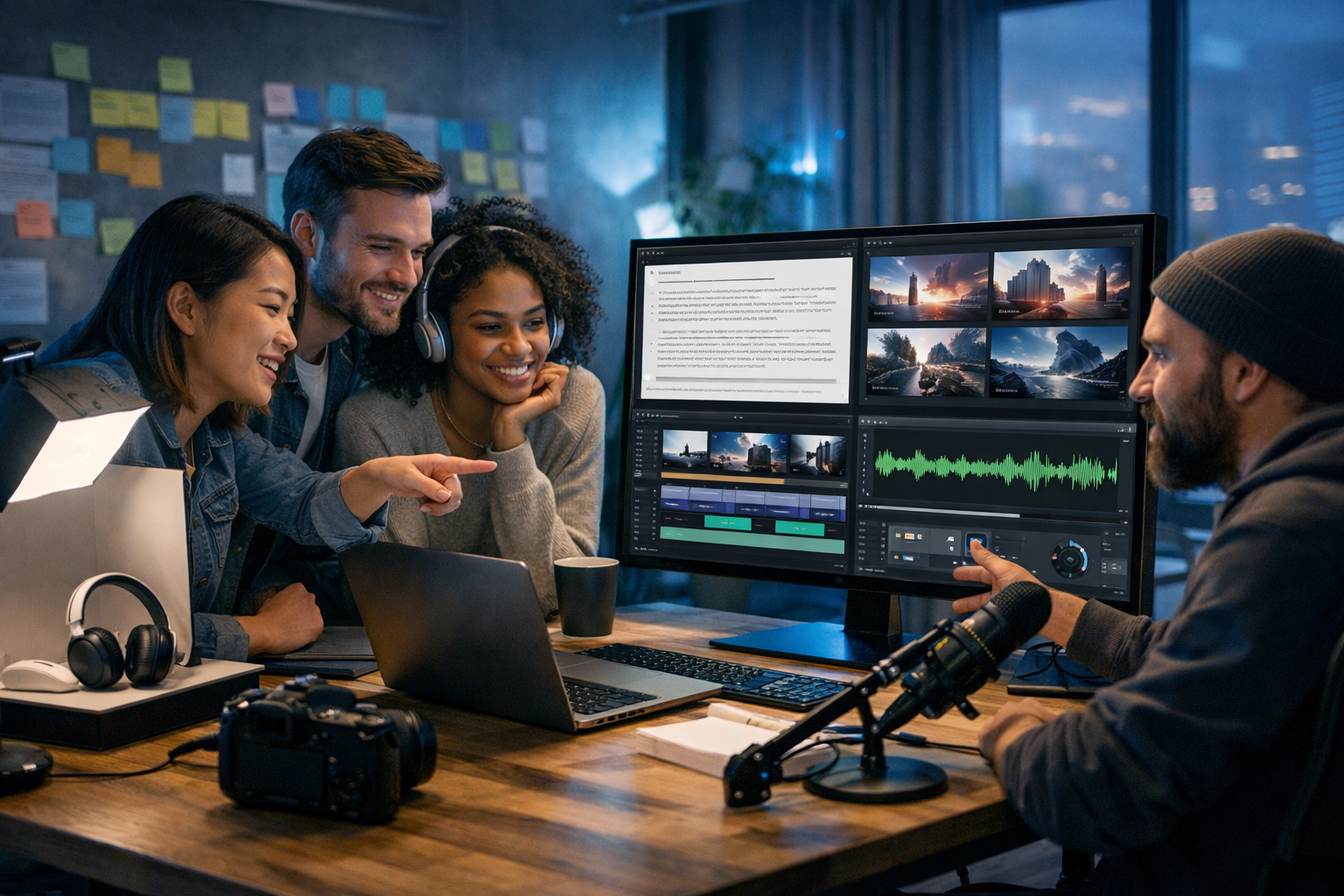
The future of ai content creation trends 2026 is less about “one magic tool” and more about connected, multimodal production: teams generating text, images, audio and video from a single brief, with brand guardrails, measurable performance and faster turnaround. In 2026, the winners won’t be the loudest adopters of AI — they’ll be the teams who build repeatable workflows that keep quality high, reduce risk and ship consistently across channels.
Why 2026 is a turning point for AI content creation
Generative AI has moved from experimentation to operations. By 2026, most organisations will already have access to capable models, so competitive advantage will come from process: how you brief, review, iterate, localise, repurpose and measure content. The core shift is that content is becoming multimodal by default — a single campaign idea can become a landing page, ad creative, short-form video, product imagery, email sequence and voice-over within days (or hours) rather than weeks.
This is especially meaningful for startups and small teams: budgets remain tight, but audiences expect high production value. Platforms like our AI content tools make it possible to generate professional text, images, audio and video from simple prompts — without stitching together multiple subscriptions.
The future of AI content creation trends 2026: the 12 trends to watch
1) Multimodal workflows replace single-format production
In 2026, planning will start with the campaign narrative, not the format. Teams will build one “source brief” and produce multiple assets in parallel: written copy, supporting graphics, a short explainer video, and voice-over narration. This cuts re-briefing time and keeps messaging consistent across channels.
Practical move: Create a master prompt that includes audience, offer, brand voice, proof points and the desired outputs (blog outline + social carousel captions + 30-second video script + voice-over tone). Then generate and refine each asset in one platform to avoid inconsistency.
2) “Campaign in a day” becomes realistic for small teams
As generation quality improves and review processes mature, lean teams will ship faster without sacrificing standards. The pattern is: draft quickly, validate facts, run brand checks, then repurpose aggressively. 2026 will normalise rapid testing: publish two creative variants, measure performance, iterate.
- Create a long-form cornerstone article and extract 10–20 short-form posts.
- Turn the same narrative into a product demo video and a voice-over for paid ads.
- Generate multiple image styles for different platforms (clean e-commerce, lifestyle, bold editorial).
If you need a predictable cost structure for this pace, view pricing from $10/month — all plans include text, image, audio and video generation.
3) Brand voice systems become non-negotiable
The biggest risk of AI content in 2026 isn’t “AI is bad” — it’s that your output becomes generic. High-performing teams will treat brand voice like a system: style rules, preferred vocabulary, taboo phrases, tone sliders (confident vs playful), and examples of “on-brand” and “off-brand” writing.
Practical move: Build a one-page brand voice sheet and feed it into every prompt. Include:
- Target audience and reading level (e.g., founders, marketing managers).
- Tone (e.g., direct, practical, not hypey).
- Formatting rules (short paragraphs, bullet lists, specific examples).
- Claims policy (no unverifiable promises; cite sources where relevant).
4) Human review shifts from writing to auditing
By 2026, humans will spend less time drafting and more time auditing: checking accuracy, ensuring claims are supported, confirming compliance, and improving strategic clarity. The “editor” role becomes closer to a producer: assembling assets, verifying details and approving final releases.
Actionable checklist for every AI-generated asset:
- What is the single goal (lead, sale, sign-up, awareness)?
- Are all facts verifiable? Remove or cite anything uncertain.
- Is the CTA specific and friction-free?
- Does it sound like your brand (not the model)?
- Is it accessible (clear structure, scannable, inclusive language)?
5) SEO evolves: topical authority + helpfulness over pure keywords
Search in 2026 will reward helpful, experience-led content that answers real questions clearly and accurately. The trend is towards building topical clusters (core pillar + supporting articles) rather than churning out isolated keyword posts. AI helps by accelerating research synthesis and first drafts, but performance still depends on strategy, structure and trust signals.
Practical move: For a topic like “AI content creation trends”, publish a pillar guide and create supporting pages such as “AI video workflow for startups”, “brand voice prompts”, “AI compliance checklist”, and “how to repurpose one webinar into 30 assets”.
6) Personalisation moves from “Hello {Name}” to contextual creative
In 2026, audiences expect relevance. AI makes it feasible to tailor content by segment: industry, job role, pain point, buying stage, platform and even creative style. The best teams will build modular copy blocks and generate variants that stay on-message.
Example: One product can have three landing page hero sections:
- Startups: “Launch faster with an all-in-one AI content suite.”
- E-commerce: “Create product images, descriptions and reels at scale.”
- Agencies: “Deliver multi-format campaigns without adding headcount.”
7) Short-form video becomes the default distribution format
Short-form video will remain the fastest way to earn attention, but 2026 raises the bar: better hooks, tighter editing, stronger storytelling and consistent visual identity. AI video generation accelerates ideation, storyboards, scripts and rapid variations for A/B testing.
Actionable video formula: Hook (0–2s) → Problem (2–6s) → Proof (6–18s) → Steps (18–26s) → CTA (26–30s). Generate 3 hook variants and test them first; the best hook often doubles performance.
8) Audio branding returns: voice-overs, podcasts and “listenable” content
As screens get saturated, audio becomes a differentiator. In 2026, more brands will add voice-over to videos, produce snackable podcast segments, and create narrated versions of key articles. AI audio generation enables consistent pacing, tone and output without booking studio time for every iteration.
Practical move: Turn your best-performing blog post into a 3–5 minute narrated audio summary, then reuse that narration as the base track for a short explainer video.
9) Image generation shifts towards product realism and style systems
The 2026 expectation: AI images must look usable in real marketing contexts. The trend is towards consistent style systems (lighting, colour palette, composition rules) and on-brand templates. For e-commerce, teams will generate clean product visuals, lifestyle scenes and seasonal creatives without reshoots for every campaign.
Actionable move: Define three repeatable “looks” (e.g., minimal studio, warm lifestyle, bold gradient) and create prompt templates so every new asset matches your brand library.
10) Governance and compliance become built into the workflow
With AI content everywhere, organisations will tighten governance: disclosure rules, copyright and licensing checks, privacy considerations, and internal approval stages. Even small teams benefit from lightweight governance because it prevents costly mistakes.
Lightweight governance for startups:
- Maintain a “do not claim” list (e.g., “guaranteed results”, medical promises).
- Store source links for any stats, quotes or comparisons.
- Use an approval checklist for paid ads and landing pages.
- Keep prompts and outputs organised for traceability.
11) Measurement closes the loop: AI content becomes performance-led
In 2026, “more content” won’t impress anyone. The trend is performance-led creation: you generate, publish, measure, and then generate the next iteration based on results. The key is to track a small set of metrics per channel and feed learnings back into prompts.
Example prompt upgrade: If email open rates are strong but clicks are weak, update your prompt to prioritise clearer benefit bullets, a single CTA, and a more specific offer. If video retention drops at 3 seconds, iterate on the hook and on-screen pacing.
12) All-in-one platforms win on speed, cost and consistency
A major 2026 trend is consolidation: fewer tools, more integrated workflows. When text, images, audio and video live in one place, you reduce context switching and keep messaging aligned. It also simplifies budgeting — a big deal for small teams.
Gen AI Last is designed for exactly this: one platform to generate blog posts, product descriptions, emails and social copy, plus marketing visuals, voice-overs, background audio and marketing videos. If you want to test the workflow quickly, start creating for free and scale when you’re ready.
A 2026-ready AI content workflow (step-by-step)
Here is a practical workflow you can implement immediately, whether you’re a solo founder or a small marketing team.
- Define the outcome: one goal per campaign (e.g., demo bookings).
- Write a source brief: audience, pain points, differentiators, proof, CTA, brand voice.
- Generate the pillar asset: a helpful, structured article or landing page.
- Derive scripts: 30–60 second video script + 15-second ad variant + voice-over.
- Create visuals: hero banner, social graphics, product/lifestyle imagery matching your style system.
- Produce video: assemble an explainer or reel; generate multiple hooks.
- Generate audio: voice-over narration and optional background music.
- Review and audit: accuracy, compliance, brand voice, accessibility.
- Publish and measure: track the primary metric; capture learnings.
- Iterate: update prompts and regenerate variants based on performance.
Prompt examples you can use in 2026
Use these as starting points and adapt to your brand. The key is specificity: audience, context, constraints and output format.
Example 1: Multimodal campaign prompt
Prompt: “You are a senior content strategist. Create a campaign kit for [product] targeting [audience]. Brand voice: [3 traits], avoid: [taboo phrases]. Provide: (1) 1,200-word blog outline with H2/H3s, (2) 5 social posts with hooks, (3) a 30-second video script with timestamps, (4) a 45-second voice-over script, (5) 4 image prompts for a consistent style (lighting, palette, composition). Include a single CTA: [CTA].”
Example 2: Brand-safe product description prompt
Prompt: “Write 3 variants of a product description for [product]. Must be factual, no medical/financial guarantees, no superlatives without proof. Include: key features, who it’s for, setup steps, and a clear CTA. Reading level: plain English.”
Example 3: Short-form video hook testing prompt
Prompt: “Generate 10 hooks for a 30-second reel about [topic] for [platform]. Each hook must be under 8 words, curiosity-driven, and avoid clickbait. Then provide the best 3 with a matching first line of narration.”
How Gen AI Last supports 2026 content demands
The trends above point to one requirement: speed without chaos. Gen AI Last helps by keeping your production in one place:
- AI Text Generation: create blog posts, product descriptions, email campaigns and social copy from a clear brief.
- AI Image Generation: generate marketing visuals, social graphics, banners and product-style imagery to match your campaign.
- AI Video Generation: produce marketing videos, product demos, reels and explainer-style content faster.
- AI Audio Generation: add voice-overs, narration, podcast-style audio and background music.
- Affordable access: plans start at $10/month and include all modalities, making it practical for startups and small teams.
If your team is juggling multiple tools today, consolidating can improve brand consistency, shorten production cycles and make experimentation cheaper.
What to do next: a 30-day action plan for 2026 readiness
To benefit from the future of ai content creation trends 2026, you need a simple plan. Here is a realistic 30-day rollout for a small team.
- Days 1–3: Write your brand voice sheet + claims policy + approval checklist.
- Days 4–10: Build one topical cluster (pillar + 3 support pieces). Focus on real customer questions.
- Days 11–17: Turn the pillar into 2 short videos, 6 social posts, and 1 email sequence.
- Days 18–24: Add audio: voice-over for the videos and a narrated summary for the article.
- Days 25–30: Measure results, identify the top-performing hook/angle, then regenerate variants and retest.
The objective is to prove a repeatable system, not chase perfection. Once the system works, scaling becomes straightforward: more clusters, more repurposing, better creative testing.
Frequently asked questions
Will AI replace content creators in 2026?
AI will replace parts of the workflow (first drafts, variations, resizing creative), but it increases the value of strategy, taste, auditing and distribution. Teams still need humans to decide what to say, what to prioritise, what to remove, and how to align content with business goals.
How do we keep AI content from sounding generic?
Use a brand voice system, include real examples, add specific constraints, and edit for clarity and proof. Generic output often comes from vague prompts and no house style.
What’s the biggest mistake teams make with AI content?
Publishing without verification. In 2026, trust is a differentiator: audit facts, avoid unsupported claims, and prioritise helpfulness over volume.
Final thoughts
The future of ai content creation trends 2026 is about integrated production, brand-safe scaling and performance-led iteration. If you build a multimodal workflow now — one brief, many assets, clear governance, rapid testing — you’ll produce more consistent, higher-performing content without expanding headcount. And with an all-in-one platform, small teams can compete on speed and quality at a cost that makes sense.
Ready to Create with Generative AI?
Join thousands of creators using Gen AI Last to generate text, images, audio, and video — all from one platform. Start your 7-day free trial today.
Start Free — Try 7 DaysQuick Links
Create AI content from $10/month
View Plans