What Is Generative AI? Definition, Examples & How It Works 2026
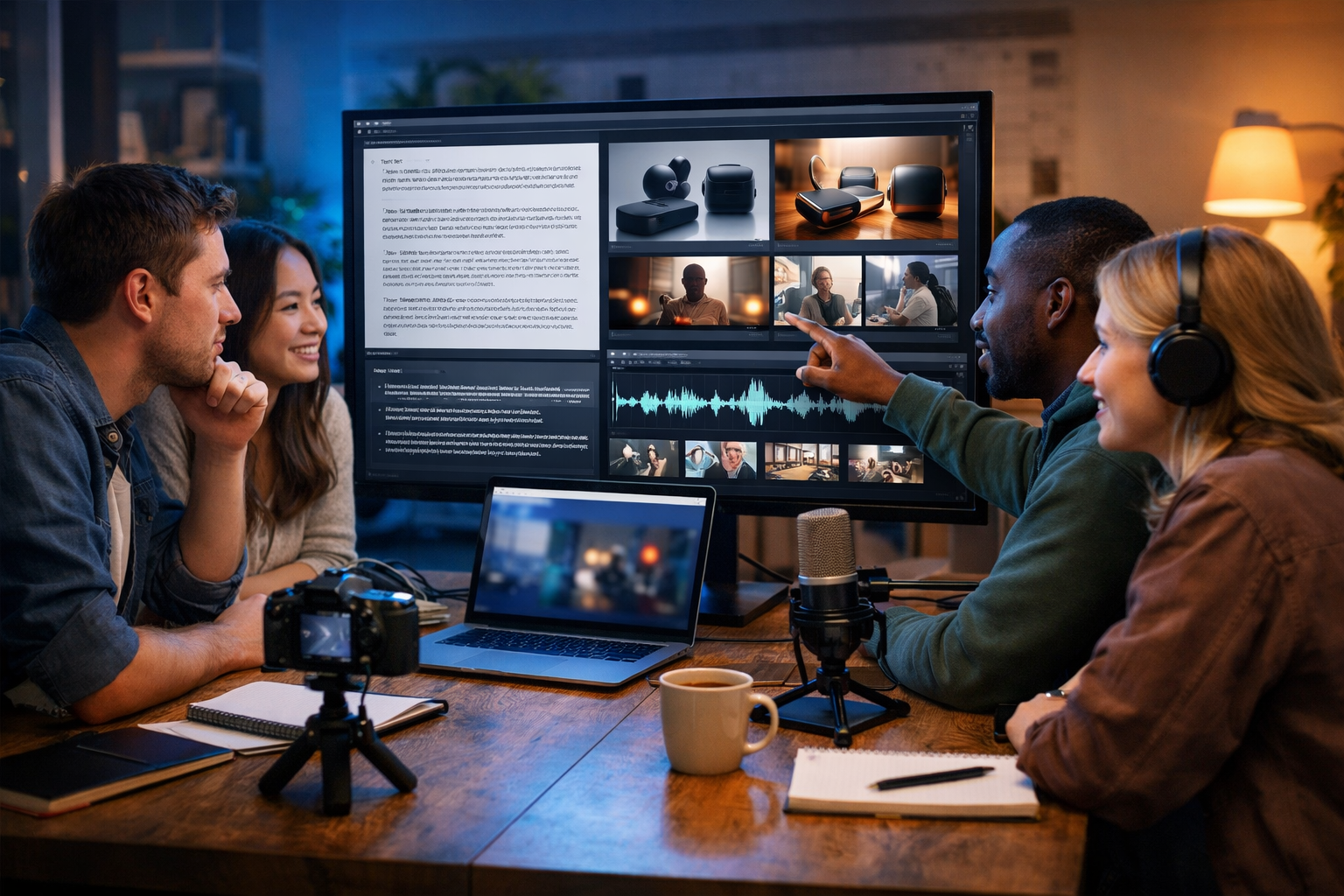
Generative AI is the technology behind tools that can create new content—writing, images, audio, and video—from a simple prompt. In 2026, it’s less about “AI that chats” and more about end-to-end production: drafting, designing, narrating, and editing marketing assets quickly, safely, and at scale. This guide covers the what is generative ai definition examples and how it works 2026 keyword in plain English, with practical use cases you can apply immediately.
What is generative AI? (Definition for 2026)
Generative AI (GenAI) is a type of artificial intelligence that creates new content—such as text, images, music, speech, and video—by learning patterns from large datasets and then generating outputs that statistically match those patterns. Unlike traditional AI, which often classifies, predicts, or recommends, generative AI produces novel outputs: a new blog article, a new product photo-style image, a new voice-over, or a new explainer video.
In 2026, generative AI is typically delivered as “multimodal” systems, meaning a single workflow can combine text, visuals, audio, and video. For businesses, the big shift is that GenAI is now a production tool, not just an experiment: it can support marketing teams, founders, agencies, educators, and creators by speeding up content creation while keeping brand tone consistent.
Generative AI vs traditional AI (quick comparison)
- Traditional AI: predicts outcomes or classifies inputs (e.g., “is this email spam?” “what will demand be next month?”).
- Generative AI: creates new artefacts (e.g., “write a welcome email series” “generate a banner image” “make a 30-second product demo video”).
Why generative AI matters in 2026
By 2026, generative AI is embedded in day-to-day business workflows because it can reduce time-to-first-draft, speed up creative testing, and help small teams compete with larger ones. The key value is not “perfect content instantly”; it’s faster iteration. You can test more angles, visuals, hooks, and formats—then refine what works.
For startups and small teams, cost is also critical. Instead of paying separately for writing tools, design tools, voice-over tools, and video tools, an all-in-one platform can be simpler and cheaper. With Gen AI Last, you can access text, image, audio, and video generation in one place—view pricing from $10/month.
Examples of generative AI (real-world, practical)
Below are the most useful 2026 examples, grouped by the type of output. Each example includes a simple prompt pattern you can adapt.
1) Generative AI text examples
- Blog posts and SEO content: outlines, introductions, FAQs, meta descriptions, and full drafts. Prompt idea: “Write an SEO outline for [topic] targeting [audience], include FAQs and a comparison table.”
- Product descriptions: benefit-led copy with specifications and variants. Prompt idea: “Create 3 product descriptions for [product], tone: [brand voice], include key features and use cases.”
- Email campaigns: welcome sequences, abandoned cart, re-engagement. Prompt idea: “Write a 5-email welcome series for [brand], goal: [conversion], include subject lines and preview text.”
- Social media copy: hooks, captions, threads, and ad variants. Prompt idea: “Create 10 short captions for [offer], include 3 with humour and 3 with urgency.”
If you want to do this in one workspace, explore our AI content tools for blog writing, product copy, emails, and social content.
2) Generative AI image examples
- Marketing visuals: hero images, website banners, ad creatives, and social graphics.
- Product photo concepts: lifestyle scenes, colour variants, seasonal campaigns (useful for pre-visualising a shoot).
- Brand style exploration: consistent lighting, composition, and mood boards for a campaign.
Prompt pattern: “Photorealistic [product] on [surface] in [setting], lighting: [style], camera: [lens], mood: [adjective], 16:9, no text.”
3) Generative AI audio examples
- Voice-overs: narration for explainer videos, product demos, onboarding guides.
- Podcast assets: intro/outro, segment stings, background beds.
- Training and e-learning: consistent voice across lessons without booking studio time.
Prompt pattern: “Create a calm, confident voice-over reading: [script]. Pace: medium. Tone: friendly expert. Accent: [if needed].”
4) Generative AI video examples
- Explainer videos: turn a script into a short video with scenes and narration.
- Product demos: feature call-outs, UI walkthroughs, before/after storyboards.
- Social reels: fast iterations of hooks, visual styles, and pacing for different audiences.
Prompt pattern: “Create a 30-second video about [topic] for [platform], style: [UGC/clean studio/animated], include 5 scenes and on-screen action directions (no text overlays).”
How generative AI works (simple explanation)
At a high level, most generative AI systems work by learning patterns in data and then producing new outputs that follow those patterns. The specifics vary by modality (text, images, audio, video), but the logic is similar: the model estimates what comes next.
Step 1: Training (learning patterns from data)
During training, a model is exposed to very large datasets (for example, text from books and web pages, images with captions, audio clips, or video frames). It learns statistical relationships—such as how words relate to one another, or how pixels form objects and scenes.
Modern systems often use transformer-based architectures for text and increasingly for multimodal tasks. The key idea is not that the model “understands” like a human, but that it becomes very good at predicting and composing plausible outputs.
Step 2: Prompting (you provide instructions and context)
A prompt is your instruction: what you want, who it’s for, constraints, tone, and format. In 2026, the best results come from prompts that include:
- Goal: what success looks like (e.g., “increase demo sign-ups”).
- Audience: industry, level of knowledge, location (e.g., UK SMEs).
- Inputs: product details, features, differentiators, FAQs.
- Constraints: word count, style guide, banned claims, required keywords.
Step 3: Generation (sampling the next tokens/frames)
For text, the model generates one token at a time (a token is a chunk of a word). For images, it generates or refines visual structure through model-specific processes. For audio and video, it generates sequences over time. “Temperature” and related settings influence creativity versus determinism: higher creativity can produce more variety but also more risk of inaccuracies.
Step 4: Refinement (iteration, editing, and alignment)
The most professional outputs come from iteration: generate, review, tighten, fact-check, and adapt to brand voice. In practice, this looks like:
- Start with a structured prompt and generate a draft.
- Ask for improvements (clarity, brevity, examples, or a different tone).
- Verify claims and add sources where required.
- Polish for your brand and publish.
A 2026 generative AI workflow for small teams (text → image → audio → video)
If you’re a startup, freelancer, or small marketing team, the most useful approach is to treat generative AI as a pipeline. Here’s a repeatable workflow you can run for almost any campaign.
1) Create the campaign message (text)
Generate a landing page section, email, and 10 social variants from the same core positioning. Keep one “source of truth” paragraph that explains your offer plainly, then ask the model to adapt it across formats.
Example prompt: “Here is our core offer: [paste]. Create: (a) a 120-word landing hero section, (b) a 5-email sequence, (c) 10 LinkedIn posts. Tone: direct, helpful, British English.”
2) Produce supporting visuals (images)
Generate a set of consistent visuals: hero banner, ad creative, and social post imagery using the same lighting and style instructions. This helps your output feel like a cohesive brand campaign rather than random AI images.
Example prompt: “Photorealistic modern home office, small business owner using a laptop, marketing dashboard on screen, warm natural light, clean minimal desk, 16:9, realistic camera depth of field, no text.”
3) Add narration or voice-over (audio)
Turn your script into a voice-over for a product demo or explainer. Keep sentences short, include pauses, and remove jargon. If you have multiple segments, generate them as separate files so you can re-edit later.
Example prompt: “Narrate this script clearly for a 40-second product demo. Tone: confident, friendly, not salesy. Script: [paste].”
4) Build a short video from the script (video)
Use your script to produce a short video plan: scene list, suggested visuals, pacing, and CTA. Even if you later edit in a traditional video tool, this step accelerates your creative direction and reduces blank-page time.
You can run this end-to-end with our AI content tools, generating the written assets, visuals, narration, and video concepts from the same campaign prompt.
Generative AI in 2026: key terms you’ll hear (and what they mean)
- LLM (Large Language Model): a model trained to generate and transform text.
- Multimodal: one system that can handle more than one format (text + images + audio + video).
- Tokens: pieces of text the model processes and generates.
- Hallucinations: confident-sounding but incorrect outputs; requires fact-checking.
- Fine-tuning / custom instructions: techniques to align output with your brand, domain, and constraints.
- Guardrails: safety and policy controls to reduce risky or non-compliant outputs.
Benefits and limitations (what to expect realistically)
Benefits
- Speed: faster first drafts and more variants for testing.
- Consistency: repeatable tone and structure with good prompting.
- Cost efficiency: fewer tools and less manual production time—especially with an all-in-one platform.
- Accessibility: smaller teams can produce professional assets without specialist software for every format.
Limitations (and how to handle them)
- Accuracy risk: always verify facts, figures, and claims—especially in healthcare, finance, and legal contexts.
- Generic output: improve results by adding specifics (audience pains, product differentiators, examples, constraints).
- Brand compliance: use a style guide prompt (voice, banned phrases, approved claims, formatting rules).
- Rights and policy considerations: avoid copying copyrighted materials; use original prompts and your own inputs.
How to write better prompts in 2026 (copy/paste templates)
These templates are designed to reduce generic outputs and make the model behave like a specialist. Replace the brackets and keep the structure.
Template 1: SEO blog section prompt
Prompt: “Write a 350-word section for a blog post targeting the keyword: [keyword]. Audience: [persona]. Include: (1) a clear definition, (2) 2 practical examples, (3) a short checklist. Tone: helpful expert, British English. Avoid hype. Add a brief caveat about fact-checking.”
Template 2: Image set prompt (campaign consistency)
Prompt: “Generate 4 photorealistic images for a [industry] campaign. Keep consistent style: [lighting], [colour palette], [camera look]. Scenes: (a) hero banner, (b) behind-the-scenes, (c) product close-up, (d) customer using product. 16:9, no text.”
Template 3: Voice-over prompt (clean narration)
Prompt: “Create a voice-over for a [duration] explainer. Tone: [tone]. Pronounce these terms: [list]. Include natural pauses. Script: [paste].”
Using Gen AI Last to apply generative AI (text, image, audio, video)
Gen AI Last is built for teams that want one place to create content across formats. You can generate blog posts and marketing copy, produce campaign visuals, create voice-overs, and build video content from prompts—without stitching together multiple subscriptions.
- AI Text Generation: blog posts, product descriptions, email campaigns, social media copy.
- AI Image Generation: marketing visuals, product photos, social graphics, banners.
- AI Audio Generation: voice-overs, podcast audio, background music, narration.
- AI Video Generation: marketing videos, product demos, social reels, explainer videos.
If you’re evaluating tools for a small business budget, you can view pricing from $10/month and scale up only when you need longer campaigns or more frequent output.
FAQ: generative AI definition, examples, and how it works (2026)
Is generative AI the same as ChatGPT?
No. Chat-style tools are one interface for generative AI, but GenAI also includes image generators, voice generators, music tools, and video generators. In 2026, many platforms combine them into one workflow.
Does generative AI “understand” what it creates?
Not in a human sense. It generates outputs based on learned patterns and probabilities. That’s why verification matters for facts, compliance, and sensitive topics.
What are the best business uses of generative AI in 2026?
Marketing production (ads, landing pages, social), content operations (SEO, email), internal enablement (training scripts), and multimedia creation (images, voice-over, video). The best results come from combining GenAI with strong brand inputs and review steps.
How do I start using generative AI safely?
Use a checklist: don’t paste confidential data, fact-check claims, avoid copying copyrighted material, and keep a human approval step for anything public-facing.
Conclusion: what generative AI is in 2026 (and what to do next)
So, what is generative ai definition examples and how it works 2026? It’s AI that creates new content—text, images, audio, and video—by learning patterns in data and generating outputs from prompts. In 2026, the winning approach is practical: treat GenAI as a workflow for faster iteration, better creative testing, and more consistent production.
If you want to turn this into real assets quickly—blog drafts, campaign visuals, voice-overs, and short videos—you can start creating for free and explore how an all-in-one platform fits your content pipeline.
Ready to Create with Generative AI?
Join thousands of creators using Gen AI Last to generate text, images, audio, and video — all from one platform. Start your 7-day free trial today.
Start Free — Try 7 DaysQuick Links
Create AI content from $10/month
View Plans